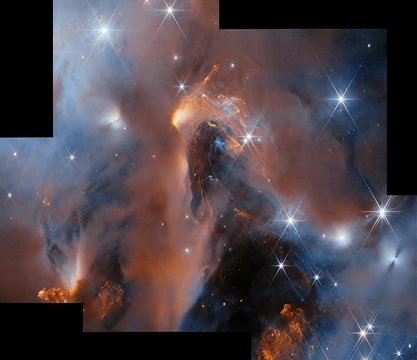
NGC 2976
A peculiar dwarf galaxy in Ursa Major, member of the M81 Group.

NGC 2976 is a peculiar dwarf galaxy located in the northern constellation Ursa Major. It belongs to the M81 Group and sits about 1° 20' southwest of Messier 81. Its brightness and size fall between those of the Large and Small Magellanic Clouds.
Discovered by William Herschel on November 8, 1801, and cataloged as H I.285, it was later described by J. L. E. Dreyer as "bright, very large, much extended 152°, star involved." The galaxy is classified morphologically as SAa—an unbarred spiral with very tightly wound arms—but visually it appears as a pure disk with no spiral arms or bulge. Some astronomers, including de Vaucouleurs and associates, have classified it as SAc, suggesting looser arms. It is tilted at an angle of 65° relative to Earth’s line of sight.
Despite its disk-like appearance, evidence points to a non-axisymmetric gas distribution, possibly including a central bar and large-scale spiral arms. The inner disk contains many dark lanes and stellar condensations, along with two strong H II regions, one on each side. The overall star formation rate is given as y⁻¹. The outer disk shows a history of steady star formation, though the rate has dropped significantly over the last billion years, leaving an older stellar population. Within a certain radius of the center, star formation has remained steady without a recent decline.
A cloud of neutral hydrogen, with a specific mass, lies to the northeast of NGC 2976 and may be gravitationally interacting with it. The galaxy also shows signs of tidal stripping, including an extended tidal tail of neutral hydrogen. Its last major interaction occurred about one billion years ago.
Quick Facts
- Epoch
- J2000
- Constellation Name
- Ursa Major
- Ra
- 09 · 47 · 15.458
- Dec
- +67 · 54 · 58.97
- Appmag V
- 10.8
- Absmag B
- 16.90
- Dist Ly
- 3.56 ±
- Group Cluster
- M81 Group
- Notes
- Peculiar
- Names
- IRAS 09431+6809, UGC 5221, H I.285, PGC 28120
Facts from the source article.
Lore & Background
NGC 2976 was discovered by German-born astronomer William Herschel on November 8, 1801, and catalogued as H I.285. J. L. E. Dreyer described it as 'bright, very large, much extended 152°, star involved'. Its morphological classification is SAa, indicating an unbarred spiral galaxy with very tightly-wound spiral arms, though its actual visual form is a pure disk with no spiral arms or bulge. De Vaucouleurs and associates classed it as type SAc, suggesting more loosely wound arms. The galaxy is inclined at an angle of 65° to the line of sight from Earth.
Although appearing as a disk, there is evidence for a non-axisymmetric form of gas distribution, with a suggestion of a central bar plus large-scale spiral arms. The inner structure contains many dark lanes and stellar condensations in its disk. There are two strong H II regions, one to each side. The outer disk shows a history of steady star formation, although the formation rate has declined significantly over the last billion years and the population is now dominated by older stars. Within a radius of the center, star formation has been steady, having not undergone a recent decline.
There is a cloud of neutral hydrogen with a mass located to the northeast of this galaxy, which may be interacting gravitationally with NGC 2976. The galaxy also shows evidence of tidal stripping, with an extended tidal tail of neutral hydrogen. The last significant interaction took place around one billion years ago.
Reader's Guide
NGC 2976 is notable as a peculiar dwarf galaxy that challenges simple classification. Despite being catalogued as an unbarred spiral (SAa), its actual appearance is a pure disk without spiral arms or a bulge, and alternative classifications (such as SAc) reflect ongoing uncertainty about its structure. Its membership in the M81 Group places it in a well-studied nearby galaxy cluster, and its position 1° 20 southwest of Messier 81 makes it a frequent target for comparative studies. The galaxy's star formation history is particularly significant: while the outer disk has experienced a steady decline in star formation over the last billion years, the central region has maintained a constant rate. This contrast, along with evidence of tidal stripping and a nearby neutral hydrogen cloud, suggests past gravitational interactions—most recently about one billion years ago—that have shaped its current state. The presence of two strong H II regions and many dark lanes and stellar condensations in its disk provides further detail on its internal dynamics. NGC 2976 thus serves as an important example of how dwarf galaxies can evolve through interactions and internal processes, offering insights into the life cycles of such systems.
Did You Know?
- It is a member of the M81 Group and lies 1° 20 southwest of Messier 81.
- The galaxy's luminosity and size are midway between the Large and Small Magellanic Clouds.
- The last significant interaction with another galaxy took place around one billion years ago.
Frequently Asked Questions
What is NGC 2976?
NGC 2976 is a small, unusual dwarf galaxy that orbits as part of the M81 Group. It sits in the constellation Ursa Major, roughly 1.3 degrees southwest of the well-known spiral galaxy Messier 81.
Who discovered NGC 2976 and when?
William Herschel first spotted the galaxy on November 8, 1801, recording it in his personal catalog under the designation H I.285. It was later included in the New General Catalogue by John Louis Emil Dreyer.
What does NGC 2976 look like through a telescope?
Despite being formally classified as an unbarred spiral (SAa), the galaxy presents as a smooth, featureless disk with no visible arms or central bulge. Dreyer noted it as bright and very large with a star embedded in its field, and its overall brightness falls somewhere between the two Magellanic Clouds.
Why is NGC 2976 called 'peculiar'?
Its formal SAa classification implies tightly wound spiral arms, yet observers see a clean disk with essentially no arm structure or bulge, creating a mismatch between catalog type and actual appearance. This discrepancy, combined with its dwarf size, sets it apart from typical spiral galaxies.
How is NGC 2976 oriented relative to Earth?
The galaxy is tilted at roughly 65 degrees to our line of sight, meaning we view it at a moderately inclined angle rather than face-on or edge-on. This tilt contributes to how its disk appears elongated in the sky.
More in NGC Objects, Part 5 1-24
Spotted an error? Know more?
Reader corrections go straight into our review queue. Suggest an edit · How this site is sourced