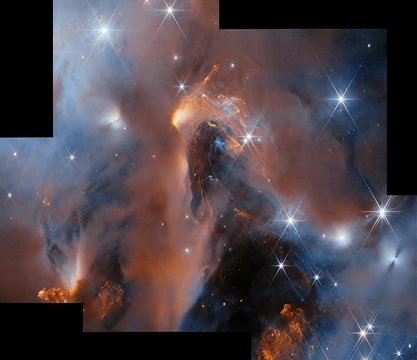
NGC 3049
Barred spiral starburst galaxy in Leo, Markarian 710.

NGC 3049 is a barred spiral galaxy in the constellation Leo. It is a starburst galaxy, containing ionized hydrogen regions and a broad HI line, and its core emits strongly in ultraviolet light. The galaxy is listed in the Markarian catalog as Mrk 710. Its velocity relative to the cosmic microwave background is 1793 ± 24 km/s, giving a Hubble distance of about 86.1 million light-years (26.4 ± 1.9 Mpc). With a luminosity class of I–II, NGC 3049 is a field galaxy—gravitationally isolated, not belonging to any cluster or group. It was discovered in 1882 by French astronomer Édouard Stephan. Eleven non-redshift measurements yield an average distance of roughly 75.5 million light-years (23.136 ± 6.782 Mpc), which falls within the Hubble distance. Using the Hubble distance, its diameter would be approximately 62,600 light-years (19.2 kpc).
Quick Facts
- Epoch
- J2000
- Ra
- 09 · 54 · 49.5648
- Dec
- +09 · 16 · 15.940
- Constellation Name
- Leo
- Z
- 0.004965
- H Radial V
- 1488 ± 1 km/s
- Dist Ly
- 23.136 ±
- Appmag V
- 12.1
- Appmag B
- 12.9
- Sbrightness
- 13.4 mag/am / 2
Facts from the source article.
Lore & Background
NGC 3049 was discovered by French astronomer Édouard Stephan in 1882. It is a field galaxy, meaning it does not belong to a cluster or group and is gravitationally isolated. Its velocity relative to the cosmic microwave background is 1793 ± 24 km/s, corresponding to a Hubble distance of 26.4 ± 1.9 Mpc (~86.1 million ly). The galaxy has a luminosity class of I-II and contains regions of ionized hydrogen, indicating active star formation. Its core shines in the ultraviolet field, and it is listed in the Markarian catalog under the reference Mrk 710.
Reader's Guide
NGC 3049 is significant as a starburst galaxy, a type that undergoes intense episodes of star formation, as evidenced by its regions of ionized hydrogen and broad HI line. Its classification as a field galaxy—gravitationally isolated from clusters or groups—makes it a valuable object for studying isolated galaxy evolution and starburst processes without environmental influences. The galaxy's inclusion in the Markarian catalog (Mrk 710) highlights its ultraviolet-bright core, a characteristic often associated with active star formation or nuclear activity. The distance to NGC 3049 shows some variation: the Hubble distance is 26.4 ± 1.9 Mpc, while 11 non-redshift measurements yield an average of 23.136 ± 6.782 Mpc. The NASA/IPAC database uses the average of independent measurements to calculate galaxy diameters; if the Hubble distance were used, the diameter would be approximately 19.2 kpc (~62,600 ly). This discrepancy underscores the challenges in measuring extragalactic distances and the importance of multiple methods.
Did You Know?
- NGC 3049 is a barred spiral galaxy discovered by Édouard Stephan in 1882.
- It is a starburst galaxy with regions of ionized hydrogen and a broad HI line.
- The galaxy is a field galaxy, gravitationally isolated from any cluster or group.
- Its core shines in the ultraviolet field, earning it the Markarian designation Mrk 710.
Frequently Asked Questions
What is NGC 3049?
NGC 3049 is a barred spiral galaxy that is also classified as a starburst system, meaning it is producing new stars at an elevated rate. It carries the Markarian catalog designation Mrk 710 because its core is a strong ultraviolet emitter.
Where is NGC 3049 located in the sky?
This galaxy sits in the constellation Leo, roughly 86 million light-years from Earth. It is a gravitationally isolated field galaxy, so it does not belong to any cluster or group.
What makes NGC 3049 interesting to deep-sky observers?
Its core shines brightly in ultraviolet wavelengths, and it hosts active ionized hydrogen regions along with a broad HI emission line. The combination of vigorous star formation and strong UV output sets it apart from quieter spiral neighbors.
Who discovered NGC 3049?
French astronomer Édouard Stephan first recorded this galaxy in 1882. It has since been cross-referenced into several catalogues, most notably the Markarian list where it appears as Mrk 710.
How fast is NGC 3049 receding and how far away is it?
Its velocity relative to the cosmic microwave background is about 1,793 km/s, placing it at a Hubble distance of roughly 26.4 megaparsecs. That works out to approximately 86.1 million light-years from us.
More in NGC Objects, Part 5 1-24
Spotted an error? Know more?
Reader corrections go straight into our review queue. Suggest an edit · How this site is sourced