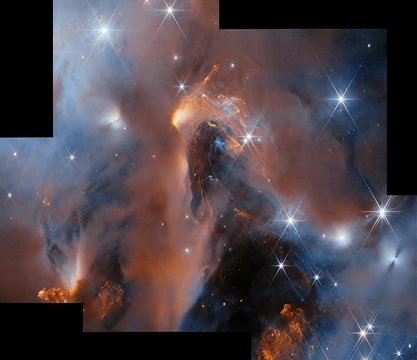
NGC 2962
A barred lenticular galaxy with two rings and an extended hydrogen disk.

NGC 2962 is a lenticular galaxy located in the constellation Hydra, approximately 110 million light years from Earth. It spans about 90,000 light years across and is notable for its complex structure featuring two bars, two rings, and an extended hydrogen disk.
Quick Facts
- Epoch
- J2000
- Ra
- 09 · 40 · 53.9396
- Dec
- +05 · 09 · 57.025
- Dist Ly
- 109 ± 20.4 Mly (33.5 ± 6.2 Mpc)
- Z
- 0.006561 ± 0.000017
- H Radial V
- 1,967 ± 5 km/s
- Appmag V
- 12.0
- Constellation Name
- Hydra
- Group Cluster
- NGC 2962 Group
Facts from the source article.
Lore & Background
NGC 2962 was discovered by Albert Marth on December 10, 1864. It is a lenticular galaxy with two bars but lacks a box-shaped bulge. The galaxy possesses two rings: an inner ring with a major axis of 0.93 arcminutes and an outer ring with a major axis of 2.13 arcminutes. The outer ring has low surface brightness and is formed by tightly wound spiral arms that overlap, with faint connections to the central region. No spiral pattern is visible in the brighter inner region. Ultraviolet imaging by GALEX shows the outer ring is bluer than the rest of the galaxy and contains about 5–8% of the stellar mass; spiral arms emerge from it, and the ring corotates with the galaxy.
The galaxy features a hydrogen disk visible in HI that extends well beyond its optical radius. It has likely accreted gas from a companion galaxy, leading to renewed star formation activity in its nucleus. One supernova, SN 1995D, was observed in NGC 2962; it was a Type Ia supernova discovered by Reiki Kushida on February 10, 1995, at an apparent magnitude of 14.0, located 11 arcseconds east and 90.5 arcseconds south of the galaxy's center, about a week before maximum brightness.
NGC 2962 is the foremost galaxy of the NGC 2962 Group (LGG 178), which also includes NGC 2966 and UGC 5107. A hydrogen bridge connects NGC 2962 to the gas-rich galaxy SDSS J094056.3+050240.5, located 8 arcminutes away.
Reader's Guide
NGC 2962 is significant as a lenticular galaxy with a rare double-barred structure and two distinct rings, offering insight into the formation and evolution of ring galaxies. The outer ring's low surface brightness and blue color, as seen in ultraviolet, indicate ongoing star formation in a region that corotates with the galaxy, suggesting a dynamic interplay between gas accretion and stellar population. The extended hydrogen disk beyond the optical radius points to past interactions, likely with a companion galaxy, which has also triggered nuclear star formation. The detection of a hydrogen bridge to a nearby gas-rich galaxy further supports a history of tidal interactions and gas transfer. The observation of a Type Ia supernova, SN 1995D, provides a valuable data point for studying such explosions in lenticular environments. As the leading member of the NGC 2962 Group, this galaxy serves as a key reference for understanding group dynamics and the role of gas accretion in shaping galaxy structure.
Did You Know?
- NGC 2962 has two bars but no box-shaped bulge.
- The outer ring contains about 5–8% of the galaxy's stellar mass.
- SN 1995D was a Type Ia supernova discovered about a week before maximum brightness.
Frequently Asked Questions
What kind of object is NGC 2962?
NGC 2962 is a lenticular galaxy sitting in the constellation Hydra, roughly 110 million light years from Earth. It stretches about 90,000 light years from edge to edge.
What makes NGC 2962's structure unusual?
This galaxy stands out because it contains two distinct bars and two rings within its disk, along with an extended hydrogen envelope. That layered, multi-component geometry is rare among lenticular galaxies.
What supernova was seen in NGC 2962?
A Type Ia supernova, catalogued as SN 1995D, was spotted in this galaxy on February 10, 1995. At its peak it reached an apparent magnitude of about 14.0, making it accessible to dedicated small telescopes.
Who first recorded NGC 2962?
The German astronomer Albert Marth identified the galaxy on December 10, 1864. It was subsequently included in the New General Catalogue of nebulae and clusters.
Where in the sky can I find NGC 2962?
Look toward the sprawling constellation Hydra, which dominates the summer and early-autumn night sky in the Northern Hemisphere. At 110 million light years away it is well beyond naked-eye visibility and requires a moderate- to large-aperture telescope to resolve.
More in NGC Objects, Part 5 1-24
Spotted an error? Know more?
Reader corrections go straight into our review queue. Suggest an edit · How this site is sourced