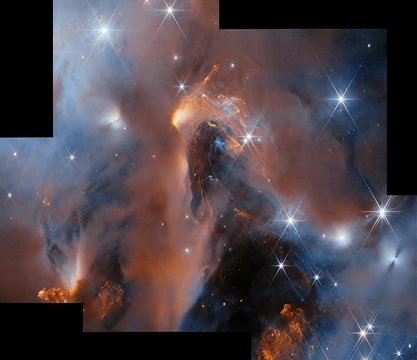
NGC 2992
An interacting Seyfert galaxy with a variable active nucleus.

NGC 2992 is a spiral galaxy of type Sa, meaning it lacks a central bar, and lies about 103 million light-years from Earth in the constellation Hydra. It was first recorded in 1785 by William Herschel. The galaxy is seen nearly edge-on, with its plane tilted 70° relative to our line of sight, and a prominent dust lane runs along its long axis, crossing the nucleus. In 1980, it was classified as a Seyfert galaxy after astronomers detected a broad component in the Hα line without a corresponding broadening in Hβ, placing it as an intermediate type 1.9/1.5. The nucleus shows strong variability in X-ray and other wavelengths, with brightness changing by up to a factor of 20 over days or weeks, likely due to alterations in an accretion disk around the central supermassive black hole. A nearby companion, NGC 2993, lies less than a certain distance to the southeast, and the two are connected by a tidal bridge of ionized hydrogen, with tidal tails extending from both galaxies. This interaction may have triggered the active nucleus in NGC 2992. The nucleus is heavily obscured by dust, and cones of material are outflowing nearly perpendicular to the galaxy’s alignment. Observations by NuSTAR indicate an ultra-fast outflow component at a specific velocity.
Quick Facts
- Epoch
- J2000
- Constellation Name
- Hydra
- Ra
- 09 · 45 · 42.045
- Dec
- −14 · 19 · 34.90
- Z
- 0.00771
- Dist Ly
- 31.6 Mpc
- Appmag V
- 12.2
Facts from the source article.
Lore & Background
NGC 2992 was discovered in 1785 by Anglo-German astronomer William Herschel. Its morphological classification is Sa, indicating a spiral galaxy with no central bar. The galaxy is viewed nearly edge-on, with an inclination of 70° to the line of sight from Earth, and a prominent dust lane extends along its major axis, crossing the nucleus. In 1980, it was identified as a Seyfert galaxy based on a broad component of the Hα line with no matching Hβ broadening, and it is classed as an intermediate Seyfert of type 1.9/1.5. The nucleus shows varying emission in X-ray and other bands, possibly due to changes in an accretion disk, with fluctuations by a factor of up to 20 on timescales of days or weeks. The mass of the central supermassive black hole is estimated to be (value not provided). The nearby companion galaxy NGC 2993 lies less than (distance not provided) to the southeast, and the two are linked by a tidal bridge of ionized hydrogen, with tidal tails to the southeast of NGC 2993 and to the north of NGC 2992. This encounter may trigger the active nucleus. Dust obscures the nucleus, and cones of material outflow from the core at nearly right angles to the galaxy's alignment. NuSTAR observations suggest an ultra-fast outflow component with a velocity of (value not provided).
Reader's Guide
NGC 2992 is significant as an intermediate Seyfert galaxy whose active nucleus shows dramatic variability, offering insights into the behavior of accretion disks around supermassive black holes. Its interaction with NGC 2993, evidenced by a tidal bridge and tails, provides a clear example of how galaxy encounters can trigger nuclear activity. The presence of an ultra-fast outflow, detected by NuSTAR, adds to its importance for studying feedback mechanisms in active galactic nuclei. The galaxy's nearly edge-on orientation and prominent dust lane make it a valuable target for understanding the structure of Seyfert galaxies and the role of obscuration. Its legacy lies in its contribution to the study of variable active galactic nuclei and galaxy interactions, serving as a case study for the connection between tidal forces and nuclear activity.
Did You Know?
- It is classified as an intermediate Seyfert galaxy of type 1.9/1.5.
- The galaxy's nucleus shows X-ray variability by a factor of up to 20 over days or weeks.
- NGC 2992 is interacting with the companion galaxy NGC 2993 via a tidal bridge.
Frequently Asked Questions
What kind of object is NGC 2992?
NGC 2992 is an unbarred spiral galaxy of type Sa, situated roughly 103 million light-years away in the constellation Hydra. It is also catalogued as an intermediate Seyfert galaxy, meaning its core hosts an actively accreting supermassive black hole.
What does NGC 2992 look like from Earth?
Because its disk is tilted about 70 degrees relative to our line of sight, we view it nearly edge-on. A prominent dust lane stretches along the galaxy's long axis and passes directly through the bright nucleus.
How was NGC 2992 identified as a Seyfert galaxy?
In 1980, spectroscopic observations revealed a broad emission component in the hydrogen-alpha line that had no matching broadening in hydrogen-beta. This unusual signature led astronomers to classify it as an intermediate Seyfert type 1.9/1.5.
Who first recorded NGC 2992 and when?
William Herschel was the first to note the galaxy in his survey logs back in 1785. It has since been studied extensively for both its spiral structure and its active nucleus.
What makes NGC 2992's core interesting to observers?
The galaxy's active nucleus shows strong brightness variability over time, a hallmark of Seyfert activity driven by the central black hole. This makes it a popular target for monitoring campaigns tracking changes in accretion processes.
More in NGC Objects, Part 5 1-24
Spotted an error? Know more?
Reader corrections go straight into our review queue. Suggest an edit · How this site is sourced