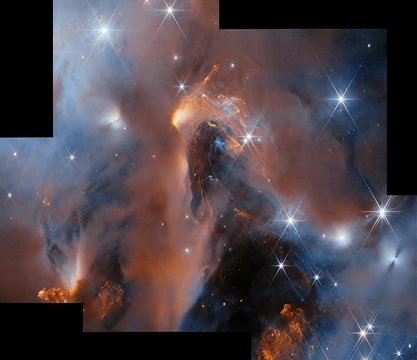
NGC 3079
Barred spiral galaxy with a central bubble of hot gas.

NGC 3079 is a barred spiral galaxy located approximately 50 million light-years away in the constellation Ursa Major. It is notable for its active Seyfert II nucleus, which exhibits quasar-like high surface brightness and strong high-ionization emission lines, while the host galaxy remains clearly detectable. A prominent feature is a large bubble of hot gas at the galaxy's center, believed to be driven by a burst of star formation.
Quick Facts
- Epoch
- J2000
- Ra
- 10 · 01 · 57.9268
- Dec
- +55 · 40 · 46.926
- Dist Ly
- 50 Mly
- Group Cluster
- NGC 3079 Group (LGG 188)
- Appmag V
- 10.8
- Constellation Name
- Ursa Major
Facts from the source article.
Lore & Background
NGC 3079 was discovered by German-British astronomer William Herschel on 1 April 1790. It is classified as a Seyfert II galaxy, meaning its nucleus has very high surface brightness and strong, high-ionization emission lines, yet the host galaxy is clearly visible. The galaxy's most striking feature is a lumpy bubble of hot gas at its center, imaged by the Hubble Space Telescope. This bubble is about 3,000 light-years wide and rises more than 3,500 light-years above the galactic disk. It is thought to have been created about one million years ago by particles streaming at high speeds, resulting from a large burst of star formation. Computer modeling suggests an ongoing cycle, with a new bubble forming approximately every 10 million years.
NGC 3079 is the namesake of the NGC 3079 Group (LGG 188), which includes six galaxies: NGC 3073, UGC 5421, UGC 5479, UGC 5459, and UGC 5460. NGC 3079 and NGC 3073 are also listed together as Holm 156 in Erik Holmberg's 1937 study of double and multiple galaxies. Two supernovae have been observed in NGC 3079: SN 2001ci (Type Ic, magnitude 18.3) discovered on 17 April 2001 by LOTOSS, and SN 2013ee (Type II, magnitude 15.5) discovered by Giancarlo Cortini on 13 July 2013.
Reader's Guide
NGC 3079 holds significance as a nearby example of a Seyfert II galaxy, offering astronomers a clear view of an active galactic nucleus where the host galaxy remains detectable. Its central bubble, a massive structure of hot gas rising above the disk, provides a laboratory for studying the effects of star formation and black hole activity on galactic scales. The bubble's estimated age of about one million years and the inferred cycle of bubble formation every 10 million years suggest a dynamic, recurring process in the galaxy's core. As the brightest member of the NGC 3079 Group, it serves as a reference point for studying galaxy interactions and group dynamics. The two recorded supernovae, SN 2001ci and SN 2013ee, add to its legacy as a site of stellar explosions, contributing to the understanding of supernova types and rates in barred spiral galaxies. The galaxy's discovery by William Herschel in 1790 places it within the historical catalog of deep-sky objects, while modern observations by Hubble and Chandra have revealed its filamentary features and superwind, cementing its role in extragalactic astrophysics.
Did You Know?
- NGC 3079 is a barred spiral galaxy about 50 million light-years away in Ursa Major.
- It has a central bubble of hot gas about 3,000 light-years wide, rising more than 3,500 light-years above the disk.
- Two supernovae have been observed: SN 2001ci (Type Ic) in 2001 and SN 2013ee (Type II) in 2013.
- The galaxy is the namesake of the NGC 3079 Group, which contains six galaxies.
Frequently Asked Questions
What is NGC 3079?
NGC 3079 is a barred spiral galaxy hosting an active Seyfert II nucleus at its core. It lies roughly 50 million light-years from Earth and is catalogued within the constellation Ursa Major.
What makes the center of NGC 3079 so interesting?
The core contains a Seyfert II nucleus that shows quasar-like surface brightness and strong high-ionization emission lines, while the surrounding host galaxy remains clearly visible. A large bubble of hot gas envelops the center, thought to have been inflated by a recent burst of star formation.
Where in the sky can I find NGC 3079?
Point your telescope toward the constellation Ursa Major to locate it. The galaxy also belongs to a small six-member group called the NGC 3079 Group (LGG 188).
Have any supernovae been observed in NGC 3079?
Yes—two notable events have been recorded. SN 2001ci was a Type Ic supernova peaking at magnitude 18.3 in April 2001, and SN 2013ee was a Type II event reaching magnitude 15.5 in July 2013.
Who discovered NGC 3079 and when?
William Herschel first catalogued the galaxy on 1 April 1790. It has since become a frequently studied example of a Seyfert II system with a clearly detectable host galaxy.
More in NGC Objects, Part 5 1-24
Spotted an error? Know more?
Reader corrections go straight into our review queue. Suggest an edit · How this site is sourced