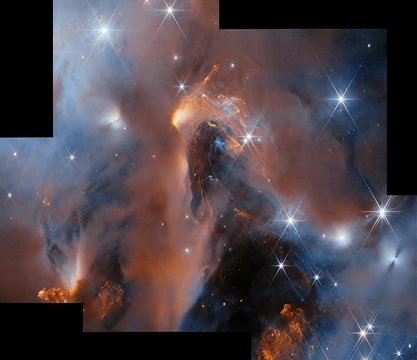
NGC 2936
A distorted spiral galaxy interacting with a nearby elliptical.

NGC 2936 is an interacting spiral galaxy located approximately 326 million light years away in the constellation Hydra. It is notable for its distorted shape, which some astronomers compare to a penguin or a porpoise, resulting from gravitational tidal interactions with the nearby elliptical galaxy NGC 2937. The pair, along with the unrelated galaxy PGC 1237172, is cataloged as Arp 142 in the Atlas of Peculiar Galaxies under the category 'Material emanating from elliptical galaxies.'
Quick Facts
- Constellation Name
- Hydra
- Epoch
- J2000
- Ra
- 09 · 37 · 44.148
- Dec
- +02 · 45 · 38.95
- Z
- 0.02331 · 0.00013
- Dist Ly
- 352 Mly
- Appmag V
- 12.85
- Absmag V
- −22.4
Facts from the source article.
Lore & Background
NGC 2936 originally possessed a flat, spiral disk, but its stars' orbits have been perturbed by gravitational tidal interactions with the elliptical galaxy NGC 2937. Gas from the center of NGC 2936 became compressed during the encounter, visible as blue knots near NGC 2937. The red dust that once resided in the galaxy's center has been largely thrown out due to the collision, and gas from NGC 2936 has triggered star formation. On June 20, 2013, the Hubble Space Telescope examined and photographed the galaxy. The unrelated bluish irregular or edge-on spiral galaxy PGC 1237172 lies off to the side, located 230 million light years away, closer to Earth than the NGC 2936 collision, and appears next to two unrelated Milky Way stars.
Reader's Guide
NGC 2936's significance lies in its role as a vivid example of galactic interaction and its inclusion in the Atlas of Peculiar Galaxies as Arp 142. The collision with NGC 2937 has dramatically reshaped the galaxy, transforming a once-ordinary spiral into a form that some astronomers interpret as a penguin or porpoise. The compression of gas and expulsion of dust illustrate the dynamic processes that drive star formation in merging systems. The Hubble Space Telescope's 2013 observation provided a detailed view of these features, including the blue knots of compressed gas and the disrupted dust lanes. The presence of the unrelated foreground galaxy PGC 1237172 adds a layer of visual complexity, though it is not physically associated with the pair. The galaxy's brightest star, USNOA2 0900-06460021, has been cataloged, but the system's legacy is primarily as a study in gravitational perturbation and morphological transformation.
Did You Know?
- NGC 2936 is also called the Penguin Galaxy or the Porpoise Galaxy due to its shape.
- It was discovered by Albert Marth on March 3, 1864.
- The galaxy's red dust was mostly thrown out of its center during the collision with NGC 2937.
- The unrelated galaxy PGC 1237172 is 230 million light years away, closer than NGC 2936.
Frequently Asked Questions
What is NGC 2936?
NGC 2936 is a distorted spiral galaxy sitting in the constellation Hydra, roughly 326 million light years from Earth. Its warped, lopsided appearance is the product of a gravitational tug-of-war with the nearby elliptical galaxy NGC 2937.
Why do fans call NGC 2936 the Penguin Galaxy?
The galaxy's bulbous, tilted silhouette looks strikingly like a penguin or a porpoise, which is why those nicknames stuck. That unusual shape is tidal distortion carved out by its ongoing gravitational interaction with NGC 2937.
What is the Arp 142 pair?
Arp 142 is the Atlas of Peculiar Galaxies designation for the NGC 2936–NGC 2937 interacting system, filed under the category 'Material emanating from elliptical galaxies.' An unrelated galaxy, PGC 1237172, is also listed in that same Arp entry.
Who discovered NGC 2936 and when?
German astronomer Albert Marth recorded the galaxy on March 3, 1864, and it was subsequently added to the New General Catalogue of nebulae and clusters.
Where in the sky can I find NGC 2936?
Look toward the sprawling constellation Hydra, where the galaxy sits about 326 million light years away. If you're cross-referencing with the Atlas of Peculiar Galaxies, search for Arp 142 to pull up the same object.
More in NGC Objects, Part 5 1-24
Spotted an error? Know more?
Reader corrections go straight into our review queue. Suggest an edit · How this site is sourced