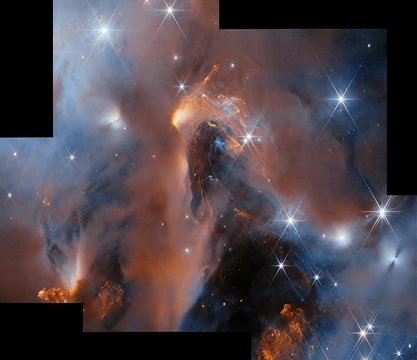
NGC 3312
Largest spiral in Hydra Cluster, a jellyfish galaxy.

NGC 3312 is a large spiral galaxy seen nearly edge-on, situated roughly 194 million light-years away in the constellation Hydra. It holds the title of the biggest spiral in the Hydra Cluster and is categorized as a LINER galaxy. John Herschel first spotted it on March 26, 1835, and Guillaume Bigourdan independently found it again on February 26, 1887. Because they share almost identical sky coordinates, NGC 3312 was later matched with IC 629.
The galaxy looks heavily warped, marked by sharp dust lanes, thin filamentary streams stretching northward, and a ring-like structure inside. Its interstellar material is also notably disturbed. Astronomer Gérard de Vaucouleurs once proposed that the giant elliptical galaxies NGC 3309 and NGC 3311—the cluster’s dominant ellipticals—were distorting NGC 3312. However, those ellipticals are too far away, and their relative speeds are too high, for them to cause the observed filaments. A more likely explanation is that NGC 3312 is plowing through the cluster’s hot intracluster medium, which strips away its own gas through ram pressure. This process probably created the filamentary extensions, especially since the galaxy sits near the cluster core. As a result, NGC 3312 belongs to the rare category known as jellyfish galaxies.
Despite looking somewhat like an anemic galaxy, its average surface brightness suggests star formation might be quite vigorous. The northwest filament, in particular, glows brightly and shows a knotted texture typical of active star-forming regions in spiral arms. The internal dust lane is also lined with bright clumps.
At its core, NGC 3312 hosts a compact, powerful radio source with a strength of 27 mJy. Additional radio emission, measuring 24 mJy, spreads across the disk, mostly confined to the spiral arms or areas where stars are forming.
Quick Facts
- Epoch
- J2000
- Ra
- 10 · 37 · 02.5
- Dec
- -27 · 33 · 54
- Dist Ly
- 59.4 Mpc
- Group Cluster
- Hydra Cluster
- H Radial V
- 2886 km/s
- Z
- 0.009627
- Appmag V
- 12.68
- Constellation Name
- Hydra
- Names
- IC 629, ESO 501-43, AM 1034-271, IRAS 10346-2718, MCG -4-25-39, PGC 31513
Facts from the source article.
Lore & Background
NGC 3312 was discovered by astronomer John Herschel on March 26, 1835, and later rediscovered by Guillaume Bigourdan on February 26, 1887. It was subsequently equated with IC 629 because the two objects share essentially the same celestial coordinates. The galaxy is highly distorted, featuring sharp dust lanes, filamentary extensions to the north, and an internal ringlike structure. Its interstellar matter appears highly disturbed.
Astronomer De Vaucouleurs suggested that NGC 3312 was distorted by the giant elliptical galaxies NGC 3309 and NGC 3311, the dominant ellipticals in the Hydra Cluster. However, those ellipticals are too distant and their relative velocity differences too large for either to cause the observed filamentary extensions. It is more likely that NGC 3312 is interacting with the intracluster medium, causing ram-pressure stripping that is stripping the galaxy's interstellar medium. This process may have produced the filamentary extensions, given the galaxy's location near the cluster core.
Although NGC 3312's morphological structure resembles that of anemic galaxies, its mean surface-brightness profile hints that star formation may be quite active. The northwest filamentary extension has high surface brightness and a knotted texture characteristic of active star-forming regions in spiral arms. The internal dust lane is ringed with bright condensations. The galaxy contains an unresolved strong radio source in its core with a strength of 27 mJy, and radio emission in the disk of 24 mJy mostly confined to the spiral arms or star-forming regions.
Reader's Guide
NGC 3312 holds significance as the largest spiral galaxy in the Hydra Cluster and as a rare example of a jellyfish galaxy, a class defined by ram-pressure stripping from the intracluster medium. Its highly distorted appearance—with sharp dust lanes, filamentary extensions, and a disturbed interstellar medium—illustrates the dynamic processes affecting galaxies in dense cluster environments. The initial hypothesis that giant ellipticals NGC 3309 and NGC 3311 caused the distortion was ruled out due to distance and velocity differences, shifting focus to ram-pressure stripping as the likely mechanism. This makes NGC 3312 a key object for studying how cluster interactions strip gas and trigger or quench star formation. Despite its anemic-looking morphology, the galaxy shows signs of active star formation, particularly in the northwest filament and along the dust lane, where bright condensations and knotted textures indicate ongoing stellar birth. The presence of a strong radio core and disk emission further links its radio activity to star-forming regions. NGC 3312 thus serves as a natural laboratory for understanding the interplay between galaxy evolution, cluster dynamics, and star formation in extreme environments.
Did You Know?
- It is classified as a LINER galaxy and also as a jellyfish galaxy.
- The galaxy was discovered by John Herschel and later rediscovered by Guillaume Bigourdan.
- Its filamentary extensions are likely caused by ram-pressure stripping from the intracluster medium.
More in NGC Objects, Part 5 1-24
Spotted an error? Know more?
Reader corrections go straight into our review queue. Suggest an edit · How this site is sourced