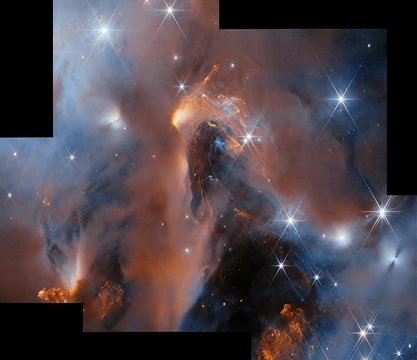
NGC 3311
Brightest member of the Hydra Cluster with a vast globular cluster system.

NGC 3311 is a super-giant elliptical galaxy (type-cD) located about 190 million light-years away in the constellation Hydra. It is the brightest member of the Hydra Cluster and, together with NGC 3309, dominates the cluster's central region. The galaxy is notable for its rich and extensive globular cluster system, which rivals that of Messier 87 in the Virgo Cluster.
Quick Facts
- Epoch
- J2000
- Ra
- 10 · 36 · 42.8
- Dec
- -27 · 31 · 42
- Dist Ly
- 57 Mpc
- Group Cluster
- Hydra Cluster
- H Radial V
- 3,825 km/s
- Z
- 0.012759
- Appmag V
- 12.65
- Stars
- more than 1 trillion
- Notes
- Massive globular cluster population
- Constellation Name
- Hydra
- Names
- ESO 501-38, AM 1034-271, MCG -4-25-36, PGC 31478
Facts from the source article.
Lore & Background
NGC 3311 was discovered by John Herschel on March 30, 1835. Its central region is obscured by a dust cloud with an estimated diameter of 0.53 kpc and a total mass of 4,600 solar masses. The cloud has an amorphous, complex structure and a disturbed morphology, suggesting it originated from a merger event within the past 10 million years, though no shells or isophote distortions are seen in the outer regions. Alternative origins include a cooling flow or galactic wind failure. An excess blue population in the central region, with a spectrum resembling an H II region, indicates ongoing formation of young bright stars.
The outer halo of NGC 3311 formed from the accretion and mergers of massive satellite galaxies, consisting of intra-cluster stars primarily from bright early-type galaxies and dwarf galaxies. The halo's build-up continues due to the infall of a group of 14 dwarf galaxies, including HCC 026 and HCC 007, which are being tidally disrupted. The inner galaxy formed from mergers of gas-rich lumps, reminiscent of early galaxy formation. Stars in the central region and halo are very old (over 10 Gyrs), but central stars have higher metallicity, suggesting a rapid, early star formation period via gas-rich dissipative collapse, while halo stars formed in smaller accreted satellites with more extended star formation.
An off-centered envelope, first detected by Arnaboldi et al., has higher metallicity than the outer halo and lies near the infalling dwarf group. It was likely offset by tidal interaction with the dark matter halos of the infalling group or with NGC 3309's halo, which also stripped gas and dust from the outer halo. NGC 3311 has a cored dark matter halo and hosts a supermassive black hole with an estimated mass of 126 million solar masses. It has a weak radio source but is bright in X-rays. About 60 intracluster planetary nebulae have been detected around it.
Reader's Guide
NGC 3311 is significant for its exceptionally large globular cluster system, one of the most extensive known in the local universe, rivaling that of Messier 87. Initially detected in 1976, a 1983 study by Harris et al. confirmed its massive system. An analysis by Secker et al. in 1995 using Washington photometry concluded it had the most metal-rich globular cluster system known, with no metal-poor or intermediate-metallicity populations. However, later studies by Brodie et al. and Wehner et al. found a bimodal color distribution with equal numbers of metal-rich and metal-poor clusters. The system's richness may be partly due to NGC 3311 stripping globular clusters from the nearby giant elliptical NGC 3309, which has an unusually low number of globular clusters. Additionally, about 50 ultra-compact dwarf galaxies (UDCs) are dynamically associated with NGC 3311, likely remnant nuclei of dwarf galaxies stripped during interactions. The galaxy's ongoing halo assembly via infalling dwarf groups and its complex dust and star formation history make it a key object for studying galaxy evolution and cluster dynamics.
Did You Know?
- NGC 3311's globular cluster system rivals that of Messier 87, which has about 13,000 globular clusters.
- The central dust cloud has a mass of 4,600 solar masses and may have originated from a merger within the past 10 million years.
- About 50 ultra-compact dwarf galaxies are dynamically associated with NGC 3311, likely stripped dwarf galaxy nuclei.
More in NGC Objects, Part 5 1-24
Spotted an error? Know more?
Reader corrections go straight into our review queue. Suggest an edit · How this site is sourced