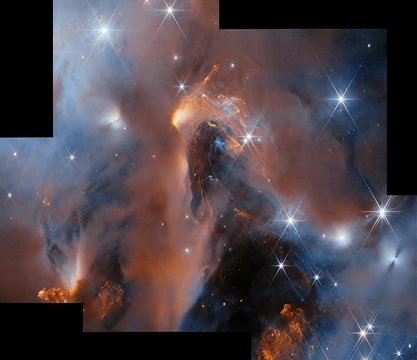
NGC 3310
Starburst spiral galaxy with a history of collision and supernovae.

NGC 3310 is a grand design spiral galaxy located in the constellation Ursa Major. It is a starburst galaxy, and astronomers believe it collided with one of its smaller companion galaxies roughly 100 million years ago, sparking intense star formation. The galaxy’s ring clusters have been producing new stars for at least the past 40 million years. Its velocity relative to the cosmic microwave background gives a Hubble distance of about 17.25 megaparsecs, though eight other measurements that do not rely on redshift suggest a closer average distance of roughly 13.1 megaparsecs. William Herschel, a German-British astronomer, discovered NGC 3310 on 12 April 1789.
Four supernovae have been observed in this galaxy. SN 1974C, of unknown type and magnitude 16.5, was found by Pieter van der Kruit and Halton Arp on 25 February 1974. SN 1991N, a Type Ib/c supernova at magnitude 15, was detected by the Berkeley Automated Supernova Search on 29 March 1991, located east and south of the galaxy’s nucleus. SN 2021gmj, a Type II-P supernova with magnitude 15.1, was discovered by the Distance Less Than 40 Mpc Survey (DLT40) on 20 March 2021. SN 2026sqf, a Type Ia-CSM supernova at magnitude 12.9, was found by American amateur astronomer Patrick Wiggins on 8 July 2026; initially classified as Type II, later analysis reclassified it as Type Ia-CSM, making it the closest known example of its kind. This supernova is part of the Unistellar “cosmic cataclysms” smart telescope tracking project.
Quick Facts
- Epoch
- J2000
- Ra
- 10 · 38 · 45.857
- Dec
- +53 · 30 · 11.89
- Constellation Name
- Ursa Major
- Z
- 0.003309
- Dist Ly
- 13.100 ± 1.142 Mpcned-distance
- Appmag V
- 11.15
Facts from the source article.
Lore & Background
NGC 3310 is a grand design spiral galaxy located in Ursa Major. Its velocity with respect to the cosmic microwave background gives a Hubble distance of 17.25 ± 1.22 Mpc, though eight non-redshift measurements yield a closer mean distance of 13.100 ± 1.142 Mpc. The galaxy is a starburst galaxy, and it is likely that it collided with one of its satellite galaxies about 100 million years ago, triggering widespread star formation. The ring clusters of NGC 3310 have been undergoing starburst activity for at least the last 40 million years.
Four supernovae have been discovered in NGC 3310. SN 1974C (type unknown, mag. 16.5) was discovered by Pieter van der Kruit and Halton Arp on 25 February 1974. SN 1991N (Type Ib/c, mag. 15) was discovered by the Berkeley Automated Supernova Search on 29 March 1991. SN 2021gmj (Type II-P, mag. 15.1) was discovered by the Distance Less Than 40 Mpc Survey (DLT40) on 20 March 2021. SN 2026sqf (Type Ia-CSM, mag. 12.9) was discovered by American amateur astronomer Patrick Wiggins on 8 July 2026; it was originally classified as Type II but later analysis concluded it to be Type Ia-CSM, the closest yet known of this kind.
Reader's Guide
NGC 3310 holds significance as a nearby starburst galaxy whose active star formation, triggered by a past collision, provides a laboratory for studying the processes of stellar birth and evolution. The galaxy's ring clusters have sustained starburst activity for tens of millions of years, offering insight into prolonged star formation episodes. Its supernovae record includes four events spanning over five decades, from the 1974 discovery to the 2026 Type Ia-CSM supernova, which is the closest known example of its kind. The 2026 supernova, discovered by an amateur astronomer, is part of the Unistellar 'cosmic cataclysms' smart telescope tracking project, highlighting the role of citizen science in modern astronomy. The discrepancy between the Hubble distance and the mean of non-redshift measurements underscores ongoing uncertainties in extragalactic distance determinations. NGC 3310's legacy lies in its contribution to understanding starburst phenomena, supernova diversity, and the dynamic interactions between galaxies and their satellites.
Did You Know?
- NGC 3310 was discovered by William Herschel on 12 April 1789.
- It is a starburst galaxy likely triggered by a collision with a satellite galaxy about 100 million years ago.
- Four supernovae have been discovered in NGC 3310, including SN 2026sqf, the closest known Type Ia-CSM supernova.
- The galaxy's ring clusters have been undergoing starburst activity for at least 40 million years.
More in NGC Objects, Part 5 1-24
Spotted an error? Know more?
Reader corrections go straight into our review queue. Suggest an edit · How this site is sourced