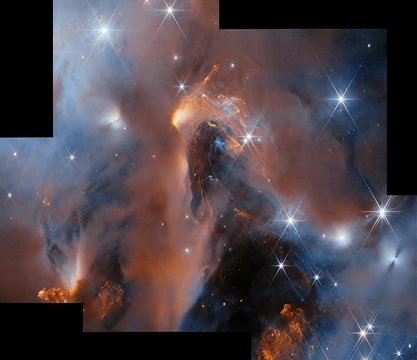
NGC 3309
Giant elliptical galaxy dominating the Hydra Cluster center.

NGC 3309 is a giant elliptical galaxy roughly 200 million light-years from Earth in the constellation Hydra. It was first observed by John Herschel on March 24, 1835. The galaxy sits about 22 kiloparsecs from NGC 3311, and together these two galaxies are the dominant members at the center of the Hydra Cluster.
A two-sided radio jet emerges from NGC 3309’s core. The northeastern side of the jet ends in a spur, while the southwestern side follows a straight line. Around 1 kiloparsec from the nucleus, the jet narrows into a nozzle-like structure before widening into a lobe that extends away from the galaxy. Most of the radio emission in the Hydra Cluster originates from NGC 3309, and this activity may have been set off by a recent interaction with the giant spiral galaxy NGC 3312.
NGC 3309 has an estimated population of globular clusters. Because of its proximity to NGC 3311, the galaxy may have lost some of its original globular clusters, with a number of them now belonging to NGC 3311’s system.
Quick Facts
- Epoch
- J2000
- Ra
- 10 · 36 · 35.6766
- Dec
- -27 · 31 · 05.788
- Dist Ly
- 60.3 Mpc
- Group Cluster
- Hydra Cluster
- H Radial V
- 4075 ± 4 km/s
- Z
- 0.013593
- Appmag V
- 12.60
- Notes
- Radio Jet
- Constellation Name
- Hydra
Facts from the source article.
Lore & Background
NGC 3309 was discovered by astronomer John Herschel on March 24, 1835. The galaxy lies about 200 million light-years away in the constellation Hydra and forms a close pair with NGC 3311, separated by about 22 kpc. Both galaxies dominate the center of the Hydra Cluster. NGC 3309 hosts a two-sided radio jet emerging from its nucleus. The northeastern part of the jet ends in a spur, while the southwestern part lies along a straight line. At a projected distance of roughly 1 kpc from the nucleus, the jet narrows into a nozzle-like structure before expanding into a lobe extending away from the galaxy. The predominant part of the radio emission in the Hydra Cluster comes from NGC 3309, and this emission may have been triggered by a recent perturbation with the giant spiral galaxy NGC 3312. The galaxy has an estimated population of globular clusters, though the exact number is not specified. Due to the influence of NGC 3311, NGC 3309 may have been stripped of part of its original globular cluster system, with some of its globular clusters possibly becoming members of NGC 3311's population.
Reader's Guide
NGC 3309 is significant as one of the two dominant galaxies at the core of the Hydra Cluster, a major nearby galaxy cluster. Its radio jet, which is two-sided and features a nozzle-like structure and a lobe, makes it a key object for studying active galactic nuclei and jet dynamics. The fact that the predominant radio emission in the Hydra Cluster originates from NGC 3309 underscores its role as the cluster's primary radio source. The possible interaction with NGC 3312 that may have triggered the radio emission highlights the role of galaxy interactions in fueling nuclear activity. Additionally, the potential transfer of globular clusters between NGC 3309 and its companion NGC 3311 provides insight into the dynamical evolution of galaxy systems and the exchange of stellar populations in dense cluster environments.
Did You Know?
- NGC 3309 was discovered by John Herschel on March 24, 1835.
- It has a two-sided radio jet with a nozzle-like structure about 1 kpc from the nucleus.
- The galaxy may have been stripped of some globular clusters by its neighbor NGC 3311.
More in NGC Objects, Part 5 1-24
Spotted an error? Know more?
Reader corrections go straight into our review queue. Suggest an edit · How this site is sourced