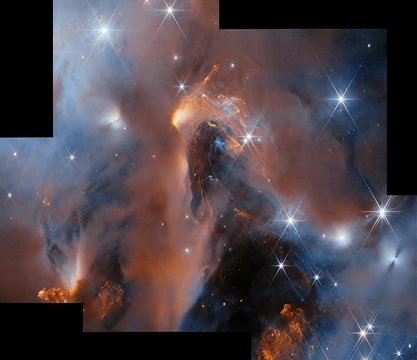
NGC 3277
A Seyfert II spiral galaxy in Leo Minor.

NGC 3277 is a spiral galaxy found in the constellation Leo Minor. It is classified as a Seyfert II galaxy, which means its nucleus resembles a quasar with extremely high surface brightness and strong, highly ionized emission lines, yet the surrounding host galaxy is still clearly visible. The galaxy belongs to the NGC 3254 group (also cataloged as LGG 197), a collection of five galaxies that includes NGC 3245 and NGC 3254. Discovered by German-British astronomer William Herschel on 11 April 1785, NGC 3277 has a velocity relative to the cosmic microwave background that corresponds to a Hubble distance of about 25.26 ± 1.80 megaparsecs. However, five non-redshift measurements yield a much larger average distance of roughly 45.480 ± 5.389 megaparsecs. One supernova, SN 2025coe, was observed in this galaxy on 24 February 2025 by Kōichi Itagaki. It was a Type Ib calcium-rich supernova with a magnitude of 17.4, and its light curves showed multiple distinct peaks—a very rare feature among calcium-rich supernovae, previously seen only in SN 2019ehk. This supernova also had an exceptionally large projected physical offset of about 39.3 kiloparsecs from the galaxy’s center, making it the most distant multi-peaked calcium-rich supernova ever found relative to its host galaxy. The progenitor system may have been ejected through dynamical interactions.
Quick Facts
- Epoch
- J2000
- Constellation Name
- Leo Minor
- Ra
- 10 · 32 · 55.4506ned
- Dec
- +28 · 30 · 42.409ned
- Z
- 0.004720 · 0.00000900ned
- Dist Ly
- 45.480 ± 5.389 Mpcned
- Group Cluster
- NGC 3254 group (LGG 197)
- Appmag V
- 12.50ned
Facts from the source article.
Lore & Background
NGC 3277 was discovered by German-British astronomer William Herschel on 11 April 1785. Its distance is uncertain: the velocity with respect to the cosmic microwave background gives a Hubble distance of 25.26 ± 1.80 Mpc, but five non-redshift measurements yield a much farther mean distance of 45.480 ± 5.389 Mpc. The galaxy is a Seyfert II, characterized by a bright, quasar-like nucleus with high-ionisation emission lines, yet the host spiral galaxy remains clearly visible. It belongs to the NGC 3254 group (LGG 197), a small collection of five galaxies that also includes NGC 3245 and NGC 3254.
Reader's Guide
NGC 3277 is significant as a Seyfert II galaxy, a class that bridges active galactic nuclei and their host galaxies, allowing detailed study of both components. Its membership in the NGC 3254 group places it within a local galactic environment that can be compared to other group members. The galaxy gained further attention with the discovery of SN 2025coe, a Type Ib calcium-rich supernova observed on 24 February 2025 by Kōichi Itagaki. This supernova exhibited multiple distinct peaks in its light curve, a rare feature among calcium-rich supernovae, previously seen only in SN 2019ehk. Its projected physical offset of approximately 39.3 kpc from the galactic center makes it the most distant multi-peaked calcium-rich supernova ever discovered relative to its host galaxy. The progenitor system may have been ejected through dynamical interactions, offering insights into the origins of such unusual stellar explosions. The distance discrepancy for NGC 3277—between Hubble and non-redshift measurements—highlights ongoing uncertainties in extragalactic distance determinations.
Did You Know?
- NGC 3277 is a Seyfert II galaxy, meaning it has a quasar-like nucleus but the host galaxy is clearly detectable.
- It is a member of the NGC 3254 group (LGG 197), which contains five galaxies.
- Supernova SN 2025coe, discovered on 24 February 2025, was a Type Ib calcium-rich supernova with multiple distinct peaks in its light curve.
- SN 2025coe had an exceptionally large projected offset of ~39.3 kpc from the galactic center, the most distant multi-peaked calcium-rich supernova relative to its host.
More in NGC Objects, Part 5 1-24
Spotted an error? Know more?
Reader corrections go straight into our review queue. Suggest an edit · How this site is sourced