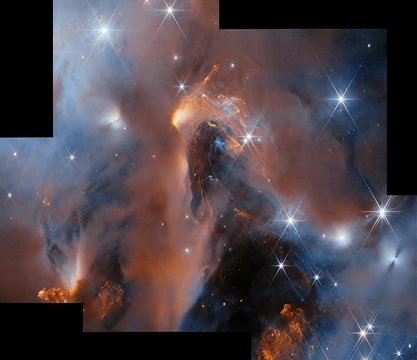
NGC 3247
A bright, massive H II region and stellar nursery.

NGC 3247, also known as RCW 49 and the Whirling Dervish Nebula, is an H II region nebula located approximately 13,700 light years away. It is a dusty stellar nursery containing more than 2,200 stars and spans about 300–400 light years across, recognized as among the brightest and most massive H II regions.
Quick Facts
- Credit
- NASA
- Epoch
- J2000.0
- Ra
- 10 · 24 · 14.6
- Dec
- -57 · 46 · 58
- Dist Ly
- 13,700
- Constellation
- Carina
- Radius Ly
- 150-200
- Names
- RCW 49, GUM 29, NGC 3247
Facts from the source article.
Lore & Background
RCW 49, also cataloged as NGC 3247, is an H II region that lies about 13,700 light years from Earth. It is a dusty stellar nursery containing more than 2,200 stars and spans roughly 300 to 400 light years across. The nebula is recognized as among the brightest and most massive H II regions. In 2004, an image taken in 2003 by the Spitzer Space Telescope was released, showing the nebula in infrared wavelengths with colors mapped to visible light: 3.6 microns (blue), 4.5 microns (green), 5.8 microns (orange), and 8 microns (red). The infrared camera could detect stars obscured by dust clouds, and it was estimated that at least 200 of the stars in the nebula have dust disks. Observations from the Spitzer Telescope, including its IRAC camera, led to the conclusion that the region is a star-forming region. In 2014, RCW 49 was identified as a bow shock candidate, along with M17, in a study of Extended Red Objects and stellar wind bow shocks in the Carina nebula.
Reader's Guide
NGC 3247, also known as RCW 49 and the Whirling Dervish Nebula, is notable as one of the brightest and most massive H II regions known. Its status as a dusty stellar nursery containing over 2,200 stars underscores its importance for studying star formation. The Spitzer Space Telescope's infrared observations revealed stars hidden by dust clouds and identified at least 200 stars with dust disks, providing insight into early planetary system development. The region's identification as a bow shock candidate in 2014, alongside M17, adds to its significance in understanding stellar wind interactions and extended red objects. The nebula's large size—300 to 400 light years across—and its distance of about 13,700 light years place it as a key target for infrared astronomy and studies of massive star formation. Its multiple designations (NGC 3247, RCW 49, G29) reflect its cataloging in different surveys, and its common name, the Whirling Dervish Nebula, evokes its dynamic appearance.
Did You Know?
- It contains more than 2,200 stars and spans 300–400 light years.
- At least 200 stars in the nebula have dust disks.
More in NGC Objects, Part 5 1-24
Spotted an error? Know more?
Reader corrections go straight into our review queue. Suggest an edit · How this site is sourced