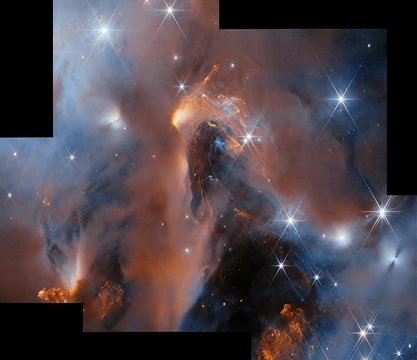
NGC 3206
Barred spiral galaxy in Ursa Major with active nucleus.

NGC 3206 is a barred spiral galaxy located in the constellation Ursa Major. It is notable as an Active Galaxy Nucleus Candidate, indicating a compact central region emitting significant energy across the electromagnetic spectrum, likely not produced by stars. The galaxy is a member of the NGC 3264 group.
Quick Facts
- Constellation Name
- Ursa Major
- Epoch
- J2000
- Ra
- 10 · 21 · 47.5192
- Dec
- +56 · 55 · 49.404
- Dist Ly
- 19.31 ± 1.36 Mpc
- Group Cluster
- NGC 3264 Group (LGG 201)
- Z
- 0.003839
- H Radial V
- 1151 ± 1 km/s
- Appmag V
- 11.9
Facts from the source article.
Lore & Background
NGC 3206 was discovered by German-British astronomer William Herschel on 8 April 1793. It is a barred spiral galaxy, and its velocity with respect to the cosmic microwave background is 1309 ± 11 km/s, corresponding to a Hubble distance of 19.31 ± 1.36 Mpc. Eleven non-redshift measurements yield a distance of 17.582 ± 1.088 Mpc, showing some discrepancy between the two methods.
The galaxy is classified as an Active Galaxy Nucleus Candidate in the SIMBAD database, meaning it has a compact central region that emits substantial energy across the electromagnetic spectrum, with characteristics indicating the luminosity is not produced by stars. NGC 3206 is part of the NGC 3264 group (also known as LGG 201), which includes at least five other members: NGC 3220, NGC 3264, NGC 3353, and two additional galaxies.
One supernova has been observed in NGC 3206: SN 2024bch, discovered by American amateur astronomer Patrick Wiggins on 29 January 2024. Initially classified as Type II with magnitude 16.1, later analysis suggested it was Type IIn-L with a red supergiant progenitor.
Reader's Guide
NGC 3206 holds significance as an Active Galaxy Nucleus Candidate, offering insights into the energetic processes at the centers of galaxies where non-stellar emission dominates. Its membership in the NGC 3264 group places it within a small galaxy cluster, providing context for studying group dynamics and interactions. The distance measurements for NGC 3206 show a tension between Hubble-based and non-redshift methods, highlighting the challenges in determining extragalactic distances. The discovery of supernova SN 2024bch, a Type IIn-L event with a red supergiant progenitor, adds to the galaxy's legacy as a site of stellar death and transient phenomena. Discovered by amateur astronomer Patrick Wiggins, this supernova underscores the ongoing contributions of citizen scientists to astronomical research. The galaxy's barred spiral structure and active nucleus make it a target for studies of galaxy evolution and central black hole activity.
Did You Know?
- NGC 3206 is a barred spiral galaxy in Ursa Major discovered by William Herschel on 8 April 1793.
- It is an Active Galaxy Nucleus Candidate, with a compact central region emitting energy not produced by stars.
- The galaxy is part of the NGC 3264 group, which includes at least five other members.
- Supernova SN 2024bch, discovered by Patrick Wiggins on 29 January 2024, was later suggested to be Type IIn-L with a red supergiant progenitor.
More in NGC Objects, Part 5 1-24
Spotted an error? Know more?
Reader corrections go straight into our review queue. Suggest an edit · How this site is sourced