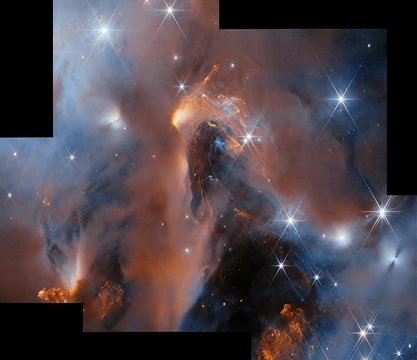
NGC 3198
Barred spiral galaxy in Ursa Major, 47 million light years away.

NGC 3198, also called Herschel 146, is a barred spiral galaxy situated in the constellation Ursa Major. It lies within the Leo Spur, a component of the Virgo Supercluster, at a distance of roughly 47 million light-years. German-British astronomer William Herschel first spotted it on 15 January 1788.
This galaxy was among 18 selected for the Hubble Space Telescope’s Key Project on the Extragalactic Distance Scale, a program designed to refine secondary distance indicators and measure the Hubble constant to within 10% accuracy. Its structure and orientation made it well suited for these observations. Using the Wide Field and Planetary Camera 2, astronomers measured the brightness of 52 Cepheid variable stars, yielding a distance modulus that corresponds to 14.5 megaparsecs (47 million light-years).
Radio observations with the Westerbork Synthesis Radio Telescope revealed, for the first time, extraplanar gas in NGC 3198. This gas accounts for about 15% of the galaxy’s total atomic hydrogen (HI) mass.
Two supernovae have been recorded in NGC 3198. SN 1966J, a Type Ia event with a magnitude of 13, was discovered by Paul Wild on 18 December 1966 (though some sources classify it as Type Ib). SN 1999bw, a gap transient with a magnitude of 17.8, was found by the Lick Observatory Supernova Search on 20 April 1999. Initially identified as a Type IIn supernova, it was notably dimmer than expected and was reclassified as a gap transient in 2021.
Quick Facts
- Epoch
- J2000
- Ra
- 10 · 19 · 55.0022
- Dec
- +45 · 32 · 59.337ned
- Dist Ly
- 47 Mly
- Z
- 0.00227
- Appmag V
- 10.3
- Constellation Name
- Ursa Major
Facts from the source article.
Lore & Background
NGC 3198 was discovered by German-British astronomer William Herschel on 15 January 1788. It lies in the Leo Spur, a filament of the Virgo Supercluster. The galaxy's type and orientation made it suitable for distance measurements using Cepheid variables. The Hubble Space Telescope's Wide Field and Planetary Camera 2 measured the magnitudes of 52 Cepheid variables in NGC 3198, yielding a distance modulus corresponding to 14.5 Mpc (47 million light years). Observations with the Westerbork Synthesis Radio Telescope detected extraplanar gas for the first time in this galaxy, with that gas comprising about 15% of the total atomic hydrogen (HI) mass. Two supernovae have been observed: SN 1966J, discovered by Paul Wild on 18 December 1966, classified as Type Ia (though some sources list it as Type Ib); and SN 1999bw, discovered by the Lick Observatory Supernova Search on 20 April 1999, initially classified as Type IIn but reclassified in 2021 as a gap transient.
Reader's Guide
NGC 3198 holds significance as one of 18 galaxies in the Hubble Space Telescope Key Project on the Extragalactic Distance Scale, a program designed to calibrate secondary distance indicators and refine the Hubble constant to within 10% accuracy. Its favorable type and orientation allowed precise Cepheid variable measurements using the WFPC2 instrument, establishing a reliable distance of 14.5 Mpc. The detection of extraplanar gas by the Westerbork Synthesis Radio Telescope marked a notable finding, revealing that roughly 15% of the galaxy's atomic hydrogen resides outside the main disk, offering insights into galactic structure and gas dynamics. The two supernovae observed—SN 1966J, with its disputed classification between Type Ia and Type Ib, and SN 1999bw, reclassified as a gap transient—add to the galaxy's astrophysical interest, highlighting the diversity of stellar explosions and the ongoing refinement of supernova taxonomy.
Did You Know?
- NGC 3198 was discovered by William Herschel on 15 January 1788.
- Extraplanar gas makes up about 15% of the galaxy's total atomic hydrogen mass.
More in NGC Objects, Part 5 1-24
Spotted an error? Know more?
Reader corrections go straight into our review queue. Suggest an edit · How this site is sourced