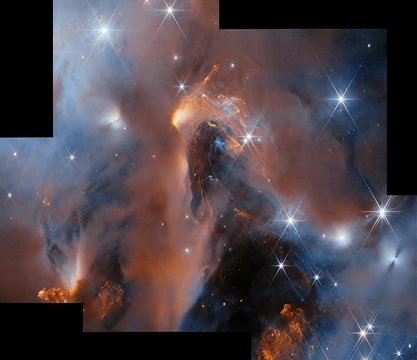
NGC 3187
A low surface brightness barred spiral in Hickson Compact Group 44.

NGC 3187, also known as HCG 44D, is a large barred spiral galaxy located in the constellation Leo. It is a member of the Hickson Compact Group 44, which also includes NGC 3185, NGC 3190, and NGC 3193. The galaxy is notable for its low surface brightness, classifying it as a low surface brightness galaxy (LSB), and for containing regions of ionized hydrogen.
Quick Facts
- Epoch
- J2000
- Ra
- 10h 17m 48s
- Dec
- +21° 52 23
- Appmag B
- 13.91
- Appmag V
- 13.44
- Sbrightness
- 23.35 mag/arcsec^2
- Constellation Name
- Leo
- Z
- 0.005290
- Dist Ly
- 91 Mly (28.04 Mpc)
- Names
- PGC 30068, HCG 44D, VV307b, UGC 5556, CGCG 123-036, MCG +04-24-025, ARP 316
- H Radial V
- 1,586 km/s
Facts from the source article.
Lore & Background
NGC 3187 was discovered by Irish physicist George Stoney in 1850. It is classified as a low surface brightness galaxy, with a surface brightness of 15.30 mag/am^2, meaning it is more diffuse than the ambient night sky. The galaxy has a broad HI line and contains regions of ionized hydrogen, indicating ongoing star formation. Its luminosity class is III, and its velocity relative to the cosmic microwave background is 1,901 ± 22 km/s, corresponding to a Hubble distance of 28.0 ± 2.0 Mpc. Eight non-redshift measurements yield a distance of 25,700 ± 10,409 Mpc, which falls within the Hubble distance range.
Reader's Guide
NGC 3187 is significant as a member of Hickson Compact Group 44, a dense grouping of galaxies that includes NGC 3185, NGC 3190, and NGC 3193. Together with NGC 3190 and NGC 3193, it appears in the Atlas of Peculiar Galaxies under the designation Arp 316, highlighting its morphological interest. As a low surface brightness galaxy, it represents a class of diffuse galaxies that are challenging to observe but important for understanding galaxy formation and evolution. Its broad HI line and ionized hydrogen regions indicate active interstellar medium processes. The galaxy's distance measurements show some variation, with non-redshift estimates averaging 25,700 Mpc, within the range of the Hubble distance. Its placement in the Leo II Groups further contextualizes its environment. NGC 3187's discovery by George Stoney in 1850 adds historical depth, and its inclusion in multiple catalogs (NGC, HCG, Arp) underscores its ongoing relevance in extragalactic studies.
Did You Know?
- NGC 3187 is also designated HCG 44D as part of Hickson Compact Group 44.
- The galaxy has a surface brightness of 15.30 mag/am^2, classifying it as a low surface brightness galaxy.
- NGC 3187, along with NGC 3190 and NGC 3193, appears in the Atlas of Peculiar Galaxies as Arp 316.
More in NGC Objects, Part 5 1-24
Spotted an error? Know more?
Reader corrections go straight into our review queue. Suggest an edit · How this site is sourced