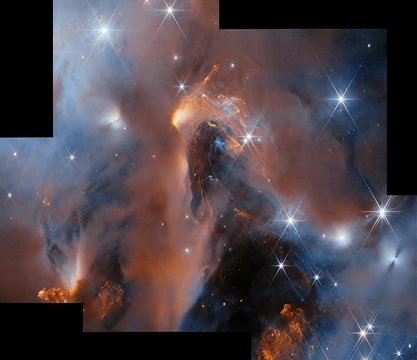
NGC 3180
An HII region in the Little Pinwheel Galaxy.

NGC 3180 is an HII region located within the unbarred spiral galaxy NGC 3184, approximately 40 million light-years away in the constellation Ursa Major. It is one of two named HII regions in that galaxy, the other being NGC 3181.
Quick Facts
- Epoch
- J2000
- Ra
- 10 · 18 · 16.9380
- Dec
- +41 · 25 · 27.400
- Z
- 0.001941 · 0.00000200
- Dist Ly
- 12.268 ± 0.466 Mpc
- Appmag V
- 9.6
- Constellation Name
- Ursa Major
Facts from the source article.
Lore & Background
NGC 3180 is one of two HII regions cataloged within NGC 3184, the other being NGC 3181. NGC 3184 itself is an unbarred spiral galaxy discovered by William Herschel on 18 March 1787. The galaxy's spiral arms, which contain regions like NGC 3180, are highlighted by relatively few bright young blue stars created in huge density waves that circle the center. NGC 3184 has a high abundance of heavy elements, and its two prominent spiral arms have constant pitch angles, making them symmetrical.
Reader's Guide
NGC 3180, as an HII region within NGC 3184, contributes to the understanding of star formation in a galaxy noted for its high metallicity. The region is part of a galaxy that has hosted six supernovae and transients, including SN 1999gi, SN 2010dn, and SN 2016bkv. The presence of HII regions like NGC 3180 and NGC 3181 provides sites for studying the interplay between massive stars and their surrounding interstellar medium. NGC 3184's symmetrical spiral arms and constant pitch angles make it a useful object for studying spiral structure dynamics. The galaxy's blue spiral arms, dominated by young blue stars, highlight the ongoing star formation in regions such as NGC 3180. The legacy of NGC 3180 is tied to its parent galaxy's role as a laboratory for supernova studies and the evolution of heavy-element-rich environments.
Did You Know?
- NGC 3180 is an HII region within the galaxy NGC 3184.
- NGC 3184 is also known as the Little Pinwheel Galaxy.
- NGC 3184 has two named HII regions: NGC 3180 and NGC 3181.
More in NGC Objects, Part 5 1-24
Spotted an error? Know more?
Reader corrections go straight into our review queue. Suggest an edit · How this site is sourced