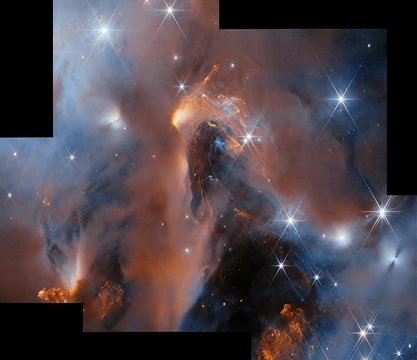
NGC 3177
Spiral galaxy in Leo with an active nucleus and a historic supernova.

NGC 3177 is a spiral galaxy located in the constellation Leo. It has a luminosity class of II and contains regions of ionized hydrogen. The galaxy is notable for hosting the supernova SN 1947A, discovered by Edwin Hubble, and for being a member of the NGC 3227 group.
Quick Facts
- Epoch
- J2000
- Ra
- 10h 16m 33s
- Dec
- +21° 07 23
- Appmag B
- 12.8
- Appmag V
- 11.6
- Sbrightness
- 22.34 mag/arcsec^2
- Constellation Name
- Leo
- Names
- UGC 05544, MRK 9018, CGCG 123-032, MCG +04-24-023, IRAS 10138+2122, PGC 030010
Facts from the source article.
Lore & Background
NGC 3177 was discovered in 1784 by the German-British astronomer William Herschel. It is a spiral galaxy with a luminosity class of II and a broad HI line, indicating significant neutral hydrogen content. The galaxy also contains regions of ionized hydrogen, and according to the SIMBAD database, it hosts an active galactic nucleus.
On March 5, 1947, the supernova SN 1947A was discovered in NGC 3177 by Edwin Hubble. The type of this supernova has not been determined. The galaxy is a member of the NGC 3227 group, which includes at least 16 other galaxies such as NGC 3162, NGC 3185, NGC 3187, NGC 3190, NGC 3193, NGC 3213, NGC 3226, NGC 3227, NGC 3287, and NGC 3301.
Nine non-redshift measurements yield a distance of 27.722 ± 4.581 Mpc (~90.4 million ly), which falls within the range of the Hubble distance of 24.0 ± 1.7 Mpc (~78.3 million ly). Its speed relative to the cosmic microwave background is 1,627 ± 22 km/s.
Reader's Guide
NGC 3177 holds significance as a spiral galaxy with an active galactic nucleus, making it a subject of interest for studies of galactic activity and evolution. Its membership in the NGC 3227 group places it within a rich environment of interacting and neighboring galaxies, offering context for understanding group dynamics and galaxy formation. The discovery of SN 1947A by Edwin Hubble adds historical value, as Hubble's work in extragalactic astronomy and supernova observation was foundational. Although the supernova's type remains undetermined, its occurrence in NGC 3177 contributes to the catalog of supernovae in nearby galaxies. The galaxy's broad HI line and ionized hydrogen regions indicate ongoing star formation and gas content, while the active nucleus suggests the presence of a supermassive black hole. The consistency between non-redshift distance measurements and Hubble distance supports the use of redshift as a distance indicator. NGC 3177 thus serves as a case study in multiple areas: galaxy classification, nuclear activity, supernova history, and group membership.
Did You Know?
- NGC 3177 was discovered by William Herschel in 1784.
- It has an active galactic nucleus according to the SIMBAD database.
More in NGC Objects, Part 5 1-24
Spotted an error? Know more?
Reader corrections go straight into our review queue. Suggest an edit · How this site is sourced