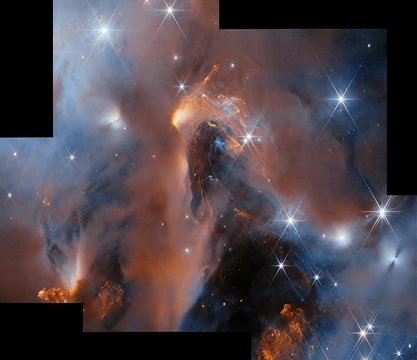
NGC 3147
A spiral galaxy with a malnourished black hole and a relativistic disk.

NGC 3147 is a spiral galaxy in the constellation Draco, approximately 130 million light years from Earth and spanning about 140,000 light years across. It is notable as the best candidate for a true type II Seyfert galaxy, where the optical spectrum lacks broad emission lines not due to obscuration but the absence of a broad line region, while the nucleus is seen unobscured in X-rays.
Quick Facts
- Epoch
- J2000
- Ra
- 10 · 16 · 53.6504
- Dec
- +73 · 24 · 02.695
- Dist Ly
- 129 ±
- Z
- 0.0093460.000003
- Appmag V
- 10.6
- Constellation Name
- Draco
- Notes
- Seyfert galaxy
Facts from the source article.
Lore & Background
NGC 3147 was discovered by German-British astronomer William Herschel on April 3, 1785. The galaxy has a small, bright nucleus and tightly wound multiple spiral arms that branch after about a quarter of a revolution, with HII regions detectable in the arms. Its overall appearance resembles NGC 488 but with a smaller nuclear bulge.
The galaxy is classified as a Seyfert II and is considered the best candidate for a true type II Seyfert, where the lack of broad emission lines in the optical/UV spectrum is due to the absence of the broad line region rather than obscuration. Observations in X-rays show an unabsorbed spectrum, while optical spectra lack broad lines, a mismatch with the Unification Model. Hard X-ray flux dropped by a factor of about 2 between 2001 and 2006, and further variability was observed in 2010, confirming the source's variability. UV nuclear emission shows negligible variability. A debate exists over whether the lack of broad lines is caused by a Compton-thick column with a highly ionized reflector, but observations by NuSTAR in 2015 strongly favor an unobscured line-of-sight and disfavor the Compton-thick scenario.
In July 2019, the Hubble Space Telescope revealed a thin disk of material around a supermassive black hole at the center, with a mass 250 million times that of the Sun. The disk rotates at more than 10% of the speed of light, causing relativistic beaming. This was surprising because such low-activity galaxies were thought to have little material feeding the black hole.
Reader's Guide
NGC 3147 holds significant importance in the study of active galactic nuclei, particularly as the best candidate for a true type II Seyfert galaxy. Its simultaneous unabsorbed X-ray spectrum and lack of broad optical emission lines challenge the standard Unification Model, prompting ongoing debate about the nature of its nucleus. The detection of a thin, relativistic disk around its supermassive black hole in 2019 was unexpected, as models of low-activity galaxies did not predict such a structure. This discovery provides insight into the behavior of 'malnourished' black holes and the dynamics of material in extreme gravitational wells. The galaxy's X-ray variability, observed across multiple missions, further supports direct line-of-sight observations of the nucleus. Six supernovae have been recorded in NGC 3147, including Type Ia, Ib, and Ic events, contributing to studies of stellar explosions in spiral galaxies. As the brightest member of the NGC 3147 group, it serves as a reference for understanding galaxy interactions and evolution in its local environment.
Did You Know?
- NGC 3147's central black hole is 250 million times the mass of the Sun.
- Six supernovae have been discovered in NGC 3147, including SN 1972H, SN 1997bq, SN 2006gi, SN 2008fv, SN 2021do, and SN 2021hpr.
- The galaxy is the brightest member of the NGC 3147 group, which includes NGC 3155 and several UGC galaxies.
More in NGC Objects, Part 5 1-24
Spotted an error? Know more?
Reader corrections go straight into our review queue. Suggest an edit · How this site is sourced