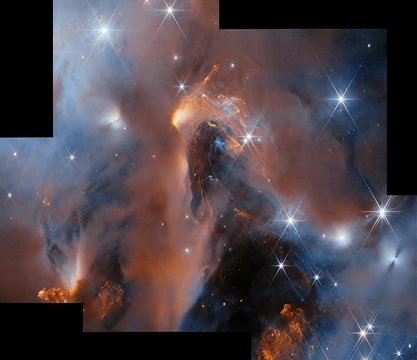
NGC 3137
A large, unbarred spiral galaxy in the NGC 3175 Group.

NGC 3137 is a spiral galaxy located in the constellation Antlia, approximately 50 million light years from Earth. It is notable for its loosely wound spiral arms and lack of a central bar, and it is one of the two large spiral members of the NGC 3175 Group.
Quick Facts
- Epoch
- J2000
- Ra
- 10 · 09 · 07.3775
- Dec
- -29 · 03 · 50.485
- Dist Ly
- 52.6 ± 9.1 Mly (16.1 ± 2.8 Mpc)
- Z
- 0.003683 ± 0.000002
- H Radial V
- 1,104 ± 1 km/s
- Appmag V
- 11.5
- Constellation Name
- Antlia
- Group Cluster
- NGC 3175 Group (LGG 189)
Facts from the source article.
Lore & Background
NGC 3137 was discovered by John Herschel on February 5, 1837. It has a moderately bright nucleus and a spiral pattern similar to NGC 3621 and the Pinwheel Galaxy, featuring multiple knots. The galaxy is classified as SA(s)d, meaning it lacks a bar (SA), has no inner ring structure (s), and possesses loosely wound spiral arms (d). A foreground star is superposed 0.3 arcminutes from the centre, and the galaxy is seen at an inclination of about 70°.
The galaxy's star formation rate is estimated at 0.5 solar masses per year, based on CO(2-1) radio emission detected by the Atacama Large Millimeter Array. Its total hydrogen mass and stellar mass are comparable, though exact values are not specified. At the centre lies a supermassive black hole with a mass estimated at 107.78 ± 0.20 (38–95 million solar masses), derived from the pitch angle of the spiral arms.
NGC 3137 is a member of the NGC 3175 Group (also known as LGG 189), where it is one of the two large spirals, the other being NGC 3175. Other group members include NGC 3113 and NGC 3125.
Reader's Guide
NGC 3137 holds significance as a prominent member of the NGC 3175 Group, a nearby collection of galaxies. Its classification as an unbarred spiral (SA(s)d) with loosely wound arms places it in a category that helps astronomers understand the diversity of spiral galaxy structures. The galaxy's star formation rate of 0.5 solar masses per year, measured via ALMA radio observations, provides insight into its ongoing stellar birth activity. The mass of its central supermassive black hole, estimated from spiral arm pitch angles, contributes to studies of black hole–galaxy scaling relations. The presence of a foreground star near its centre is a common observational detail that must be accounted for in photometric and spectroscopic studies. As one of the two large spirals in its group, NGC 3137 offers a comparative case with NGC 3175 for understanding galaxy evolution in a group environment. Its moderate distance and clear spiral structure make it a useful target for morphological and kinematic studies.
Did You Know?
- The galaxy is classified as SA(s)d, meaning it has no bar and no inner ring, with loosely wound spiral arms.
- A foreground star lies 0.3 arcminutes from the centre of NGC 3137.
- The supermassive black hole at its centre has an estimated mass of 107.78 ± 0.20 (38–95 million solar masses).
More in NGC Objects, Part 5 1-24
Spotted an error? Know more?
Reader corrections go straight into our review queue. Suggest an edit · How this site is sourced