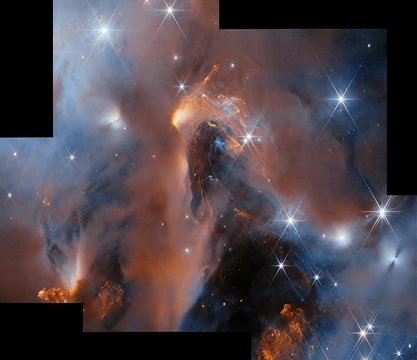
NGC 3114
A sparse open cluster in the Carina complex, difficult to study.

NGC 3114 is a loose open cluster located on the edge of the Carina complex. Because so many field stars from the Milky Way’s disc lie in the same line of sight, the cluster’s true boundaries are hard to pin down, making it a challenging object to study.
The first detailed look at NGC 3114 came in 1963, when Jankowitz and McCosh used photographic and photoelectric UBV photometry on 171 and 52 of its stars, respectively. They placed the cluster 910 parsecs from the Sun and gave estimates for its mean visual extinction and age. In 1988, Schneider and Weiss measured 122 stars and updated the cluster’s reddening value. Three years later, Sagar and Sharpless carried out the largest survey up to that time, gathering BV CCD photometry for roughly 350 stars across seven small fields. Because those fields were well away from the cluster’s center, heavy contamination was expected. Still, using the reddening value from Schneider and Weiss, they found a distance that matched the 1963 result, and they also determined the cluster’s age. In 1989, Clariá and colleagues measured the cluster’s chemical makeup and found its metal content—specifically the ratio of iron to hydrogen—to be essentially the same as the Sun’s.
Quick Facts
- Epoch
- J2000
- Ra
- 10 · 02 · 42
- Dec
- -60 · 06 · 0
- Appmag V
- + 4.2
- Constellation
- Carina
- Names
- Cr 215
Facts from the source article.
Lore & Background
NGC 3114 lies in a region of the sky rich with background stars from the Milky Way's disc, making its boundaries unclear. Early photometric work in 1963 by Jankowitz and McCosh on 171 stars gave a distance of 910 parsecs and an age range. Later studies revised the reddening and extended the stellar sample. In 1991, Sagar and Sharpless obtained BV CCD photometry for about 350 stars from seven fields offset from the cluster centre, confirming the earlier distance. Chemical abundance work in 1989 by Claria' et al. found the cluster's metal content to be essentially solar.
Reader's Guide
NGC 3114's significance lies in its role as a test case for studying open clusters in crowded, contaminated fields. The cluster's distance has remained consistent across multiple studies spanning nearly three decades, lending confidence to its placement within the Carina complex. Its solar metallicity makes it a useful benchmark for comparing chemical evolution in the Milky Way's disc. The difficulty in defining its true extent due to field star contamination highlights the challenges of cluster astronomy in the Galactic plane. The cluster's age, around 240 million years, places it in an intermediate range, offering insights into stellar evolution and cluster dynamics over timescales shorter than those of older, more dispersed clusters.
Did You Know?
- NGC 3114 was first studied photometrically in 1963 by Jankowitz and McCosh.
- The cluster's distance was measured as 910 parsecs in both 1963 and 1991 studies.
- Its chemical abundance is essentially the same as the Sun's.
- The cluster's size is ambiguous due to heavy contamination by Milky Way field stars.
More in NGC Objects, Part 5 1-24
Spotted an error? Know more?
Reader corrections go straight into our review queue. Suggest an edit · How this site is sourced