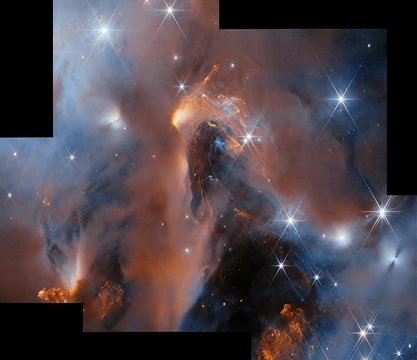
NGC 3106
A lenticular galaxy with an active nucleus and faint spiral arms.

NGC 3106 is a lenticular galaxy located in the constellation Leo Minor, approximately 290 million light-years from Earth. It spans about 100,000 light-years across and was discovered by William Herschel on March 13, 1785. The galaxy is notable for its active nucleus, classified as a LINER, and for hosting faint spiral-like structures in its outer regions that are sites of active star formation.
Quick Facts
- Epoch
- J2000
- Ra
- 10 · 04 · 05.2636
- Dec
- +31 · 11 · 07.756
- Dist Ly
- 293 ± 21 Mly (89.9 ± 6.3 Mpc)
- Z
- 0.020654 ± 0.000007
- H Radial V
- 6,192 ± 2 km/s
- Appmag V
- 12.3
- Constellation Name
- Leo Minor
Facts from the source article.
Lore & Background
NGC 3106 is characterized as a lenticular galaxy, possessing both a disk and a bulge. Nearly 95% of the stars in the bulge are old, formed more than 6 billion years ago, while the disk contains a younger stellar population, with 77% of its stars older than 6 billion years. Its nucleus is active and classified as a LINER based on its emission. Some star formation occurs in the central region of the disk, possibly triggered by tidal interaction, but no star formation is observed in the bulge.
The outer regions of the galaxy exhibit faint structures resembling spiral arms. Although these features are otherwise dim, they account for more than half of the galaxy's H-alpha emission. HII regions detected within these spiral features indicate ongoing star formation, with an estimated star formation rate of 0.1–0.3 solar masses per year. The innermost star formation ring has a radius of 20 arcseconds, and the galaxy contains a series of rings.
Four supernovae have been discovered in NGC 3106: SN 1983J (magnitude 16.0) by Natalya Metlova on April 8, 1983; SN 2009gt (magnitude 16.1) by the Catalina Real-time Transient Survey on June 25, 2009; SN 2021aewn (Type II, magnitude 18.658) by ATLAS on November 18, 2021; and SN 2025aauj (Type Ia, magnitude 17.6858) by the Zwicky Transient Facility on October 18, 2025.
Reader's Guide
NGC 3106 is significant as a field galaxy, meaning it does not belong to any galaxy group, yet it has seven known dwarf companion galaxies in its vicinity. Its classification as a lenticular galaxy with an active LINER nucleus places it among galaxies that bridge elliptical and spiral types, offering insights into galaxy evolution. The presence of faint spiral arms and HII regions in the outer disk, along with a central star formation ring, suggests ongoing dynamical processes, possibly from past tidal interactions. The four recorded supernovae, spanning over four decades, provide a timeline of stellar explosions within the galaxy, including both Type II and Type Ia events. The galaxy's proximity to NGC 3116 and UGC 5481, along with its dwarf companions, makes it a useful target for studying isolated galaxy environments and the effects of minor interactions on star formation and nuclear activity.
Did You Know?
- The galaxy has an active nucleus classified as a LINER.
- Four supernovae have been discovered in NGC 3106, including SN 2025aauj (Type Ia) in 2025.
- The outer regions of NGC 3106 contain faint spiral-like structures that produce more than half of its H-alpha emission.
Frequently Asked Questions
What is NGC 3106?
NGC 3106 is a lenticular galaxy sitting in the constellation Leo Minor, roughly 290 million light-years from Earth. It measures about 100,000 light-years across, making it comparable in scale to the Milky Way.
Who discovered NGC 3106 and when?
William Herschel spotted the galaxy on March 13, 1785, during his extensive deep-sky surveys. His observation added it to the growing catalog of extragalactic objects known at the time.
What makes NGC 3106's galactic nucleus notable?
Its core is classified as a LINER, meaning it emits low-ionization spectral lines rather than the brighter signatures of a Seyfert or quasar. This makes it a milder form of active galactic nucleus.
Does NGC 3106 actually have spiral arms?
Although it is formally typed as a lenticular galaxy, faint spiral-like structures are visible in its outer disk. Those outer regions are also where active star formation is taking place.
How far away is NGC 3106 and where should I look for it?
The galaxy lies approximately 290 million light-years from Earth in the direction of Leo Minor. Its apparent size spans roughly 100,000 light-years, so it presents a fairly extended shape to deep-sky observers.
More in NGC Objects, Part 5 1-24
Spotted an error? Know more?
Reader corrections go straight into our review queue. Suggest an edit · How this site is sourced