First State National Historical Park
Park covering Delaware's colonial history and first statehood.
Last updated
Where it is
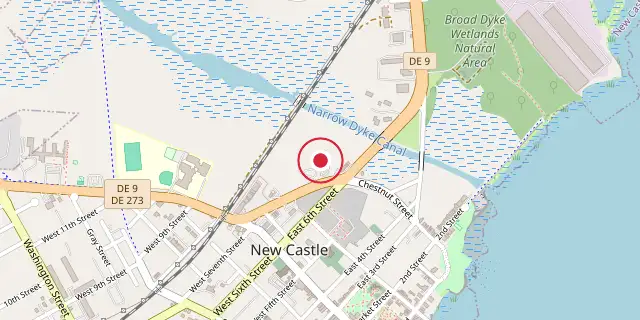
Coordinates: 39°39′54″N 75°33′54″W (39.6650, -75.5650) · Open in OpenStreetMap
Coordinates and connected clubs: the infobox of Wikipedia: First State National Historical Park (CC BY-SA 4.0). Map: drawn by Codexery from OpenStreetMap tiles.
First State National Historical Park is a unit of the National Park Service located primarily in Delaware and extending into Chadds Ford, Pennsylvania. It was initially created as First State National Monument by President Barack Obama under the Antiquities Act on March 25, 2013, and later redesignated as a national historical park by Congress. The park highlights Delaware's early colonial history and its role as the first state to ratify the U.S. Constitution.
Description
First State National Historical Park explores Delaware’s early colonial history and its role as the first state to ratify the U.S. Constitution. It highlights the diverse settlement of the Delaware Valley by Dutch, Swedes, Finns, and English, and their interactions with Native Americans, while also preserving the Brandywine River Valley’s cultural landscape.
Sites
The park includes the New Castle Court House, built in 1730, one of the oldest courthouses in the country. Its cupola is the center of a 12-mile circle forming the border between Delaware, Pennsylvania, and Maryland, surveyed as part of the Mason–Dixon line. The building housed Delaware's colonial assembly, which voted for independence from Pennsylvania and England in 1776; the Declaration of Independence was read from its balcony, and Delaware's first constitution was drafted there.
U.S. Supreme Court Justice Samuel Chase was impeached over his actions in the Court House during an 1800 trial. In 1848, Chief Justice Roger Taney presided over trials of Quaker abolitionists Thomas Garrett and John Hunn for violating the Fugitive Slave Act; the Garrett trial inspired scenes in Uncle Tom's Cabin. The New Castle Green, laid out as a town common in the 1650s by Dutch colonists, is near where William Penn first arrived in America in 1682.
It is bounded by the Court House, the 1809 federal Arsenal, and the 1703 Immanuel Episcopal Church on the Green, where founder George Read is buried. The Sheriff's House, built in 1857, will become the park's headquarters and Visitor Center. The Court House and Green are owned by the state of Delaware, with a National Park Service conservation easement; the Sheriff's House is owned by the National Park Service.
Park history
Before the First State National Monument, Delaware had no unit of the National Park System, a concern for U.S. Senator Tom Carper. Starting in 2002, Carper held hearings and solicited resident suggestions for potential park sites. In 2006, Congress directed the National Park Service to study historic and scenic sites in Delaware's coastal areas. The 2009 study recommended a national historical park including the New Castle Court House Museum, Dover Green, Fort Christina, Old Swedes' Church, the John Dickinson Plantation, Stonum, Lombardy Hall, and the Ryve's Holt House.
Carper and Delaware's congressional delegation then proposed the First State National Historical Park Act of 2011, which included those sites but not the Woodlawn tract at Beaver Valley later included in the National Monument. The act gained support from former Delaware resident Ken Burns, who noted that the nation is bound together by such places and that Delaware's sites reflect some of the oldest settlement histories on the continent. However, the bill was approved by the Senate Energy and Natural Resources Committee but failed to pass the full Senate and was not approved in the House committee.
More in National Historical Parks of the United States
Sources
Compiled from Wikipedia and the sources listed below. Text from Wikipedia is available under CC BY-SA 4.0; this entry is adapted from it.
- Wikipedia: First State National Historical Park (CC BY-SA 4.0).
Spotted an error? Know more?
Reader corrections go straight into our review queue. Suggest an edit · How this site is sourced