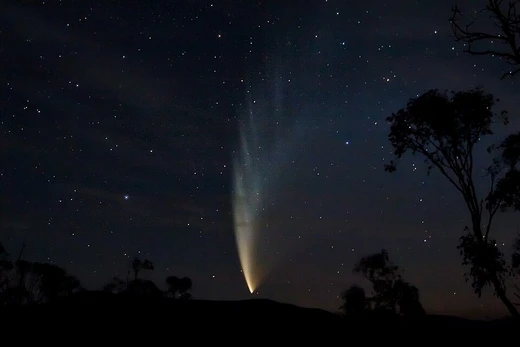
Great Southern Comet of 1880
A great comet known for its tail, not brightness.

The Great Southern Comet of 1880, known today as C/1880 C1, earned its title as a "great comet" not because of its brightness, but due to its exceptionally long tail. It was visible without a telescope across the Southern Hemisphere during February 1880. Astronomers believe it passed roughly 110,000 kilometers (68,000 miles) from the Sun’s surface.
No single person is credited with discovering the comet, as none of the earliest reports came from direct, firsthand observers. It is generally accepted that the comet was first spotted on the evening of February 1, 1880, in Australia and New Zealand. The first recorded sighting came from Henry C. Russell, director of the Sydney Observatory, who received a message from an unnamed gentleman living in the northern part of the colony. That man reported being surprised by a bright streak of light stretching from the horizon toward the South Pole.
Studies of the comet’s orbit revealed it to be nearly identical to those of the Great Comet of 1843 and the Great September Comet of 1882. This led some astronomers to suggest that all three were appearances of the same comet, whose orbit shifted dramatically each time it passed near the Sun. However, later recalculations disproved this, showing their orbital periods ranged from 600 to 800 years. In 1888, Heinrich Kreutz concluded that they were fragments of a much larger sungrazing comet that had broken apart several centuries earlier. These comets, along with Ikeya–Seki, White–Ortiz–Bolelli, and Lovejoy, belong to the Kreutz sungrazer group. It is thought that both C/1880 C1 and C/1887 B1 split off directly from the Great Comet of 1843, roughly 100 to 150 days after that comet’s previous perihelion passage sometime in the 11th century.
- Designation
- C/1880 C1
- First observed
- 1 February 1880
- Location of first sighting
- Australia and New Zealand
- First known observer
- Henry C. Russell, director of the Sydney Observatory
- Perihelion distance
- approximately 110,000 km (68,000 mi) from the Sun's surface
- Orbital period
- between 600 and 800 years
Lore & Background
The comet had no single discoverer, as all initial observations were not first-hand reports. It is generally agreed that the comet was first seen on the evening of 1 February 1880 in Australia and New Zealand. The first known sighting was recorded by Henry C. Russell, director of the Sydney Observatory, who received a message from a gentleman in the northern part of the colony, stating he 'was surprised by a bright streak of light, stretching from the horizon towards the South Pole'.
Reader's Guide
A study of the orbit of C/1880 C1 showed it has essentially the same orbit as the Great Comet of 1843 and the Great September Comet of 1882. This led some astronomers to believe these were all appearances of the same comet that somehow had its orbit change significantly on each perihelion passage. However, subsequent recalculations showed this is not the case, as the orbital periods were found to be between 600 and 800 years. In 1888, Heinrich Kreutz concluded they were fragments of an earlier giant sungrazing comet that broke up several centuries prior. These comets, alongside Ikeya–Seki, White–Ortiz–Bolelli, and Lovejoy, are members of the Kreutz sungrazer group. It is thought that both C/1880 C1 and C/1887 B1 broke off directly from the Great Comet of 1843, about 100–150 days after the latter's previous perihelion passage sometime in the 11th century.
Did You Know?
- The comet was classified as a 'great comet' not by its apparent magnitude, but by its prominent tail.
- It passed approximately 110,000 km (68,000 mi) from the surface of the Sun.
- Heinrich Kreutz concluded in 1888 that it was a fragment of an earlier giant sungrazing comet.
Defining Greatness: The Threshold of Naked-Eye Splendor
A great comet is one that blazes with such intensity that it commands attention from anyone looking up, not just trained astronomers. There exists no formal, codified definition for what qualifies a comet as great, yet the term has become a recognized label in public astronomy. In practice, a comet earns this distinction when it shines at or above the brightness of a second-magnitude star and unfurls a tail stretching ten degrees or more across a dark sky. Such a display is visible to casual stargazers who are not actively searching for anything in particular, and the event quickly spills beyond the astronomical community into popular consciousness. The Great Southern Comet of 1880, like Halley's Comet during its most luminous returns, exemplifies this category: a celestial visitor so brilliant and so conspicuous that it becomes a shared cultural moment rather than a niche observational target. The lack of a rigid threshold means the label carries as much cultural weight as scientific precision, marking those rare apparitions that seize the public imagination.
The Three Pillars of Brilliance
For a comet to erupt into a naked-eye spectacle, three conditions must align: a nucleus that is both large and rich in volatile material, a trajectory that carries it close to the Sun, and a path that brings it near Earth. A comet satisfying all three is virtually guaranteed to blaze. Nuclei range from a few hundred meters to many kilometers across, and when solar heating drives gas and dust outward, the resulting coma and tail scatter light dramatically. Comets that have made many returns to the inner Solar System tend to be depleted and dimmer than newcomers on their first passage. Yet the rules are not absolute. Hale-Bopp never approached the Sun very closely but possessed an extraordinarily large, active nucleus, remaining visible for months. Hyakutake was comparatively small yet dazzled observers because of its extremely close flyby of Earth. The 1880 apparition, like these examples, demonstrates that no single factor governs brilliance; it is the interplay of size, solar proximity, and terrestrial distance that determines whether a visitor becomes a great comet or passes unnoticed.
The Geometry of Light
A simple reflective object brightens according to the inverse square of its distance from the Sun: halve the distance and the brightness quadruples. Comets, however, obey a steeper law. Because solar heating triggers the ejection of vast quantities of volatile gas that themselves reflect and even fluoresce sunlight, a comet's brightness scales roughly with the inverse cube of its solar distance. Halving the distance to the Sun therefore multiplies brightness by eight rather than four. This makes perihelion distance a critical variable: most comets swing around the Sun well outside Earth's orbit, but any that dip within roughly 0.5 astronomical units, about 75 million kilometers, gain a genuine chance of becoming a great comet. Equally important is proximity to Earth. Halley's Comet in 1986 passed at nearly the most distant possible point from our planet and, though visible, was unremarkable. By contrast, the intrinsically faint Hyakutake in 1996 grazed Earth at just 0.1 AU and became spectacular. The 1880 comet's brilliance was a product of these geometric relationships working in concert.
Irregular Visitors and the Language of Wonder
Great comets do not arrive on a schedule. They appear at irregular, unpredictable intervals, averaging roughly one per decade, which makes each apparition a surprise rather than a predictable event. Officially, comets receive names after their discoverers, but the public and the press often prefer a simpler, more evocative label: The Great Comet of a given year. This formulation strips away the discoverer's name and centers the experience of the observer, emphasizing the year in which the sky was transformed. The term can also serve as a generic descriptor when a brilliant comet is spotted simultaneously by many observers, none of whom can claim sole discovery. The vast majority of comets never achieve naked-eye visibility and drift through the inner Solar System observed only by professional astronomers with instruments. The 1880 event, like the handful of great comets catalogued across the past two millennia, stands as one of those rare interruptions to the ordinary night sky, moments when the boundary between the astronomical and the everyday dissolves entirely.
Frequently Asked Questions
Who discovered the Great Southern Comet of 1880?
No single individual is credited with the discovery, since the earliest reports did not come from direct observers. The first known observer on record is Henry C. Russell, director of the Sydney Observatory, who logged it in early February 1880.
What makes the Great Southern Comet of 1880 a 'great comet'?
It earned the 'great comet' label not for exceptional brightness but for its extraordinarily long tail, which made it a spectacular naked-eye sight across the Southern Hemisphere in February 1880.
When and where was the Great Southern Comet of 1880 first spotted?
The comet was first observed on the evening of February 1, 1880, with initial sightings coming from observers in Australia and New Zealand.
How close did the Great Southern Comet of 1880 pass to the Sun?
Astronomers estimate its perihelion brought it to roughly 110,000 kilometers (about 68,000 miles) above the Sun's surface, an extremely tight approach for a long-period visitor.
How often does the Great Southern Comet of 1880 return to the inner Solar System?
Its orbital period is estimated to fall somewhere between 600 and 800 years, meaning the next close approach would not occur until well into the distant future.
More in Named Comets 1-24
Spotted an error? Know more?
Reader corrections go straight into our review queue. Suggest an edit · How this site is sourced