C/2024 G3 (ATLAS)
Partially disintegrated non-periodic comet, Great Comet of 2025.

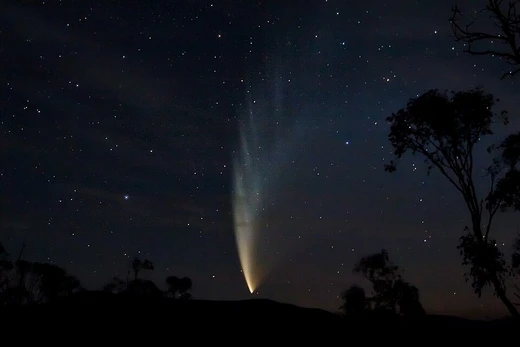
C/2024 G3 (ATLAS) is a non-periodic comet that partially broke apart after swinging past the Sun on 13 January 2025, coming within 0.09 AU (13 million km) of our star. Known as the Great Comet of 2025, it was the year's brightest, hitting an apparent magnitude of −3.8 at perihelion. Observers in the southern hemisphere could see it both before and after that closest approach, while those in the northern hemisphere only spotted it in the daytime sky around perihelion.
The comet was first spotted on 5 April 2024 by the Asteroid Terrestrial-impact Last Alert System (ATLAS) survey, using a 0.5-meter reflector telescope in Río Hurtado, Chile. At discovery, it was a faint magnitude 19 object, about 4.38 AU (655 million km) from Earth, with a diffuse coma roughly 4.5 arcseconds across and a straight tail. By 30 October 2024, it had brightened to magnitude 11.9, visible only through large telescopes. In mid-December, it reached 8th magnitude in Scorpius, appearing at dawn for southern and equatorial viewers. By month's end, it was magnitude 5 to 5.5, with a coma about two arcminutes wide and a tail up to 18 arcminutes long.
On 2 January 2025, Terry Lovejoy reported an outburst, estimating the comet at magnitude 3.7 photographically and 3.2 visually. The next day, it had brightened to magnitude 2–2.4, showing a nuclear shadow, a dark lane in the tail, and becoming barely visible to the naked eye. By 7 January, it was first magnitude with a tail roughly 20 arcminutes long. Cosmonaut Ivan Vagner photographed it from the International Space Station on 10 January, and astronaut Donald Pettit observed it from the station the following day. The comet entered the LASCO C3 coronagraph on SOHO on 11 January, remaining visible until 15 January. Predicting its peak brightness was extremely difficult, with estimates varying by more than 10 magnitudes; G. van Buitenen predicted −4, accounting for forward scattering, but at its brightest the comet was just 5 degrees from the Sun. It became bright enough to photograph in broad daylight and was reported visible to the naked eye in daylight, making it the fifth comet in a century to achieve this, after Skjellerup-Maristany (1927), Ikeya-Seki (1965), West (1976), and McNaught (2007). After perihelion, it headed south; at mid-northern latitudes, it sat low, only 2 degrees above the horizon at the end of civil twilight.
- Discovery date
- 5 April 2024
- Discovery survey
- Asteroid Terrestrial-impact Last Alert System (ATLAS)
- Discovery location
- Río Hurtado, Chile
- Discovery telescope
- 0.5-m reflector
- Perihelion date
- 13 January 2025
- Perihelion distance
- 0.09 AU (13 million km)
- Peak apparent magnitude
- −3.8
- Orbital period after perihelion
- about 600,000 years
Lore & Background
The comet was discovered by the ATLAS survey on 5 April 2024, in images obtained with a 0.5-m reflector telescope in Río Hurtado, Chile. At discovery it was a magnitude 19 object about 4.38 AU from Earth, with a diffuse coma about 4.5 arcseconds across and a straight tail. By 30 October 2024 it had brightened to magnitude 11.9, and by mid-December it was at 8th magnitude in Scorpius, visible at dawn in southern and equatorial regions. By the end of December its magnitude was between 5 and 5.5, with a coma about two arcminutes across and a tail up to 18 arcminutes long.
On 2 January 2025, Terry Lovejoy reported an outburst, estimating magnitude 3.7 photographically and 3.2 visually. By 3 January it had brightened to magnitude 2–2.4, with a nuclear shadow and dark lane in the tail. On 7 January it was first magnitude with a tail about 20 arcminutes long. It was photographed from the International Space Station on 10 January by cosmonaut Ivan Vagner and observed by astronaut Donald Pettit the next day. The comet entered the LASCO C3 coronograph on SOHO from 11 to 15 January. It became bright enough to photograph in broad daylight and was visible with the naked eye, making it the fifth comet in the last 100 years observed in daylight with the naked eye, joining Skjellerup-Maristany (1927), Ikeya-Seki (1965), West (1976), and McNaught (2007).
After perihelion the comet headed southwards. On 18 January its tail was reported 4 degrees long at magnitude −0.9. On 19 January, Hungarian astrophotographer Lionel Majzik reported a bright streamer within the tail while its head became less prominent, indicating possible disintegration. Reports of earlier fragmentation dated to 12 January; intense solar heating during perihelion likely caused jetting and outgassing leading to fragmentation. The comet retained its tail shape, becoming a 'headless' comet similar to Comet Lovejoy in 2011. John Bortle considered it the Great Comet of 2025 due to its brightness and night time appearance.
Reader's Guide
C/2024 G3 (ATLAS) is notable as the brightest comet of 2025, reaching apparent magnitude −3.8 at perihelion, and as the fifth comet in the last 100 years observed with the naked eye in daylight. Its discovery by the ATLAS survey in April 2024 and subsequent brightening were closely tracked by amateur and professional astronomers. The comet's partial disintegration after perihelion, reported by Lionel Majzik on 19 January 2025, added to its scientific interest, with fragmentation likely caused by intense solar heating. It is the first known Oort cloud comet observed to have a significant debris trail at perihelion, primarily due to sodium emission, and alongside C/2020 F3 (NEOWISE) it has the strongest measured NaI and KI emission lines of any comet at distances greater than 0.4 AU from the Sun since Ikeya–Seki in 1965. Its orbital period after the 2025 approach is about 600,000 years, according to JPL Horizons calculations. The comet was photographed from the International Space Station and featured in multiple NASA Astronomy Picture of the Day entries. Its legacy includes being a rare daylight comet and a subject of study for cometary fragmentation and sodium emission.
Did You Know?
- The comet was photographed from the International Space Station by cosmonaut Ivan Vagner on 10 January 2025 and observed by astronaut Donald Pettit the following day.
- After perihelion, the comet became 'headless' due to fragmentation, similar to Comet Lovejoy in 2011.
Frequently Asked Questions
What is C/2024 G3 (ATLAS)?
It is a non-periodic comet that made a single dramatic pass by the Sun in January 2025, earning the nickname 'Great Comet of 2025' for its extraordinary brightness. Unlike periodic comets, it will never return to the inner solar system.
Who discovered C/2024 G3 (ATLAS) and where?
The ATLAS survey network detected it on 5 April 2024 using a 0.5-metre reflector telescope at the Río Hurtado station in Chile. The survey was originally designed to hunt for near-Earth asteroids that might pose an impact threat.
Why is C/2024 G3 (ATLAS) called the 'Great Comet of 2025'?
It reached an apparent magnitude of −3.8 at perihelion, making it the brightest object in the sky that year and easily outshining everything except the Sun, Moon, and planets. That level of brilliance is what historically earns a comet the 'Great' designation.
What happened to C/2024 G3 (ATLAS) when it passed the Sun?
The comet swung to just 0.09 AU (about 13 million km) from the Sun on 13 January 2025 and partially shattered under the intense tidal and thermal stress. The disintegration actually made it even more spectacular to watch, as the debris spread into a longer, brighter tail.
Could I have seen C/2024 G3 (ATLAS) from my location?
Southern-hemisphere observers had the best luck, spotting the comet in the evening sky both before and after its January 2025 perihelion. Northern-hemisphere viewers could only catch it as a faint daytime object near the Sun around the time of closest approach.
More in Named Comets 1-24
Spotted an error? Know more?
Reader corrections go straight into our review queue. Suggest an edit · How this site is sourced