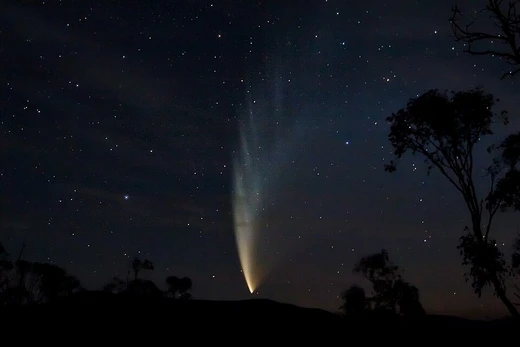
C/1845 L1 (Colla)
A great non-periodic comet visible to the naked eye in 1845.

C/1845 L1, called the Great June Comet of 1845 and Colla's Comet, is a bright non-periodic comet that was visible without a telescope from June into July 1845. It ranks among the few great comets on record.
Antonio Colla first reported the comet from Paris, France, on 2 June 1845, spotting it "near the head of Medusa" in Perseus. No position was recorded until George Phillips Bond noted it a day later. By then the comet was already nearly naked-eye visible, with a tail extending one degree to the north-northeast. Many observers saw it within an hour of Colla's sighting, describing its brightness as similar to the star Capella. In October 1845, after the comet had faded, the American Journal of Science reported a prediscovery observation from Norfolk, Virginia, made on 31 May 1845.
The comet was tracked worldwide throughout June 1845. Joseph S. Hubbard and John H. C. Coffin made the last observation on 2 July 1845, when the comet was in Cancer. Around that time, Augustin Reslhuber tried to find it but failed.
Heinrich d'Arrest calculated an elliptical orbit with a period of 250 years and noted a resemblance to C/1596 N1 (Brahe). That link was disproven in 1904, when Henry Allen Peck revised the orbital period to roughly 313,000 years. Further work by Richard L. Branham, Jr. in 2009 showed the comet was about 260 AU (39 billion km) from Earth in 1596. Branham also revised Peck's orbit into a hyperbolic trajectory, ruling out any chance of C/1845 L1 becoming a near-Earth object.
- Formal designation
- C/1845 L1
- Discoverer
- Antonio Colla
- Discovery date
- 2 June 1845
- Discovery location
- Paris, France
- Last observed date
- 2 July 1845
- Last observed by
- Joseph S. Hubbard and John H. C. Coffin
- Orbital period initial calculation
- 250 years (Heinrich d'Arrest, later disproven)
- Orbital period revised
- approximately 313000 years (Henry Allen Peck, 1904)
- Orbital trajectory revised
- hyperbolic (Richard L. Branham, Jr., 2009)
Lore & Background
Antonio Colla first reported the comet's discovery from Paris, France on 2 June 1845, situated near the head of Medusa in the constellation Perseus, though no position was recorded until George Phillips Bond noted it a day later. The comet was already almost visible to the naked eye, with a tail extending 1 degree to the north-northeast. Many observers saw it an hour after Colla's first sighting, reporting its brightness comparable to the star Capella. In October 1845, an issue of the American Journal of Science reported a prediscovery observation from Norfolk, Virginia on 31 May 1845.
The comet was observed globally throughout June 1845. It was last observed by Joseph S. Hubbard and John H. C. Coffin on 2 July 1845, while in the constellation Cancer. Around the same time, Augustin Reslhuber attempted to spot the comet but was unable to find it. Heinrich d'Arrest computed an elliptical orbit suggesting a 250-year period and noted similarity to C/1596 N1 (Brahe), but this was disproven in 1904 when Henry Allen Peck revised the orbital period to approximately 313000 years. Further calculations by Richard L. Branham, Jr. in 2009 showed the comet was about 260 AU from Earth in 1596 and revised the orbit into a hyperbolic trajectory, eliminating the possibility of it becoming a near-Earth object.
Reader's Guide
C/1845 L1 is notable as one of the few great comets in history, achieving naked-eye visibility for about a month. Its discovery by Antonio Colla in Paris and subsequent observations worldwide highlight the global interest in cometary astronomy in the mid-19th century. The comet's orbital calculations underwent significant revision: Heinrich d'Arrest's initial 250-year period and link to a 1596 comet were disproven by Henry Allen Peck in 1904, who calculated a period of approximately 313000 years. Richard L. Branham, Jr. further revised the orbit in 2009 to a hyperbolic trajectory, ruling out any future near-Earth approach. The prediscovery observation from Norfolk, Virginia on 31 May 1845, reported months later, adds to its historical record. The comet's legacy lies in its status as a great comet and the evolving understanding of its orbit, which shifted from periodic to hyperbolic, demonstrating the refinement of cometary science over more than a century.
Did You Know?
- The comet's brightness was compared to the star Capella by observers shortly after discovery.
- A prediscovery observation was made from Norfolk, Virginia on 31 May 1845.
- Richard L. Branham, Jr. revised the orbit to a hyperbolic trajectory in 2009.
The Discovery and First Light
The Great June Comet of 1845 first entered the record books on 2 June 1845, when Antonio Colla reported its presence from Paris, France. He placed it near the head of Medusa within the constellation Perseus, though no precise positional data was captured at that moment. That distinction fell to George Phillips Bond, who logged a formal position just one day later. Remarkably, the comet was already bordering naked-eye visibility at the time of its initial report, sporting a tail that stretched roughly one degree toward the north-northeast. Within an hour of Colla's sighting, numerous other observers across the region confirmed the object, describing its brilliance as rivaling that of the star Capella. The comet's story, however, stretches slightly further back than Colla's announcement. In October 1845, the American Journal of Science published a prediscovery observation made from Norfolk, Virginia, on 31 May 1845, indicating that the visitor had been detectable even before its formal discovery was credited.
A Month of Global Wonder
For the entirety of June 1845, C/1845 L1 commanded attention from stargazers around the world. The comet remained a prominent naked-eye object through the summer months, drawing observations from a wide range of locations. Its final confirmed sightings came on 2 July 1845, when Joseph S. Hubbard and John H. C. Coffin tracked it while it resided in the constellation Cancer. Around that same period, the observer Augustin Reslhuber made an attempt to locate the fading visitor but was unsuccessful, a testament to how rapidly the comet's brilliance was diminishing. The object's visibility window, spanning from June into early July, placed it among the most spectacular cometary appearances in recorded history. Despite the global excitement it generated, the comet's passage was brief, and by the time the American Journal of Science published its October issue containing the Norfolk prediscovery data, the bright visitor had long since vanished from the sky.
The Orbital Mystery
Understanding the true nature of C/1845 L1's orbit proved to be a multi-generational puzzle. Heinrich d'Arrest initially calculated an elliptical path, concluding the comet was a long-period visitor with a period of roughly 250 years. He even noted a striking resemblance between this object and the 1596 comet catalogued as C/1596 N1, known as Brahe's Comet. That connection, however, was shattered in 1904 when Henry Allen Peck reworked the numbers and stretched the orbital period to approximately 313,000 years, rendering any link to the sixteenth-century apparition untenable. The question was finally settled by Richard L. Branham Jr. in 2009. His calculations demonstrated that in 1596 the comet would have been roughly 260 astronomical units—about 39 billion kilometres—away from Earth, making a physical connection to Brahe's Comet impossible. Branham went further, reclassifying Peck's elliptical solution as a hyperbolic trajectory. This reclassification eliminated any prospect of C/1845 L1 ever returning as a near-Earth object, confirming it as a truly one-time visitor on a grand cosmic scale.
A Place Among the Greats
C/1845 L1 occupies a distinguished position in the pantheon of cometary history as one of the very few apparitions to earn the title of a great comet. Its designation as a bright non-periodic visitor, visible to the unaided eye between June and July 1845, set it apart from the countless fainter objects that cross the inner solar system each year. The comet carries the informal name Colla's Comet, a nod to Antonio Colla, the Paris-based astronomer whose report on 2 June 1845 secured him a place in the discovery credits. In the broader context of nineteenth-century cometary spectacle, it arrived just two years after the legendary Great Comet of 1843, making the mid-1840s an extraordinary era for naked-eye cometary displays. Today, the object's data is preserved in the JPL Small-Body Database, ensuring that future generations of astronomers can trace its hyperbolic path and appreciate the fleeting brilliance that once rivaled the star Capella in the summer sky of 1845.
Frequently Asked Questions
Who is C/1845 L1 (Colla)?
C/1845 L1, often called the Great June Comet of 1845, is a bright non-periodic comet that dazzled skywatchers from June into July 1845. It holds a place among the very few comets in recorded history to earn the 'great' designation for its exceptional brilliance.
Who discovered C/1845 L1 (Colla)?
Antonio Colla first reported the comet from Paris, France, on 2 June 1845, locating it near the constellation Perseus. No precise coordinates were logged at the moment of discovery, but George Phillips Bond recorded a position the following day, by which time the object was already close to naked-eye visibility.
How bright was C/1845 L1 (Colla)?
The comet was clearly visible to the unaided eye throughout June and into July 1845, displaying a tail that stretched roughly one degree toward the north-northeast. Numerous observers confirmed its brightness within just an hour of Colla's initial sighting, underscoring how spectacular it appeared.
Why is C/1845 L1 (Colla) important?
It belongs to the small handful of 'great comets' catalogued in astronomical history, making it a landmark event for 19th-century observers. The rapid spread of sightings across Europe and its sustained naked-eye visibility turned it into a widely shared public spectacle.
When was C/1845 L1 (Colla) last observed?
The comet's final recorded sighting came on 2 July 1845, made by Joseph S. Hubbard and John H. C. Coffin. After fading from view that month, it has never been detected again, consistent with its non-periodic trajectory.
More in Named Comets 1-24
Spotted an error? Know more?
Reader corrections go straight into our review queue. Suggest an edit · How this site is sourced