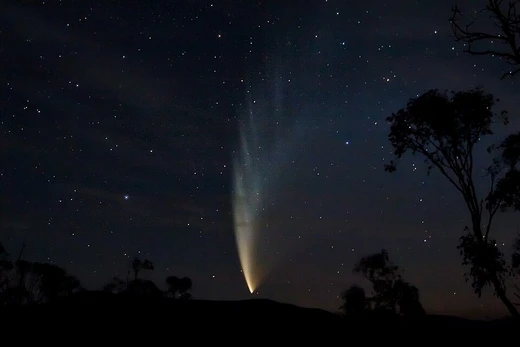
3I/ATLAS
Third confirmed interstellar object, discovered July 2025.

3I/ATLAS, designated C/2025 N1 (ATLAS) and originally A11pl3Z, is the third interstellar object confirmed to have entered the Solar System, following 1I/ʻOumuamua and 2I/Borisov. It was discovered on 1 July 2025 by the Asteroid Terrestrial-impact Last Alert System (ATLAS) station. The comet follows a hyperbolic, unbound path around the Sun and passed Earth at a safe distance of 1.8 AU.
The object is an active comet with a solid icy nucleus less than 1 km (0.62 mi) across, based on images from the Hubble Space Telescope and interplanetary spacecraft. Solar heating sublimates the ice into gas, which outgasses and lifts dust to form a coma. The James Webb Space Telescope found it unusually rich in carbon dioxide, with traces of water ice, water vapor, carbon monoxide, carbonyl sulfide, and methane. The Very Large Telescope detected cyanide gas and atomic nickel vapor at concentrations similar to Solar System comets.
3I/ATLAS reached solar conjunction on 21 October 2025 and its closest approach to the Sun on 29 October 2025, at 1.36 AU (203 million km; 126 million mi)—between the orbits of Earth and Mars. It likely originated from either the Milky Way's thin disk or thick disk; if from the thick disk, it could be at least 7 billion years old, older than the Solar System.
The comet was discovered at apparent magnitude 18, entering the inner Solar System at 61 km/s (140,000 mph; 220,000 km/h) relative to the Sun. It was then 3.50 AU from Earth and 4.51 AU from the Sun, moving along the border of Serpens Cauda and Sagittarius near the galactic plane. Initial observations suggested a highly eccentric path that might approach Earth, so the Minor Planet Center (MPC) placed it on the Near-Earth Object Confirmation Page until follow-up observations clarified its interstellar, hyperbolic trajectory. Pre-discovery observations from the Zwicky Transient Facility (28–29 June, 14–21 June 2025) and ATLAS (25–29 June 2025) confirmed this. Amateur astronomer Sam Deen noted additional ATLAS precoveries from 5–25 June 2025, and suspected the comet was missed earlier because it was passing in front of the Galactic Center's dense star fields.
Early reports were unclear whether the object was an asteroid or comet.
- Discovery date
- 1 July 2025
- Discovery site
- ATLAS survey telescope at Río Hurtado, Chile (observatory code W68)
- Interstellar designation
- 3I
- Perihelion date
- 29 October 2025
- Perihelion distance
- 1.36 AU (203 million km; 126 million mi)
- Closest approach to earth
- 1.8 AU
- Nucleus diameter
- less than 1 km (0.62 mi)
Lore & Background
3I/ATLAS was discovered on 1 July 2025 by the NASA-funded ATLAS survey telescope at Río Hurtado, Chile, at apparent magnitude 18. It was entering the inner Solar System at 61 km/s relative to the Sun, located 3.50 AU from Earth and 4.51 AU from the Sun, moving along the border of Serpens Cauda and Sagittarius. Initial observations suggested a highly eccentric path that might come close to Earth, leading the MPC to temporarily list it on the Near-Earth Object Confirmation Page. Follow-up observations revealed its interstellar, hyperbolic trajectory, confirmed by pre-discovery observations from ZTF and ATLAS. The comet came to solar conjunction on 21 October 2025 and reached perihelion on 29 October 2025 at 1.36 AU. It appears to have originated from either the Milky Way's thin disk or thick disk; if from the thick disk, it could be at least 7 billion years old—older than the Solar System.
The comet is active, consisting of a solid icy nucleus and a coma of gas and icy dust. Observations by the Hubble Space Telescope and various interplanetary spacecraft suggest its nucleus diameter is less than 1 km. JWST observations showed it is unusually rich in carbon dioxide, with small amounts of water ice, water vapor, carbon monoxide, carbonyl sulfide, and methane. The Very Large Telescope detected cyanide gas and atomic nickel vapor at concentrations similar to Solar System comets. Polarimetric observations revealed an unusually high degree of negative polarization at small phase angles, similar to trans-Neptunian objects, suggesting a coma of icy and dark material.
Reader's Guide
3I/ATLAS is significant as the third confirmed interstellar object, reinforcing that such visitors are not rare anomalies. Its discovery by the ATLAS survey on 1 July 2025, with pre-discovery observations extending back to May 2025, demonstrates the growing capability of sky surveys to detect fast-moving interstellar objects early. The comet's hyperbolic trajectory and origin from the Milky Way's thin or thick disk—potentially making it older than the Solar System—provide a rare sample of material from outside the Solar System. Its unusual carbon dioxide richness, detected by JWST, and the presence of cyanide and nickel at levels similar to Solar System comets, offer clues about interstellar chemistry. The comet's activity at 6.4 AU from the Sun, observed by TESS before discovery, indicates sublimation of volatile ices other than water. The extensive multi-observatory campaign—including Hubble, JWST, VLT, Rubin, and TESS—highlights the coordinated effort to characterize interstellar objects. Its legacy includes advancing understanding of interstellar material and refining detection methods for future such objects.
Did You Know?
- 3I/ATLAS is the third confirmed interstellar object, after 1I/ʻOumuamua and 2I/Borisov.
- The comet's nucleus diameter is less than 1 km (0.62 mi), as suggested by Hubble and spacecraft images.
- JWST observations showed 3I/ATLAS is unusually rich in carbon dioxide.
Discovery and Confirmation
3I/ATLAS first entered human awareness on 1 July 2025, when the ATLAS survey telescope at Río Hurtado, Chile, captured a faint object at apparent magnitude 18 near the border of Serpens Cauda and Sagittarius. The initial report sent to the Minor Planet Center raised alarm: early orbital calculations hinted the body might be on a highly eccentric path approaching Earth's orbit, prompting its temporary listing on the Near-Earth Object Confirmation Page. That concern dissolved quickly. Follow-up imaging from observatories worldwide, combined with pre-discovery frames from the Zwicky Transient Facility dating back to 14 June and ATLAS data from 25 June, revealed a hyperbolic trajectory unmistakably interstellar in character. Amateur astronomer Sam Deen later noted additional ATLAS precoveries stretching to 5 June, speculating the comet had been hidden by the dense star fields of the Galactic Center. On 2 July, the MPC officially confirmed the discovery, assigning the "3I" prefix to mark it as the third confirmed interstellar visitor after ʻOumuamua and Borisov, along with the non-periodic comet designation C/2025 N1 (ATLAS). By naming day, 122 observations from 31 observatories had already been logged.
Composition and Chemical Makeup
The James Webb Space Telescope delivered a striking chemical portrait of 3I/ATLAS: an unusually high abundance of carbon dioxide, accompanied by modest quantities of water ice, water vapor, carbon monoxide, carbonyl sulfide, and methane. The Very Large Telescope added two more surprises to the inventory—cyanide gas and atomic nickel vapor—both present at concentrations comparable to those measured in native Solar System comets. Hubble Space Telescope imagery and data from interplanetary spacecraft constrained the solid icy nucleus to a diameter of less than one kilometer. The coma, that glowing envelope of outgassed material and lifted dust, showed a distinctly reddish hue reminiscent of 2I/Borisov, and a study by Toni Santana-Ros and colleagues documented the reddening intensifying through July 2025 as solar heating drove increasing sublimation. Polarimetric measurements from the VLT, the Nordic Optical Telescope, and Rozhen Observatory revealed an unusually strong negative polarization at small phase angles, a signature the team linked to a coma composed of a blend of icy and dark material, echoing the optical properties of trans-Neptunian objects.
Trajectory and Cosmic Origin
Traveling at 61 kilometers per second relative to the Sun, 3I/ATLAS threaded through the inner Solar System on a hyperbolic, unbound path that guarantees it will never return. Its closest approach to Earth occurred at 1.8 AU, posing no impact risk whatsoever. The comet reached perihelion on 29 October 2025 at 1.36 AU, a distance between the orbits of Earth and Mars, after passing solar conjunction on 21 October. Perhaps the most tantalizing aspect of its trajectory is what it implies about the comet's birthplace. Dynamical analysis points to an origin in either the Milky Way's thin disk or its thick disk. If the thick-disk scenario holds, 3I/ATLAS could be at least seven billion years old, making it older than the Solar System itself. That would mean this small icy body has been drifting through the galactic interstellar medium for longer than our Sun has existed, carrying a chemical record of conditions in the early galaxy. Its discovery elevates the interstellar object catalog to three members, each a potential sample of a different stellar neighborhood.
The Global Observational Campaign
Within days of its discovery, 3I/ATLAS became the target of an extraordinary multi-instrument, multi-institution effort. David C. Jewitt and Jane Luu confirmed clear cometary activity with the Nordic Optical Telescope on 2 July, while Miguel R. Alarcón's team at Teide Observatory's Two-meter Twin Telescope reached the same conclusion independently. The Deep Random Survey, Lowell Discovery Telescope, and Canada–France–Hawaii Telescope all detected a marginal coma with a faint tail-like elongation of three arcseconds, settling the asteroid-versus-comet question. The newly commissioned Vera C. Rubin Observatory serendipitously captured the comet during its science validation runs from 21 June to 3 July, recording a slight growth in coma diameter and providing nucleus-size constraints; had those validation observations begun two weeks earlier, Rubin would have beaten ATLAS to the discovery. The Zwicky Transient Facility supplied precoveries stretching back to 22 May, and the Weizmann Astrophysical Observatory contributed an even earlier frame from 21 May. By the time the MPC finalized the designation, 31 observatories had contributed 122 observations, a testament to the speed and coordination of modern astronomical networks.
Frequently Asked Questions
Who is 3I/ATLAS?
3I/ATLAS (formally C/2025 N1) is the third interstellar object ever confirmed to pass through our Solar System, arriving after 1I/ʻOumuamua and 2I/Borisov. It is an active comet with a small icy nucleus under one kilometre wide, first detected by the ATLAS survey network in Chile.
What are 3I/ATLAS's powers/role?
As an interstellar comet, 3I/ATLAS carries material forged in another star system into our own, giving scientists a rare glimpse at chemistry that formed light-years away. As solar heating sublimates its icy surface, the object develops a visible coma and tail, behaving much like a typical Solar-System comet on a fly-by.
Why is 3I/ATLAS important?
With only three interstellar visitors confirmed to date, every detection sharpens our statistical picture of how common such objects are and what they reveal about planet formation elsewhere. Unlike the enigmatic ʻOumuamua, 3I/ATLAS shows clear cometary activity, making it a more straightforward benchmark for interstellar composition.
When and where was 3I/ATLAS discovered, and how close did it get to Earth?
The ATLAS station at Río Hurtado, Chile (observatory code W68) first spotted it on 1 July 2025. Its closest approach to Earth was roughly 1.8 AU, a distance well outside any danger threshold for our planet.
More in Named Comets 1-24
Spotted an error? Know more?
Reader corrections go straight into our review queue. Suggest an edit · How this site is sourced