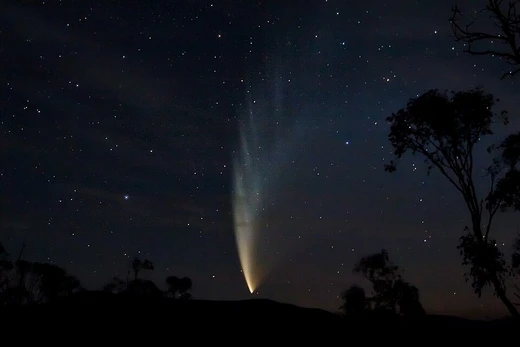
C/1989 W1 (Aarseth–Brewington)
Non-periodic comet discovered by two amateurs, peaked at magnitude 2.8.

C/1989 W1 (Aarseth–Brewington) is a non-periodic comet discovered independently on 16 November 1989 by Norwegian amateur astronomer Knut Aarseth and American amateur astronomer Howard Brewington. It is notable for reaching an apparent magnitude of 2.8 and being visible to the naked eye for several days in December 1989.
- Discovery date
- 16 November 1989
- Discoverers
- Knut Aarseth and Howard Brewington
- Type
- non-periodic comet
- Peak apparent magnitude
- 2.8
- Perihelion date
- 27.9 December 1989
- Closest approach to earth
- 0.94 AU on 26 December 1989
- Last observed
- 31 January 1990
Lore & Background
Norwegian amateur astronomer Knut B. Aarseth discovered a diffuse object near Iota Coronae Borealis on 16 November 1989 with his 14-cm reflector, estimating its magnitude at 8.5. American astronomer Howard J. Brewington found the comet independently a few hours later with his 40-cm reflector while searching from Sumter National Forest, South Carolina, in the Hercules constellation; this was his first discovery, and he determined the magnitude at about 9. The discovery was confirmed by several observers in the following days, including Mauro Zanotta on 18 November, who was unaware of the prior discoveries.
The comet upon discovery was located 49° from the Sun and moving southwards. It brightened to magnitude 7.5 by the end of November, with a tail reported up to one degree long. Most observations occurred in December as the comet approached Earth to 0.94 AU on 26 December, with perihelion on 27.9 December and minimum solar elongation of 18 degrees on 27 December. The comet brightened to magnitude 2.8 on 20 December and faded thereafter. Alan Hale reported naked-eye visibility on 18 December, and other observers reported naked-eye sightings until 29 December. The tail reached 2.7 degrees on 17 December, with both a dust tail and an ion tail reported.
The comet faded rapidly in January 1990, observed from the southern hemisphere after late 1989. It reached its southernmost declination of -46° on 8 January 1990, and by the end of January its apparent magnitude was about 9. It was last seen on 31 January 1990.
Reader's Guide
C/1989 W1 (Aarseth–Brewington) is significant as a non-periodic comet discovered independently by two amateur astronomers on the same day, highlighting the role of dedicated amateurs in comet hunting. Its peak brightness of magnitude 2.8 and naked-eye visibility from 18 to 29 December 1989 made it a notable event for observers. The comet's dual tails—dust and ion—were documented, and its rapid fading after perihelion and shift to southern hemisphere skies illustrate typical behavior for such comets. The discovery also marked Howard Brewington's first comet find, and the comet's naming includes both discoverers, with a later independent sighting by Mauro Zanotta. The comet's legacy lies in its well-observed passage, providing data on brightness evolution and tail structure, and it remains a reference point for amateur comet discoveries in the late 20th century.
Did You Know?
- The comet was discovered independently by two amateur astronomers on the same day: Knut Aarseth in Norway and Howard Brewington in the United States.
- It reached a peak apparent magnitude of 2.8 on 20 December 1989.
- The comet displayed both a dust tail and an ion tail, with the tail reaching 2.7 degrees in length on 17 December.
- It was last observed on 31 January 1990.
Independent Discovery and Observation Window
Zanotta–Brewington, carrying the formal designation C/1991 Y1, entered the attention of the astronomical community during the winter of 1991. What made its discovery noteworthy was the fact that two separate observers—Mauro V. Zanotta and Howard J. Brewington—identified the object independently, each arriving at the same conclusion without coordination. The comet was not spotted through casual sky-watching but rather through dedicated telescopic observation, a method that suited its modest brightness. The window during which the object could be tracked telescopically stretched from December 1991 through May 1992, giving the astronomical community roughly six months of data to work with. As a non-periodic comet, it carried no expectation of returning on a short cycle, meaning that this brief observing season represented essentially the entire opportunity to study it in the foreseeable future. The dual-credit naming convention honors both discoverers equally, a tradition that underscores the collaborative spirit of modern comet detection even when the initial sightings were made separately.
Spectroscopic Fingerprint and Gas Production
Photometric investigations carried out at the La Silla Observatory provided a quantitative picture of how vigorously Zanotta–Brewington outgassed near its closest approach to the Sun. At perihelion, the comet's gas production rate reached approximately 110 × 10²¹ molecules per second per square centimeter, a figure that placed it well above the output of the periodic comet 4P/Faye, a useful benchmark in the field. However, the activity was not sustained indefinitely; cyanogen emission, a key tracer of cometary chemistry, had already declined noticeably by March 1992. A more nuanced comparison emerged when CCD spectroscopy was used to measure the comet at heliocentric distances between 0.64 and 0.72 AU, roughly 96 to 108 million kilometers from the Sun. At that range, researchers compared its molecular ratios with those of C/1991 X2 (Mueller), another long-period visitor. The ammonia-to-water ratio proved identical in both objects, yet the cyanogen-to-water ratio in Zanotta–Brewington came in at roughly half the value recorded for Mueller, hinting at subtle differences in the volatile inventory carried by these two dynamically new visitors.
Orbital Architecture and Oort Cloud Origins
The orbital picture for Zanotta–Brewington was not fully resolved until September 1993, when Brian G. Marsden published a calculation that encompassed the comet's entire 130-day observation arc. His analysis revealed a trajectory with a subtle but important signature: during the inbound leg, the comet's path was weakly hyperbolic, meaning it was technically not gravitationally bound to the Sun at the moment of arrival. This characteristic is the hallmark of a dynamically new comet, one that has never previously completed a full orbit around the Sun and therefore originated in the distant Oort cloud. The story changed, however, after perihelion passage. As the comet traveled outward, the gravitational tugs of the giant planets acted to reduce its relative velocity just enough to flip the trajectory from hyperbolic to a closed, albeit extremely elongated, ellipse. The resulting orbital period stretches to approximately 27,000 years, a timescale that confirms the object's deep reservoir origin while also ensuring that no human generation will witness its return.
A Comet Among Peers
Zanotta–Brewington occupies a meaningful niche within the broader family of long-period comets, and its scientific value is amplified by the comparisons drawn to its contemporaries. Its gas production rate was benchmarked against 4P/Faye, a well-studied periodic object, establishing a clear contrast between the energetic outgassing of a fresh Oort cloud visitor and the more muted activity of a comet that has made many prior passages. The spectroscopic comparison with C/1991 X2 (Mueller) added another layer, revealing that while both comets shared an identical ammonia-to-water ratio at similar heliocentric distances, their cyanogen signatures diverged by a factor of two. The name Brewington also links this comet to 97P/Metcalf–Brewington, a periodic object sharing one of its discoverers, and to C/1989 W1 (Aarseth–Brewington), another long-period visitor. These connections, catalogued in resources such as the JPL Small-Body Database, remind us that even a single six-month observing window can anchor a comet within a rich web of comparative science.
Frequently Asked Questions
Who is C/1989 W1 (Aarseth–Brewington)?
It is a long-period comet independently spotted on 16 November 1989 by Norwegian amateur Knut Aarseth and American amateur Howard Brewington. Because both observers made the discovery on the same night, the comet carries both of their surnames.
How bright did C/1989 W1 (Aarseth–Brewington) appear to the naked eye?
The comet peaked at an apparent magnitude of 2.8, bright enough to be seen without any optical aid. It stayed visible to unaided observers for several days around late December 1989.
When was C/1989 W1 (Aarseth–Brewington) closest to Earth and the Sun?
It passed 0.94 AU from Earth on 26 December 1989, and reached perihelion roughly a day later on 27.9 December 1989. That tight window is what produced the brief naked-eye display.
Why do comet fans consider C/1989 W1 (Aarseth–Brewington) special?
It is a rare case of a non-periodic comet that became a genuine public spectacle rather than a faint smudge in a telescope. The dual-amateur discovery by two observers in different countries also gives it a beloved 'grassroots' story in the community.
Will C/1989 W1 (Aarseth–Brewington) come back on a short cycle?
No; it is classified as a non-periodic comet, so it does not return on a brief, predictable interval like Halley. Its elongated orbit means the next visit, if it returns at all, would be many centuries away.
More in Named Comets 1-24
Spotted an error? Know more?
Reader corrections go straight into our review queue. Suggest an edit · How this site is sourced