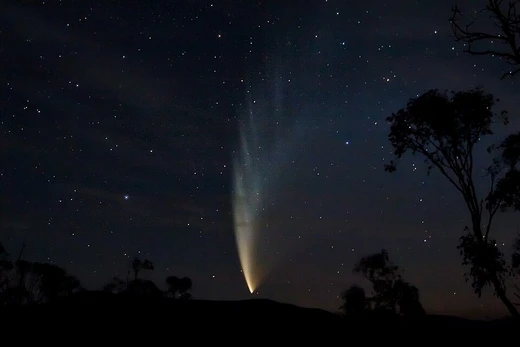
Comet Arend–Roland
A hyperbolic comet discovered in 1956, never to return.

Comet Arend–Roland was first spotted on November 6, 1956, by Belgian astronomers Sylvain Arend and Georges Roland, who caught it on photographic plates at the Uccle Observatory in Brussels. It was the eighth comet found that year, earning the temporary name Arend–Roland 1956h. After becoming the third comet to reach perihelion in 1957, it was reclassified as 1957 III, and later given the permanent designation C/1956 R1 (Arend–Roland). The "C/" marks it as a non-periodic comet, while "R1" indicates it was the first comet reported in the half-month period from September 1 to 15.
At discovery, the comet shone at magnitude 10 with a bright central core and a short tail. Its early detection gave astronomers time to prepare observation programs. Michael Philip Candy calculated its orbit, predicting perihelion on April 8, 1957, and forecasting a bright display in the northern hemisphere. In early December 1956, the comet was 2.5 AU from the Sun and 1.7 AU from Earth, remaining in Pisces until February, when it reached magnitude 7.5–8.
During its April perihelion, the comet’s tail stretched 15° across the sky. Its appearance shifted: streamers appeared on April 16 and May 5, and the tail split into three beams on April 29. By April 22, a prominent antitail spanning 5° had emerged, extending to 12° by April 25 before vanishing on April 29. After perihelion, the comet faded rapidly from its peak brightness of magnitude –1. On May 1, it measured magnitude 5.46; by May 8, it had dimmed to magnitude 7, beyond naked-eye visibility; and on May 29, it dropped to magnitude 8.55.
This comet was the first target for radio-frequency detection attempts, but none succeeded—no comet would be detected in radio until Kohoutek in 1973. It also featured on the debut episode of the BBC’s *The Sky at Night* on April 24, 1957. Astronomer Carl Sagan recalled in his 1980 book *Cosmos* a late-night call in 1957 from a tipsy man near Chicago asking about a "fuzzy thing" in the sky. Sagan explained it was a comet—"a snowball, one mile wide." After a long pause, the man replied, "Lemme talk to a real 'shtronomer!"
The comet followed a hyperbolic orbit, meaning it was moving fast enough to escape the solar system forever.
- Discovery date
- November 6, 1956
- Discoverers
- Sylvain Arend and Georges Roland
- Discovery location
- Uccle Observatory, Brussels
- Perihelion date
- April 8, 1957
- Maximum brightness
- magnitude −1
- Tail length at perihelion
- 15° of arc
- Antitail maximum extent
- 12° on April 25, 1957
Lore & Background
Comet Arend–Roland was discovered on photographic plates during routine investigation of minor planets. At discovery it was at visual magnitude 10 with a strong central condensation and a short tail. Orbital elements computed by Michael Philip Candy predicted perihelion passage on 8 April 1957. The comet was in the constellation Pisces until February, when it reached magnitude 7.5–8. During the April perihelion passage, the tail reached a length of 15° of arc, with streamers on April 16 and May 5, and the tail splitting into three beams on April 29. By April 22 the comet displayed a prominent anomalous tail (antitail) spanning 5°, which stretched to 12° on April 25 before disappearing by 29 April. Following perihelion, the comet faded rapidly from its maximal brightness of magnitude −1; by 8 May it had decreased to magnitude 7, and on 29 May it had dropped to magnitude 8.55. It was traveling on a hyperbolic orbit, fast enough to escape the Solar System entirely, implying it will never be seen again by earthbound observers. Observations over 520 days allowed precise orbital elements, but a wavy pattern suggested a non-gravitational influence; alternatively, the comet may have originated from interstellar space rather than from the Oort cloud.
Reader's Guide
Comet Arend–Roland holds significance as the first comet for which attempts were made to detect it at various radio frequencies, though these efforts were unsuccessful; no comets were successfully detected in the radio band until the 1973 passage of comet Kohoutek. It was also the subject of the first edition of the BBC's astronomy program The Sky at Night on 24 April 1957. Astronomer Carl Sagan relates an anecdote in his 1980 book Cosmos about a late-night phone call from an inebriated man who asked about the 'fuzzy thing' in the sky; Sagan told him it was a comet and described it as 'a snowball, one mile wide.' The comet's hyperbolic orbit indicates it will never return. At perihelion, it was emitting an estimated 7.5 × 10⁴ kg/s of dust and releasing roughly 1.5 × 10³⁰ gas molecules per second. An outburst of dust likely occurred on April 2, six days before perihelion. The antitail was formed from particles released between February 6 and 1 March 1957. Estimates of total dust released into the zodiacal cloud range from 3 × 10⁸ to 5 × 10¹⁰ kg.
Did You Know?
- Comet Arend–Roland was the eighth comet discovered in 1956.
- It was the first comet for which attempts were made to detect it at radio frequencies, though these were unsuccessful.
- Astronomer Carl Sagan recounted a phone call about this comet in his 1980 book Cosmos.
Discovery and the Naming Conventions
On the night of November 6, 1956, Belgian astronomers Sylvain Arend and Georges Roland were conducting routine minor-planet surveys with a double astrograph at the Uccle Observatory in Brussels when a faint object appeared on their photographic plates. The newcomer, then at visual magnitude 10, showed a strong central condensation and a short tail. Because it was the eighth comet identified that year, it was initially catalogued as Arend–Roland 1956h. Once it became the third body to reach perihelion in 1957, the designation shifted to 1957 III, and it ultimately received the standard IAU label C/1956 R1 (Arend–Roland). The "C/" prefix marks it as a non-periodic visitor, while "R1" indicates it was the first comet reported in the half-month window covering September 1 through 15. Michael Philip Candy computed the orbital elements and predicted perihelion for April 8, 1957, noting the object was already well developed and would likely produce a prominent display for northern-hemisphere observers. The early November discovery gave the astronomical community a full five months to prepare equipment and observing programs.
The April 1957 Spectacle
The perihelion passage on April 8, 1957, delivered one of the most visually dramatic comet displays of the mid-twentieth century. At its peak the comet blazed at magnitude −1, easily visible to the naked eye, and its tail stretched a remarkable 15 degrees of arc across the sky. The structure of that tail was anything but static: observers recorded streamers on April 16 and again on May 5, and on April 29 the tail split into three distinct beams. Perhaps the most striking feature was the anomalous tail, or antitail, which first became prominent by April 22 and spanned five degrees. It reached its maximal extent of twelve degrees on April 25 before vanishing entirely by April 29. After perihelion the comet faded with astonishing speed. By the first of May its brightness had dropped to magnitude 5.46, by May 8 it had slipped to magnitude 7—just past the threshold of unaided vision—and by May 29 it had dimmed to magnitude 8.55. In early December, before perihelion, the comet had been 2.5 AU from the Sun and 1.7 AU from Earth, lingering in the constellation Pisces until February when it brightened to magnitude 7.5–8.
Scientific Firsts and Cultural Resonance
Arend–Roland holds a unique place in the history of observational astronomy as the first comet for which scientists attempted detection at radio frequencies. Those early efforts proved unsuccessful, and no comet would be confirmed in the radio band until the 1973 apparition of Kohoutek. The comet also captured public attention in a landmark cultural moment: on April 24, 1957, it was the subject of the very first episode of the BBC's long-running astronomy programme The Sky at Night. The object's brief but brilliant appearance even inspired a memorable anecdote recounted by Carl Sagan in his 1980 book Cosmos. Sagan described being on duty at an observatory near Chicago in 1957 when a late-night phone call came from an inebriated man asking about the "fuzzy thing" he could see in the sky. Sagan identified it as a comet and, when asked what a comet was, described it as "a snowball, one mile wide." After a long pause, the caller reportedly replied, "Lemme talk to a real 'shtronomer!"
Orbital Fate and Physical Composition
Arend–Roland traveled on a hyperbolic orbit, meaning it was moving fast enough to escape the Solar System entirely and will never return to be observed from Earth. Observations spanning 520 days allowed astronomers to compute precise orbital elements, yet the distribution of those elements revealed a wavy pattern that pointed to a non-gravitational influence on the comet's trajectory. One interpretation is that the object originated not from the Oort cloud but from interstellar space. When orbital solutions incorporate non-gravitational forces that vary as the inverse square of heliocentric distance, somewhat different values emerge, as documented in Marsden's 1970 analysis. Physically, the comet was extraordinarily active near perihelion, ejecting an estimated 7.5 × 10⁴ kilograms of dust per second—roughly 83 tons—and releasing approximately 1.5 × 10³⁰ gas molecules each second. A dust outburst occurred on April 2, six days before perihelion, and the antitail was produced by particles shed between February 6 and March 1, 1957. Estimates of total dust deposited into the zodiacal cloud range from 3 × 10⁸ to 5 × 10¹⁰ kilograms.
Frequently Asked Questions
Who found Comet Arend–Roland and where was it spotted?
Belgian astronomers Sylvain Arend and Georges Roland caught it on photographic plates at the Uccle Observatory in Brussels on November 6, 1956. It was the eighth comet identified that calendar year, earning the temporary label Arend–Roland 1956h.
What does the 'C/' prefix in C/1956 R1 actually tell us?
The 'C/' flag marks the object as a non-periodic comet, meaning its orbit is too elongated or hyperbolic for it to be expected to swing back around the Sun on a predictable cycle. In this case, its hyperbolic trajectory confirmed it was a one-time visitor.
How impressive was Comet Arend–Roland at its brightest?
It peaked at magnitude −1, making it visible to the naked eye well beyond twilight. At perihelion on April 8, 1957, its tail stretched roughly 15 degrees of arc across the sky.
Will Comet Arend–Roland ever return to the inner solar system?
No—its orbit is hyperbolic, so it carries enough excess velocity to escape the Sun's gravity permanently. It will never swing back around to be seen again.
What does the 'R1' in its permanent designation refer to?
The 'R1' code simply means it was the first comet reported during the half-month window from September 1 to 15 of the year it was catalogued. It is an administrative reporting slot, not a physical property of the comet itself.
More in Named Comets 1-24
Spotted an error? Know more?
Reader corrections go straight into our review queue. Suggest an edit · How this site is sourced