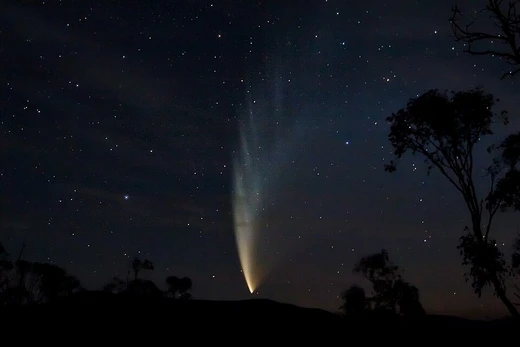
96P sungrazer family
Rarest SOHO comet group, fragments of 96P/Machholz.

The 96P sungrazer family is a rare grouping of sungrazing comets that all come from the parent comet 96P/Machholz. This family makes up only 3% of all objects recorded by SOHO, making it the rarest type observed by the probe. It can only be seen using CCOR coronagraphs and LASCO. The family consists of three subgroups: Marsden, Kracht, and Kracht II.
The group is thought to be made up of fragments that broke away from 96P/Machholz between 800 and 1,200 years ago. Their orbits closely resemble that of the parent comet, though they have slightly different gravitational interactions with Jupiter, as well as a lower perihelion distance and inclination. The Marsden subgroup was discovered by British astronomer Brian G. Marsden and announced on 18 February 2002, at the same time as the Meyer group. Rainer Kracht discovered the Kracht I and II subgroups in 2002 after analyzing orbits and finding similarities between a pair of comets.
These comets have an average orbital period of about six years and often appear in clusters of two or more, arriving within days of each other. Their peak brightness usually occurs a few hours after perihelion, with apparent magnitudes typically between 7 and 8, though the brightest can reach magnitude 5. Fragmentation happens during close passes to the Sun, creating smaller objects. The 96P complex is likely to become extinct in the near future. Their sizes are not well known, but they are probably larger than Kreutz group comets, which are typically several meters to a few decameters wide. The 5000th comet observed by SOHO belonged to the Marsden group and was discovered on 25 March 2024.
- Subgroups
- Marsden, Kracht, Kracht II
- Percentage of soho objects
- 3%
- Discovery date of marsden group
- 18 February 2002
- Discoverer of marsden group
- Brian G. Marsden
- Discoverer of kracht i and ii
- Rainer Kracht
- Year of kracht discovery
- 2002
- Average orbital period
- 6 years
- Typical apparent magnitude range
- 7 to 8
- Brightest apparent magnitude
- 5
Lore & Background
The 96P sungrazer family is suggested to be composed of fragments that detached from the parent comet 96P/Machholz about 800 to 1,200 years ago. Their orbit is very similar to the parent body, with slightly different gravitational contacts with Jupiter and lower perihelion distance as well as inclination. The Marsden subgroup was discovered by British astronomer Brian G. Marsden and announced on 18 February 2002, while Kracht I and II were discovered by Rainer Kracht in 2002 after analyzing orbits and finding similarities between a pair of comets.
These objects show up at intervals averaging around 6 years, their approximate orbital period. They are often observed in clusters of two or more objects, appearing within a few days after each other. Peak brightness typically occurs a few hours after perihelion, and the apparent magnitude typically ranges from 7 to 8, although the brightest can reach magnitude 5. During passage near the Sun, fragmentation takes place, creating smaller objects, and the 96P complex will likely become extinct in the near future.
The size range is not well known, but they are probably larger than Kreutz group comets, which are usually several meters to a few decameters wide. The 5000th comet observed by SOHO belongs to the Marsden group and was discovered on 25 March 2024.
Reader's Guide
The 96P sungrazer family holds significance as the rarest group among all comets recorded by SOHO, accounting for only 3% of the total. Its origin as fragments of 96P/Machholz, detached 800 to 1,200 years ago, provides insight into the breakup and evolution of sungrazing comets. The family is divided into three subgroups—Marsden, Kracht, and Kracht II—each discovered in 2002 by Brian G. Marsden and Rainer Kracht, respectively. These comets are observed exclusively by CCOR coronographs and LASCO, and their approximate 6-year orbital period leads to clustered appearances. The 5000th SOHO comet, discovered on 25 March 2024, belongs to the Marsden group, marking a milestone in solar observation. The family's tendency to fragment during solar passages and its likely extinction in the near future underscore the dynamic and transient nature of such comet groups. Their size, though poorly constrained, is thought to exceed that of Kreutz group comets, adding to their distinctiveness.
Did You Know?
- The 96P sungrazer family comprises only 3% of all objects recorded by SOHO.
- The Marsden subgroup was announced on 18 February 2002 by Brian G. Marsden.
- These comets are only observed by CCOR coronographs and LASCO.
Orbital Architecture and Physical Composition
These comets trace among the most extreme paths in the Solar System. Their orbital eccentricity approaches unity, making their trajectories nearly parabolic rather than circular. They swing out to roughly one hundred astronomical units—about fifteen billion kilometres—before plunging back inward to a perihelion closer than the Sun's own diameter. Orbital inclinations of 139 to 144 degrees effectively prevent any close gravitational interaction with the major planets, and a full circuit takes somewhere between five and ten centuries.
The nuclei are modest in size, most measuring under one hundred metres across, though the brightest specimens reach one to ten kilometres. They possess irregular shapes and appear diffuse, star-like, or faintly tailed. Internal material is structurally weak, and volatile concentrations are sparse. Because most ices were shed during earlier solar passages, these comets remain largely inert until they approach within ten to fifteen solar radii of the Sun, where intense heating triggers a brief brightening. Exposed mineral grains—olivine and pyroxene—evaporate and form dust tails that linger in the solar corona, interacting with the Sun's magnetic field. Repeated passages steadily erode each member's orbit.
From Mystery to Family: The Historical Identification
For centuries, astronomers puzzled over a series of brilliant comets that appeared near the Sun with striking regularity. The Great Comet of 1680 was the first whose orbit was recognized as passing extremely close to the solar surface, roughly 235,000 kilometres above it. Edmond Halley and his contemporaries speculated it might be a return of a bright comet recorded in 1106. When the Great Comet of 1843 appeared, some wondered whether it was the same body, even though orbital calculations suggested a period of several centuries.
The breakthrough came in 1880, when a comet was found travelling on an almost identical orbit to that of 1843, followed by the Great Comet of 1882 on yet another matching path. The idea that these were all fragments of a single shattered giant gained strong support when the 1882 comet visibly broke into multiple pieces after its perihelion passage. In 1888, German astronomer Heinrich Kreutz published a paper demonstrating that the 1843, 1880, and 1882 comets were almost certainly debris from one progenitor that had disintegrated several orbits earlier. The 1680 comet, it turned out, was a sungrazer but not a member of this particular family.
Spectacular Appearances Across the Centuries
The brightest Kreutz sungrazers have produced some of the most dramatic sky events in recorded history. The Great Comet of 1843, the Great Comet of 1882, and a comet observed in 1106 stand as the three most impressive members, all easily visible in the daytime sky. The progenitor of the entire family may have been the Great Comet of 371 BC, though comets seen in 214 BC, 423 AD, and 467 AD are also candidates.
In the modern era, Comet Ikeya–Seki of 1965 stands out as perhaps the most famous member. It became extremely bright—possibly one of the brightest comets in the preceding millennium—and then shattered into three fragments after its perihelion passage. The Great Southern Comet of 1887 passed a mere 27,000 kilometres above the solar surface. Other notable appearances include the Eclipse Comet of 1882, C/2005 S1 (described as one of the best-observed Kreutz sungrazers), and various historical sightings recorded in China, Japan, Korea, Russia, and Egypt. The appearance of two Kreutz sungrazers in quick succession in the 1960s—Pereyra in 1963 and Ikeya–Seki in 1965—sparked renewed scientific interest in the group's dynamics.
The SOHO Era and the Question of Survival
The launch of the SOHO satellite in 1995 transformed our understanding of the Kreutz family. Since then, more than five thousand members have been catalogued, revealing that the group is far larger and more active than earlier records suggested. Yet a sobering pattern has emerged: none of these smaller, newly discovered comets have survived their perihelion passage. Only the larger bodies, such as the Great Comet of 1843 and C/2011 W3 (Lovejoy), have endured the extreme heating of a close solar approach.
Amateur astronomers have played a surprisingly vital role in the modern era, successfully identifying Kreutz comets from real-time data streams available over the internet. Recent discoveries include C/2024 S1 (ATLAS), which disintegrated in October 2024, and C/2026 A1 (MAPS), expected to reach perihelion on 4 April 2026. Looking ahead, researchers have suggested that another cluster of bright Kreutz-system comets may begin arriving in the inner Solar System within the next few decades, offering the possibility of another spectacular daytime display.
Frequently Asked Questions
What is the 96P sungrazer family?
It is a small cluster of sungrazing comets that all broke away from the parent body 96P/Machholz roughly 800 to 1,200 years ago. Their orbital paths closely mirror those of the original comet, tying them together as a single family.
How was the 96P sungrazer family discovered?
Brian G. Marsden identified the Marsden subgroup on 18 February 2002, and Rainer Kracht spotted the Kracht I and Kracht II subgroups that same year. All three groups were detected using SOHO's coronagraphic instruments.
Why is the 96P sungrazer family the rarest group seen by SOHO?
Members of this family make up only about 3% of every object the probe has catalogued, far below any other sungrazer population. They are also exclusively visible through CCOR coronagraphs and LASCO, which limits how often they can be caught.
What subgroups make up the 96P sungrazer family?
The family is split into three distinct subgroups: Marsden, Kracht, and Kracht II. Each was identified by a different discoverer during 2002 observations.
How do 96P sungrazer comets differ from their parent comet 96P/Machholz?
Although their orbits closely resemble the parent's, the fragments undergo slightly different gravitational interactions with Jupiter over time. That subtle divergence is what gradually separates their paths from the original comet's trajectory.
More in Named Comets 1-24
Spotted an error? Know more?
Reader corrections go straight into our review queue. Suggest an edit · How this site is sourced