Comet of 841–842
A ninth-century comet recorded across Eurasia during a Frankish civil war.

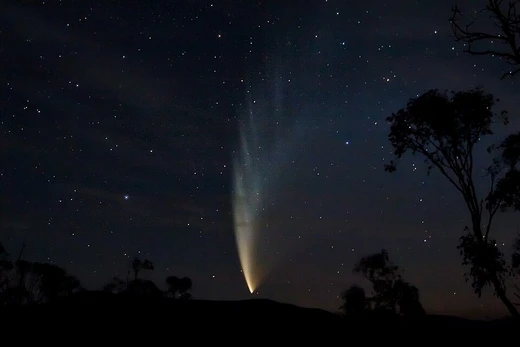
Comet X/841 Y1, known as the Comet of Nithard, was observed in both China and Europe from December 841 through February 842. Its appearance was recorded by the Japanese monk Ennin, who was staying in Chang'an, and the Frankish historian Nithard, placing observers at opposite ends of Eurasia. Several other Chinese and European sources also mention it. The comet first appeared around the winter solstice in the constellation Piscis Austrinus, near the star Fomalhaut, low in the southwestern sky. It vanished nearly two months later in Camelopardalis. Because it coincided with a Frankish civil war, many European accounts treat it as an ominous sign.
Ennin noted in his diary that the comet appeared during the winter solstice festival on 17 December, and that it "gradually grew larger" over the following days. He recorded that officials ordered monasteries to read scriptures, and that the comet "gradually disappeared" from 23 January 842. The *Zoku Nihon goki* mentions the comet on 22 December and again on 6 January. Three Chinese histories—the *Jiu Tangshu* (945), *Tang Huiyao* (961), and *Xin Tangshu* (1060)—report a "broom star" on 22 December 841 (Huichang era). It later moved into the constellation Shi and then the Zigong enclosure, and "went out of sight" after 56 days on 9 February 842. The *Wenxian Tongkao* of Ma Duanlin also catalogs it. The Japanese *Dai Nihonshi* (1715) states: "On the sixth day in the 11th month of the eighth year of the Shōwa reign-period a comet appeared lasting until the 26th day." This would mean the comet was visible from 22 December to 11 January, vanishing a month earlier in Japan than in China. Some scholars suggest the text may have originally said the 26th day of the 12th month, which would match Ennin's data.
Nithard, writing around 843 in his *Four Books of Histories*, records the comet from December 841 to February 842. It disappeared after the "conference of dignitaries"—the meeting between Kings Charles the Bald and Louis the German where they swore the Oaths of Strasbourg on 14 February. Nithard describes its path: it "ascended through Pisces at the center, and disappeared after the end of this meeting between the constellation which is called Lyra by some and Andromeda by others and the darker Arcturus." It likely passed through Andromeda rather than Lyra.
- First recorded appearance
- 17 December 841 (Ennin's diary)
- Last recorded disappearance
- 9 February 842 (Chinese sources, after 56 days)
- Constellations traversed
- Piscis Austrinus, Aquarius, Pisces, Andromeda, Perseus, Camelopardalis
- Maximum apparent magnitude
- Slightly less than 1 (between about 30 December and 5 January)
- Key observers
- Ennin (Japanese monk in Chang'an), Nithard (Frankish historian)
- Notable contemporary event
- Frankish civil war; Oaths of Strasbourg on 14 February 842
Lore & Background
The comet appeared around the winter solstice of 841 in the constellation Piscis Austrinus, near the star Fomalhaut, low in the southwest sky. It was observed in China and Europe for nearly two months, moving through Aquarius, Pisces, Andromeda, Perseus, and Camelopardalis before disappearing. The Japanese monk Ennin, staying in Chang'an, recorded its appearance on 17 December, noting that it gradually grew larger and that officials ordered monasteries to read scriptures. He recorded its gradual disappearance from 23 January 842. It 'went out of sight' after 56 days on 9 February 842. It disappeared after the 'conference of dignitaries', that is, the meeting between Kings Charles the Bald and Louis the German whereat they swore the Oaths of Strasbourg on 14 February. It 'went out of sight' after 56 days on 9 February 842.
Reader's Guide
The Comet of 841–842 is significant as a well-documented early medieval comet observed from both East Asia and Europe, providing a rare cross-cultural record of a celestial event. Its conventional designation X/841 Y1 indicates that while well-documented, it lacks enough information for a reliable orbital calculation. Modern astronomers Piero Sicoli, Marilina Cesario, and Roberto Gorelli have attempted to approximate its orbit, tracing its path through Piscis Austrinus, Aquarius, Pisces, Andromeda, Perseus, and Camelopardalis. They reject the view that the comet entered Pegasus, interpreting Chinese references to Shi as indicating celestial longitude.
The comet's legacy lies partly in its association with the Frankish civil war, where it was interpreted as an omen in European sources, reflecting classical influences such as Virgil's Georgics. No clear reference to the comet has been found in Islamic world sources, though historian David Cook has tentatively linked a rebellion in Palestine in early 842 to its appearance. It has also been suggested that comets reported for 20 March 840 and July–August 841 in Chinese histories may be erroneously catalogued doublets of this comet. The comet's maximum apparent magnitude, slightly less than 1, indicates it was a bright object visible to the naked eye.
Did You Know?
- The Japanese monk Ennin recorded the comet while staying in the Chinese city of Chang'an.
- The comet disappeared after the Oaths of Strasbourg, sworn on 14 February 842 between Charles the Bald and Louis the German.
- Chinese histories record the comet as a 'broom star' that appeared next to the star Fomalhaut.
- No clear reference to this comet has been found in sources from the Islamic world.
A Celestial Event Spanning Two Civilizations
The Comet of 841–842 stands out in medieval astronomy because it was independently witnessed and recorded across the full breadth of Eurasia, from the Chinese capital to the Frankish heartlands. In Chang'an, the Japanese monk Ennin noted the comet during the winter solstice festival of 17 December 841, observing that it grew larger over the following days and that officials ordered monasteries to recite scriptures. Three separate Chinese dynastic histories—the Jiu Tangshu, Tang Huiyao, and Xin Tangshu—each logged a "broom star" appearing beside Fomalhaut on 22 December. In the Frankish world, the historian Nithard composed his Four Books of Histories around 843, describing the comet's passage in considerable detail. Additional European witnesses include Florus of Lyon, the Annales Fuldenses, the Annales Fontanellenses, the Annales Xantenses, and Sigebert of Gembloux. This dual-hemisphere documentation makes the event one of the better-attested comets of the early ninth century, bridging two very different literary and observational traditions.
Tracking the Comet's Path Across the Sky
The comet first became visible around the winter solstice of 841, positioned low in the southwestern sky near the star Fomalhaut in the constellation Piscis Austrinus. Over the following weeks it traversed a long arc through the northern sky, passing through Aquarius, Pisces, Andromeda, Perseus, and finally Camelopardalis, where it faded from view. Chinese records place its disappearance after 56 days, on 9 February 842, while Ennin noted it had gradually vanished by 23 January. Nithard described its path as ascending through Pisces at the center and vanishing near the region between Andromeda and Arcturus. Modern astronomers Piero Sicoli, Marilina Cesario, and Roberto Gorelli interpreted the Arcturus reference as pointing to a disappearance near the north celestial pole. The comet's peak brightness, estimated at an apparent magnitude slightly under 1, occurred roughly between 30 December and 5 January. Because no reliable orbital elements could be derived from the available observations, the comet carries the "X" prefix in its designation X/841 Y1, signifying a well-documented but orbitally uncertain object.
Omen and Empire: The Comet in a Time of War
In the Frankish world, the comet's two-month visibility coincided with the bitter civil war between Charles the Bald and Louis the German, and European writers could not resist reading it as a celestial warning. Florus of Lyon, in his poem Querela de divisione imperii, described "terrible comets" with tails of flame that forebode the empire's division. The Annales Xantenses, composed around 873, deliberately juxtaposed the comet's appearance with the ongoing conflict, implying a causal or symbolic link. Nithard, while noting that the comet vanished immediately after the Oaths of Strasbourg were sworn on 14 February, refrained from explicit omen-reading, though the coincidence was clearly noted. In China, the response was more ritualistic: Ennin recorded that officials directed monasteries to read scriptures, a practice consistent with the broader Chinese tradition of treating comets as portents requiring spiritual countermeasures. The classical influence of Virgil's Georgics on European comet interpretation is also evident in these sources.
Discrepancies, Doubts, and Missing Witnesses
Despite the wealth of records, the Comet of 841–842 presents several unresolved puzzles. The Japanese chronicle Dai Nihonshi, completed in 1715, places the comet's disappearance on 11 January—roughly a month earlier than Ennin's 23 January date—though scholars suggest a scribal error may have swapped the 11th month for the 12th. The Annales Xantenses push the sighting into Lent, beginning 15 February, a significantly later window than other European sources. The Chinese reference to the comet entering the constellation Shi cannot be easily reconciled with Nithard's account; Sicoli, Cesario, and Gorelli argue it refers to celestial longitude rather than a constellation entry. The Annales Fontanellenses give a visibility window of only 37 days, from 7 January to 13 February, which conflicts with the 56-day Chinese figure. Notably, no clear reference to this comet has been found in Islamic-world sources, a conspicuous gap given the Abbasid Caliphate's contemporaneous presence. David Cook has tentatively linked the sufyānī al-Mubarqaʿ's early-842 rebellion in Palestine to the comet, but this remains speculative.
Frequently Asked Questions
Who is Comet of 841–842?
Comet X/841 Y1, nicknamed the Comet of Nithard after the Frankish chronicler who documented it, is a historical comet visible across Eurasia from late December 841 to early February 842. It stands out as one of the very few medieval comets with independent records from both East Asian and Western European observers.
What are Comet of 841–842's powers/role?
The comet peaked at a brightness just under magnitude 1 between roughly 30 December 841 and 5 January 842, making it a striking naked-eye object. Over its approximately 56-day visible run it swept through six constellations, starting in Piscis Austrinus near Fomalhaut and ending in Camelopardalis.
Why is Comet of 841–842 important?
It is prized for having been independently chronicled by observers at opposite ends of the known world, giving it rare cross-continental documentation for a medieval sky event. Its timing also overlapped the Frankish civil war and the Oaths of Strasbourg on 14 February 842, lending the comet a political resonance in contemporary accounts.
Who observed Comet of 841–842?
The two most prominent witnesses were Ennin, a Japanese Buddhist monk residing in Tang-dynasty Chang'an, and Nithard, a Frankish nobleman and military chronicler. Their respective diaries supply the core timing and positional data that anchor the comet's modern catalogue entry.
More in Named Comets 1-24
Spotted an error? Know more?
Reader corrections go straight into our review queue. Suggest an edit · How this site is sourced