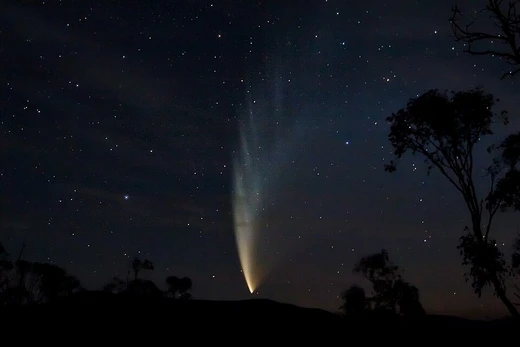
2I/Borisov
First observed rogue comet and second interstellar interloper.

2I/Borisov, first spotted as C/2019 Q4 (Borisov), is the second interstellar object ever seen in our solar system, following ʻOumuamua, and the first rogue comet. Amateur astronomer and telescope builder Gennadiy Borisov discovered it on 29 August 2019 UTC (30 August local time) at the MARGO Observatory. With a heliocentric orbital eccentricity of 3.36, it is not gravitationally tied to the Sun.
The International Astronomical Union (IAU) officially named it "2I/Borisov," where "2I" marks it as the second interstellar object (the "I" stands for interstellar) and "Borisov" honors its discoverer, following comet-naming tradition. In the popular press, it is often called Comet Borisov. Before this final designation, it went by other names. Early orbit calculations suggested it might be a near-Earth object, so it was listed on the IAU's Minor Planet Center (MPC) Near-Earth Object Confirmation Page as gb00234. After thirteen days of observations, it was clearly a hyperbolic comet, and the MPC labeled it C/2019 Q4 (Borisov) on 11 September 2019. Astronomers including Davide Farnocchia, Bill Gray, and David Tholen then concluded it was interstellar. On 24 September 2019, the IAU's Working Group for Small Bodies Nomenclature confirmed the interstellar designation 2I/Borisov.
Unlike ʻOumuamua, which looked like an asteroid, 2I/Borisov had a coma—a cloud of dust and gas—around its nucleus. Early size estimates for the nucleus ranged from 1.4 to 16 kilometers in diameter. During its pass through the solar system, it noticeably shrank, losing at least 0.4% of its mass before perihelion. Non-gravitational acceleration measurements suggest the nucleus is no larger than 0.4 kilometers, consistent with a Hubble Space Telescope upper limit of 0.5 kilometers. The comet never came closer to Earth than about 300 million kilometers (2.0 AU), so radar could not determine its size and shape. An occultation of a star could do this, but predicting it would require a very precise orbit, and detecting it would need a network of small telescopes.
Studies of its rotation gave mixed results. Hubble observations found no variation in its light curve, indicating a rotational period longer than 10 hours. Canada's NEOSSat found a period of 13.2 ± 0.2 days, which is unlikely to be the nucleus's actual spin.
- Discoverer
- Gennadiy Borisov
- Discovery date
- 29 August 2019 UTC (30 August local time)
- Discovery location
- MARGO Observatory
- Orbital eccentricity
- 3.36
- Perihelion date
- 8 December 2019
- Perihelion distance
- just over 2 AU
- Closest approach to earth
- 28 December 2019
Lore & Background
2I/Borisov was discovered by amateur astronomer Gennadiy Borisov at his personal observatory MARGO in Nauchnij, Crimea, using a 0.65 meter telescope he designed and built himself. Early orbit solutions suggested the comet could be a near-Earth object and was listed on the IAU's Minor Planet Center's Near-Earth Object Confirmation Page as gb00234. After thirteen days of observation, it was clear the object was a hyperbolic comet, and it was given the designation C/2019 Q4 (Borisov) on 11 September 2019. On 24 September 2019 the IAU announced the interstellar designation 2I/Borisov.
Unlike ʻOumuamua, which had an asteroidal appearance, 2I/Borisov's nucleus was surrounded by a coma. Early estimates of its nucleus diameter ranged from 1.4 to 16 km. The comet noticeably shrunk during its Solar System flyby, losing at least 0.4% of its mass before perihelion. A study using Hubble could not find a variation in the light curve, indicating a rotational period larger than 10 hours; another study with CSA's NEOSSat found a period of 13.2 ± 0.2 days, which is unlikely to be the nuclear spin.
2I/Borisov's composition appears uncommon yet not unseen in Solar System comets, being relatively depleted in water and diatomic carbon (C2), but enriched in carbon monoxide and amines. The molar ratio of carbon monoxide to water in its tail is 35–105%, resembling the unusual blue-tailed comet C/2016 R2 (PanSTARRS). It also produced a minor amount of neutral nickel emission, with a nickel to iron abundance ratio similar to Solar System comets.
Reader's Guide
2I/Borisov is significant as the first observed rogue comet and the second interstellar object detected after ʻOumuamua, confirming that such visitors are not unique. Its discovery by an amateur astronomer using a self-built telescope highlights the ongoing contributions of non-professionals to astronomy. The comet's extremely hyperbolic trajectory, with an eccentricity of 3.36 and a hyperbolic excess velocity of 32 km/s, firmly establishes its interstellar origin. Its composition, enriched in carbon monoxide and depleted in water relative to typical Solar System comets, provides clues about the chemical diversity of other planetary systems. The comet's passage through the Solar System allowed astronomers to study an object from another star system up close, offering a rare opportunity to compare interstellar and Solar System comets. Its legacy includes demonstrating that interstellar comets can be detected and characterized, paving the way for future discoveries of such objects.
Did You Know?
- The comet's tail was 14 times the size of Earth, according to astronomers from Yale University in November 2019.
- 2I/Borisov's composition is enriched in carbon monoxide, with a molar ratio of carbon monoxide to water in its tail of 35–105%.
- The comet lost at least 0.4% of its mass before reaching perihelion.
The Amateur Who Changed Astronomy
On the night of 29 August 2019 UTC, a telescope at the MARGO Observatory captured an object that would soon reshape humanity's understanding of its cosmic neighborhood. The person behind that instrument was Gennadiy Borisov, an amateur astronomer and telescope maker whose meticulous observations earned him a permanent place in interstellar science. In the early days the orbit looked ambiguous enough that the Minor Planet Center listed the object on its Near-Earth Object Confirmation Page under the code gb00234. Thirteen days of refined tracking, however, revealed a hyperbolic path, and the center reclassified it as comet C/2019 Q4 (Borisov) on 11 September. A small group of researchers, including Davide Farnocchia, Bill Gray, and David Tholen, pushed further, arguing the visitor had never belonged to our Solar System. On 24 September the IAU's Working Group for Small Bodies Nomenclature confirmed the interstellar status and assigned the designation 2I/Borisov, the "2I" marking it as the second interstellar object after 1I/ʻOumuamua. The name Borisov, following the tradition of honoring comet discoverers, ensured an amateur's patience would be etched into the record.
A Trajectory Written in Hyperbolic Numbers
The orbital numbers for 2I/Borisov leave little room for doubt about its origin. Its heliocentric eccentricity of 3.36 dwarfs the roughly 1.2 of ʻOumuamua and the barely-above-1 values of the 300-plus weakly hyperbolic comets already catalogued. The hyperbolic excess velocity of 32 km/s is far beyond what gravitational perturbations could produce, which typically yield only a few km/s at infinite distance. For perspective, Voyager 1, humanity's fastest spacecraft leaving the Solar System, cruises at 16.9 km/s. The comet entered from the direction of Cassiopeia near the Perseus border, a trajectory pointing to the galactic plane rather than the halo. It crossed the ecliptic on 26 October near Regulus, reached perihelion just beyond 2 AU on 8 December, and made its closest pass to Earth at 1.9 AU on 28 December. Its 44-degree inclination meant no close planetary encounters. It will exit toward Telescopium, and in the void between stars it will take roughly 9,000 years to cover a single light-year relative to the Sun.
A Nucleus Wrapped in Unusual Chemistry
Unlike the bare, asteroid-like ʻOumuamua, 2I/Borisov arrived wrapped in a glowing coma of dust and gas, making it unmistakably a comet. Early nucleus diameter estimates spanned a wide range from 1.4 to 16 km, though non-gravitational acceleration data and a Hubble Space Telescope constraint both pointed to an upper limit near 0.4 to 0.5 km. The object shed at least 0.4 percent of its mass before perihelion, and David Jewitt and Jane Luu estimated it was ejecting 2 kg of dust per second while losing 60 kg of water per second. Its chemical fingerprint is striking: relatively poor in water and diatomic carbon yet rich in carbon monoxide and amines, with a CO-to-water molar ratio of 35 to 105 percent compared to the 4 percent average in Solar System comets. A trace of neutral nickel emission, attributed to an unidentified nickel volatile, added another odd note, while the nickel-to-iron ratio remained broadly Solar-System-like. Precovery images dating to 13 December 2018 showed the coma was already active months before its closest approach.
Scale, Legacy, and the Humbling View
By November 2019, Yale astronomers measuring the comet's tail reported a structure fourteen times the size of Earth, prompting the observation that it is humbling to realize how small our planet is beside a visitor from another solar system. That single image encapsulates what 2I/Borisov meant for the field: it was the first rogue comet ever observed, a category distinct from ʻOumuamua's asteroidal profile, and it proved that interstellar objects can arrive as active, outgassing bodies rather than inert rocks. Because the comet never came closer than roughly 300 million kilometres to Earth, radar could not resolve its shape, and a stellar occultation—difficult to predict and requiring a distributed network of small telescopes—remained the only viable direct-sizing method. Hubble light-curve work set a rotation period floor of ten hours, while CSA's NEOSSat detected a 13.2-day modulation unlikely to be true nuclear spin. Monte Carlo orbit simulations suggested an equatorial obliquity of either 59 or 90 degrees. Together these measurements, gathered from a single flyby that will never repeat, form the entire physical portrait of a body that has already left our Solar System behind.
Frequently Asked Questions
Who is 2I/Borisov?
2I/Borisov is a rogue comet that originated outside our solar system and was first detected in August 2019. It holds the distinction of being the second confirmed interstellar visitor to pass through our neighborhood, after ʻOumuamua, and the first one confirmed to be a comet rather than a bare asteroid.
What does the '2I' in 2I/Borisov mean?
The '2I' prefix is the IAU's shorthand for the second interstellar object ever catalogued, with the 'I' standing for interstellar. The 'Borisov' portion simply credits Gennadiy Borisov, the amateur astronomer who first spotted the object.
How was 2I/Borisov discovered?
Gennadiy Borisov, a self-taught telescope builder and amateur astronomer, identified the object on 29 August 2019 UTC using equipment at the MARGO Observatory. Its highly unusual trajectory quickly flagged it as interstellar rather than a typical solar-system comet.
Is 2I/Borisov still in our solar system?
No — with a heliocentric orbital eccentricity of 3.36, it follows a hyperbolic path and is no longer gravitationally bound to the Sun. It reached perihelion in early December 2019 at just over 2 AU and is now heading back into interstellar space.
Why is 2I/Borisov important to astronomy?
It gave scientists their first close-up look at a rogue comet from another star system, allowing detailed study of its dust tail, outgassing behavior, and composition. That made it a far richer data source than ʻOumuamua, which appeared to be a bare rock with no visible coma.
More in Named Comets 1-24
Spotted an error? Know more?
Reader corrections go straight into our review queue. Suggest an edit · How this site is sourced