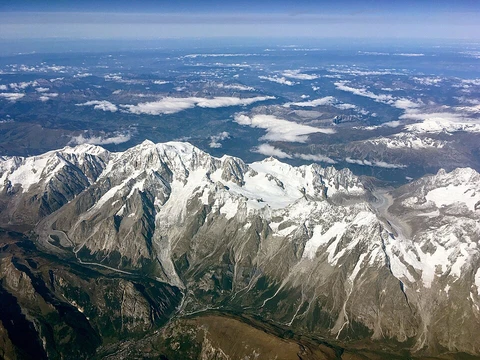
Blue Ridge Mountains
Ancient mountain range with highest peaks in eastern North America.

The Blue Ridge Mountains (Cherokee: ᏌᎪᏂᎨ ᏣᎴᎩ, Sagonige Tsalegi) are a physiographic province of the larger Appalachian Highlands range, extending 550 miles southwest from southern Pennsylvania through Maryland, West Virginia, Virginia, North Carolina, South Carolina, Tennessee, and Georgia. The province is divided into northern and southern regions near the Roanoke River gap. To the west lies the Great Appalachian Valley, bordered by the Ridge and Valley province. The range is famous for its bluish appearance from a distance, a result of isoprene released by trees into the atmosphere, which creates a characteristic haze. The Blue Ridge contains the highest peaks in eastern North America south of Baffin Island, with about 125 summits exceeding a certain elevation; the highest is Mount Mitchell in North Carolina. The Blue Ridge Parkway, a scenic highway, runs along the crests and connects Shenandoah National Park in the north with Great Smoky Mountains National Park in the south, also paralleled by the Appalachian Trail. Eight national forests—George Washington and Jefferson, Cherokee, Pisgah, Nantahala, and Chattahoochee—lie within the province. Geologically, the mountains are composed of ancient granitic charnockites, metamorphosed volcanic formations, and sedimentary limestone. Studies have shown the basement rocks include unique gneisses and granitoids, with zircon analysis providing emplacement ages. The Blue Ridge once rivaled the Alps in height but has been reduced by weathering and erosion over hundreds of millions of years. Historically, tribes such as the Siouan Manahoacs, Iroquois, and Shawnee hunted at its foot, and German explorer John Lederer first reached the crest in 1669.
- states_spanned
- Pennsylvania, Maryland, West Virginia, Virginia, North Carolina, South Carolina,
- national_parks
- Shenandoah National Park and Great Smoky Mountains National Park
Lore & Background
The Blue Ridge Mountains are a physiographic province of the larger Appalachian Highlands, stretching 550 miles southwest from southern Pennsylvania through Maryland, West Virginia, Virginia, North Carolina, South Carolina, Tennessee, and Georgia. The range is divided into northern and southern regions near the Roanoke River gap. To its west lies the Great Appalachian Valley, bordered by the Ridge and Valley province. The mountains appear blue from a distance due to isoprene released by trees, which creates a characteristic haze. This range contains the highest peaks in eastern North America south of Baffin Island, with about 125 summits exceeding a notable elevation. The highest point is Mount Mitchell in North Carolina. The Blue Ridge includes the Great Smoky Mountains, Great Balsams, Roans, and Blacks, as well as lower eastern foothills like the Brushy and South Mountains in North Carolina and the Southwest Mountains in Virginia. It extends north to South Mountain in Pennsylvania, with ancient rock bands continuing through the New Jersey and Hudson River highlands into the Berkshires and Green Mountains. The Blue Ridge Parkway runs along the crests, linking Shenandoah National Park in the north and Great Smoky Mountains National Park in the south. The rocks are primarily ancient granitic charnockites, metamorphosed volcanic formations, and sedimentary limestone, with gneiss showing folded mineral bands. At emergence, the Blue Ridge rivaled the Alps in height, but hundreds of millions of years of weathering have reduced them. Indigenous tribes including the Siouan Manahoacs, Iroquois, and Shawnee hunted and fished at the range’s foot. German explorer John Lederer first reached the crest in 1669 and recorded the Virginia Siouan name Ahkonshuck.
Reader's Guide
The range is defined by its ancient geology, with rocks including granitic charnockites, metamorphosed volcanic formations, and sedimentary limestone. At the time of their emergence, the Blue Ridge were among the highest mountains in the world, comparable to the much younger Alps, but weathering and erosion over hundreds of millions of years has resulted in much shorter peaks. The range supports diverse flora and fauna, including stunted oak and oak-hickory forests, Southern Appalachian spruce-fir forests at highest elevations, and animals such as the American black bear, bobcat, coyote, and many endemic fish species.
Did You Know?
- The range's bluish color is caused by isoprene released from trees into the atmosphere.
Frequently Asked Questions
Who is Blue Ridge Mountains?
Blue Ridge Mountains is a 550-mile physiographic province nested within the larger Appalachian Highlands, stretching southwest from southern Pennsylvania all the way through Georgia. Its Cherokee name, Sagonige Tsalegi, translates to 'blue mountain ridge.'
What are Blue Ridge Mountains's powers/role?
The range holds the distinction of containing the highest peaks in eastern North America, with Mount Mitchell reaching 6,684 feet. It also produces a distinctive bluish haze visible from afar, caused by isoprene vapors released by its dense tree canopy.
How does Blue Ridge Mountains's story end?
The range's 550-mile arc terminates in the southern reaches of Georgia, where its ridgelines gradually blend into the broader Piedmont landscape. Its geological story is still unfolding, as the ancient rock continues to erode and reshape over deep time.
Why is Blue Ridge Mountains important?
It anchors two major national parks—Shenandoah and Great Smoky Mountains—and is threaded by the 469-mile Blue Ridge Parkway, one of the most scenic drives in the country. Cities like Roanoke, Asheville, and Johnson City grow along its flanks, making it a cultural and recreational hub for the Eastern United States.
What is Blue Ridge Mountains's signature move?
Its most iconic feature is the soft blue veil that hangs over the ridgelines when viewed from a distance, a natural phenomenon created when trees exhale isoprene into the atmosphere. This signature haze is what gave the range its name and remains its most recognizable visual trademark.
More in Mountain Ranges And Massifs 1-24
Related in Mountain Ranges And Massifs
Links follow this subject's own source article.
Spotted an error? Know more?
This is a living reference — every entry is fact-audited, and reader corrections feed straight into our audit queue. Suggest an edit · See this site's audit record