Life Investigation For Enceladus
Proposed sample-return mission to Enceladus's icy plumes.

NASA's James Webb Space Telescope from Greenbelt, MD, USA · CC BY 2.0
Life Investigation For Enceladus (LIFE) was a proposed astrobiology mission concept that would capture icy particles from Saturn's moon Enceladus and return them to Earth for detailed study. It was notable for aiming to sample Enceladus's subsurface ocean via its geysers, potentially detecting signs of life such as biomolecules.
- Sample return time to earth
- about 14 years
Lore & Background
The LIFE orbiter concept was proposed by a team led by Peter Tsou to NASA's 13th Discovery Mission solicitation, but the mission was not selected by NASA for Phase-A design study. Enceladus is a small icy moon with jets or geysers of water erupting from its surface that might be connected to active hydrothermal vents at its subsurface water ocean floor, where the moon's ocean meets the underlying rock, a prime habitat for life. The geysers could provide easy access for sampling the moon's subsurface ocean, and if there is microbial life in it, ice particles from the sea could contain the evidence astrobiologists need to identify them.
Reader's Guide
The LIFE mission concept proposed a 15-year timeline: entering Saturn orbit, performing multiple flybys through Enceladus's icy plumes for about two years at speeds as slow as 2 km/s, then escaping Saturn for a ~4.5 year voyage back to Earth with collected particles in a return capsule. The spacecraft could sample Enceladus's plume, the E ring of Saturn, and the Titan upper atmosphere. In December 2014, NASA announced it would be selecting finalists in June 2015 to submit proposals for a future Discovery Program mission, and selecting a winning proposal in September 2016. The selected mission must launch by the end of 2021. The mission would have a $425 million development cost cap, and it would reach Saturn after a series of gravity assists past Venus and the Earth. Samples from Enceladus's plume would make it to Earth about 14 years later. In September 2016, NASA announced that five proposals had been selected for further study. The science payload would include an aerogel collector, a tool for collecting volatile chemicals, a mass spectrometer (CHIMPS, an upgraded ROSINA on Rosetta spacecraft), a camera for optical navigation and observing jet dynamics, and a dust counter to confirm particle flux. The samples would be returned to Earth for extensive analyses.
Did You Know?
- The LIFE mission would use a 'Tanpopo' aerogel collector similar to the one used in the Stardust sample return mission.
- The spacecraft would spend about two years in orbit around Saturn at speeds as slow as 2 km/s.
- The mission was proposed to NASA's 13th Discovery Mission solicitation but was not selected for Phase-A design study.
- The science payload included CHIMPS, an upgraded version of the ROSINA instrument on the Rosetta spacecraft.
From a Faint Dot to a World of Wonders
Enceladus first entered human knowledge on August 28, 1789, when William Herschel spotted the faint speck through his newly commissioned 1.2-metre telescope at Observatory House in Slough, England. The moon's dim apparent magnitude of +11.7, combined with its close angular proximity to the brilliant planet Saturn and its dazzling rings, made it an extraordinarily challenging target for ground-based observers. Herschel's initial sighting occurred during a Saturnian equinox, a window when Earth sits within the ring plane and the glare from the rings diminishes, rendering the smaller satellites slightly easier to discern. For nearly two centuries after that discovery, Enceladus remained essentially a point of light; astronomers could estimate only its orbital parameters, mass, density, and reflectivity. The Voyager 1 and Voyager 2 flybys of 1980 and 1981 finally revealed a real surface, and then in 2005 the Cassini spacecraft began a series of close encounters that transformed Enceladus from a quiet, snow-covered world into one of the most dynamically fascinating bodies in the entire Solar System.
Geysers, Snow, and the E Ring
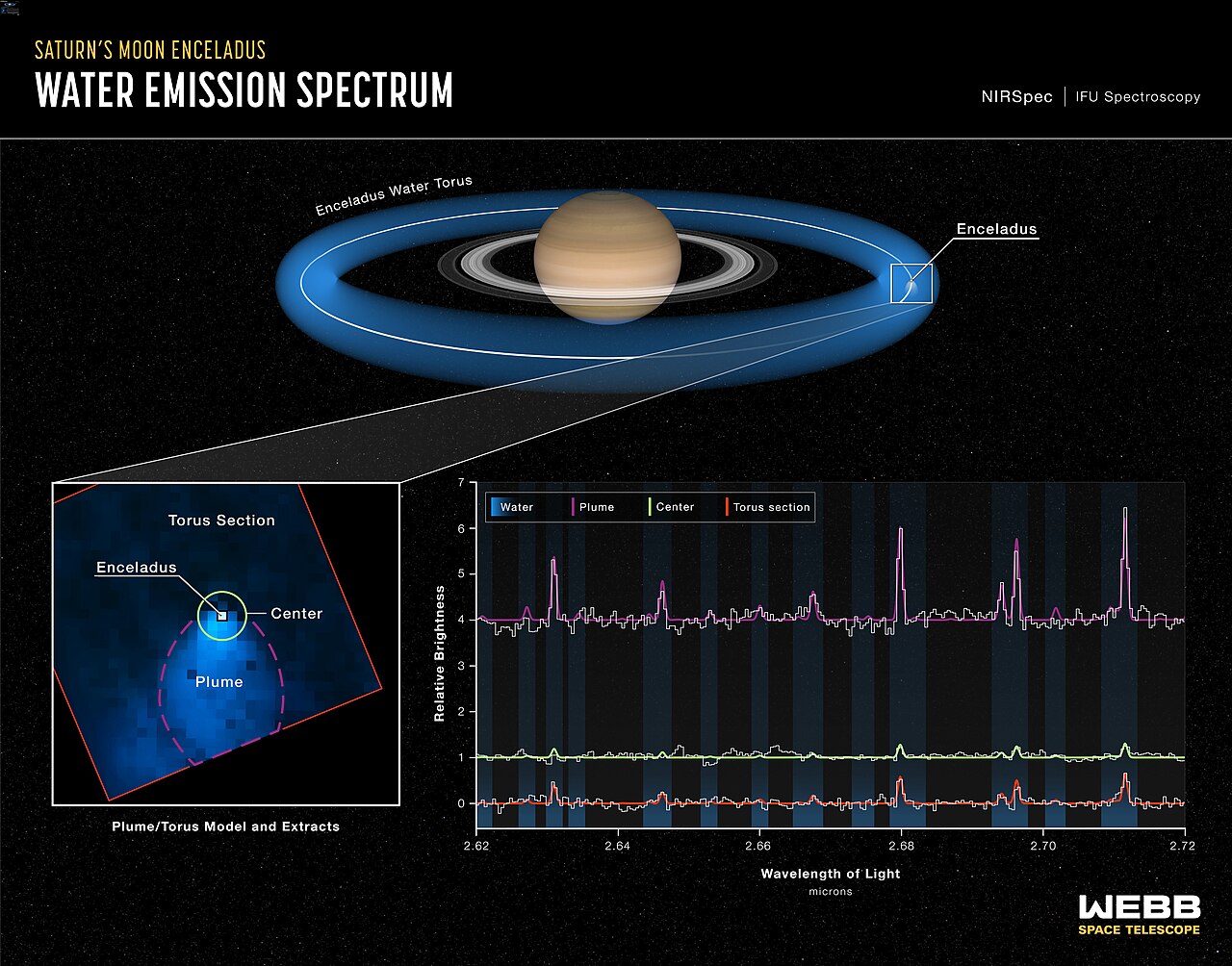
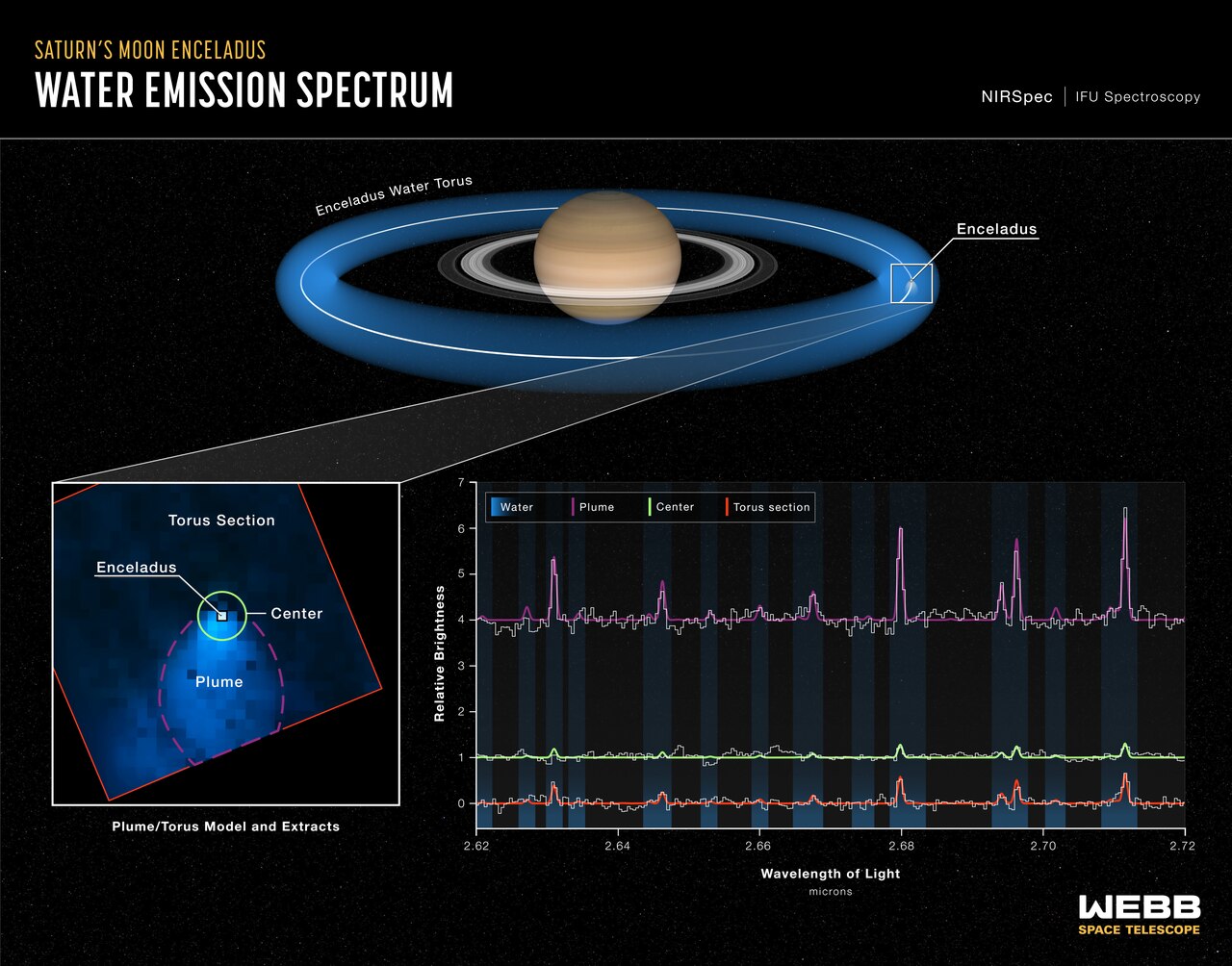
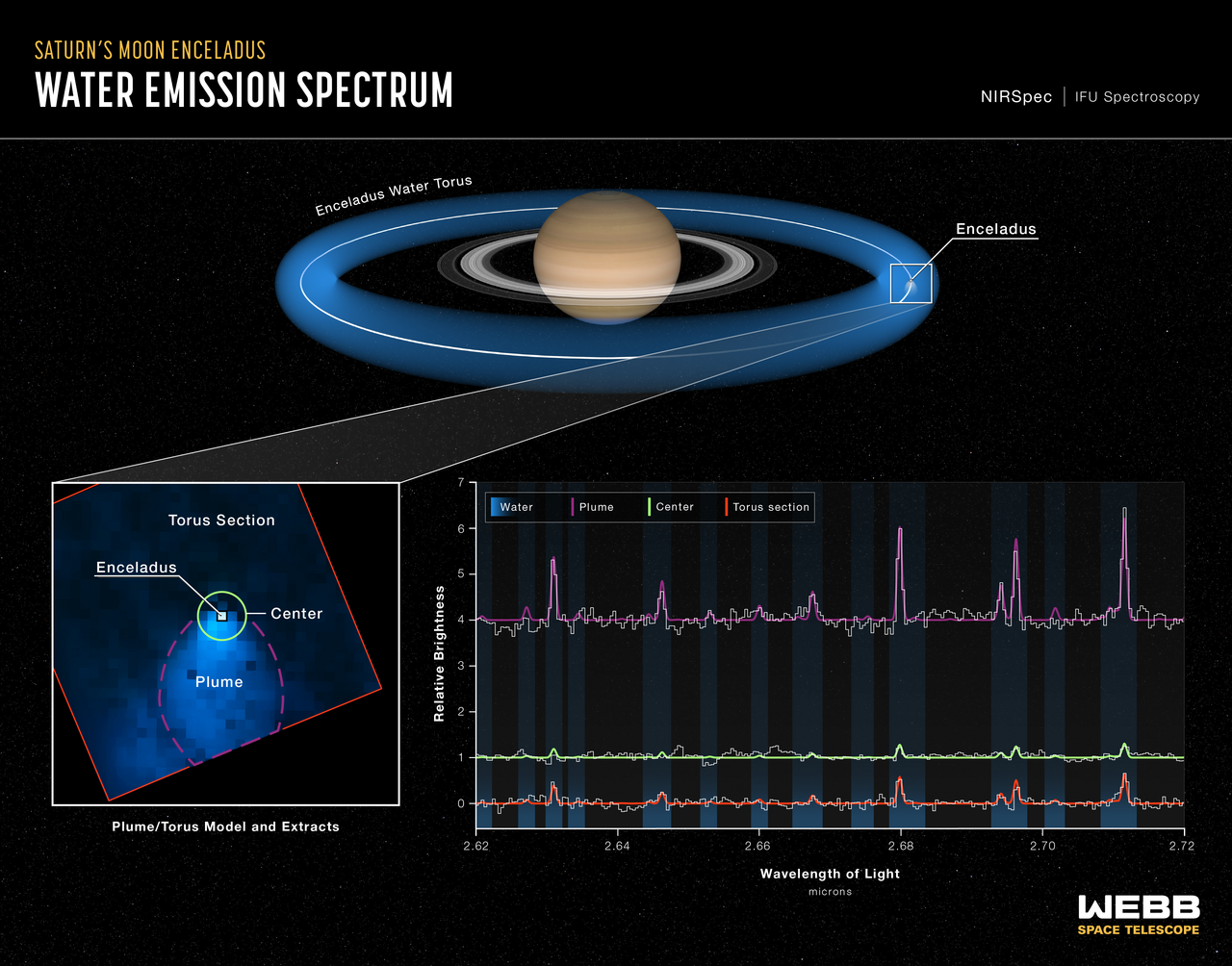
Perhaps no feature of Enceladus has captured the imagination of planetary scientists more than the active cryovolcanic vents clustered near its south pole. Cassini's flybys in 2005 revealed that more than a hundred geyser-like jets are erupting from fissures in the south polar terrain, hurling water vapour, molecular hydrogen, sodium chloride crystals, and ice particles into space at a combined rate of roughly 200 kilograms per second. NASA researchers noted that the chemical makeup of these plumes closely resembles that of cometary material. A fraction of the ejected water condenses and drifts back down as pristine snow, accumulating into layers hundreds of metres thick that blanket the surface and give Enceladus one of the highest reflectivities of any object in the Solar System. The remainder escapes the moon's weak gravity and becomes the dominant source of material feeding Saturn's vast E ring, the outermost of the planet's principal rings. The interplay between eruption, deposition, and escape makes Enceladus a remarkable engine of ring renewal.
A Hidden Ocean and the Question of Life
In 2014, NASA announced that Cassini data provided compelling evidence for a vast subsurface ocean of liquid water beneath Enceladus's south polar ice shell, estimated to be roughly ten kilometres thick. Subsequent mathematical modelling has successfully replicated the conditions necessary for such an ocean to persist. Chemical analyses of the plume material detected signatures consistent with hydrothermal activity at the seafloor, suggesting that heat and chemical gradients could be driving complex reactions in the dark water below. Researchers have noted that the methane detected in the plumes might be a by-product of biological processes analogous to those carried out by microorganisms thriving around Earth's deep-sea hydrothermal vents. While no direct evidence of life has been confirmed, the combination of liquid water, chemical energy sources, and the presence of molecular hydrogen creates an environment that many astrobiologists consider potentially habitable. The near-total absence of impact craters in the south polar region further underscores how young and geologically vigorous this hidden world truly is.
Tidal Forces and the Engine of Activity
Enceladus orbits Saturn at a distance of roughly 238,000 kilometres, completing one circuit every 32.9 hours as the second-largest moon in the planet's system. Its orbital path is not entirely circular; a 2:1 mean-motion resonance with the more distant moon Dione keeps Enceladus's eccentricity locked at a small but significant value of 0.0047. This forced eccentricity means the moon is perpetually stretched and squeezed by Saturn's gravity as it moves through its slightly elliptical path. The continuous tidal flexing dissipates energy as heat deep within the interior, and this tidal heating is widely regarded as the primary power source behind the cryovolcanic eruptions and geological deformation observed at the south pole. Enceladus also rotates synchronously, always presenting the same face toward Saturn, though its libration is minimal at no more than 1.5 degrees. Shape analyses hint that the moon may once have experienced a 1:4 spin-orbit libration that could have supplied an additional, now-vanished, source of internal warmth.
Gallery
Frequently Asked Questions
What is Life Investigation For Enceladus (LIFE)?
LIFE was a proposed astrobiology mission concept that envisioned capturing frozen particles ejected from Enceladus's geysers and delivering them back to Earth for close laboratory examination.
What was LIFE's main scientific objective?
The mission sought to collect samples from Enceladus's active plumes, which originate from a hidden subsurface ocean, in order to look for biomolecules or other chemical signatures that might indicate life.
How long would it take LIFE to bring samples back to Earth?
Under the proposed design, the round-trip journey to capture plume material and return it to the surface would take roughly fourteen years.
Why do scientists consider Enceladus a strong target for the search for life?
The moon harbors a global subsurface ocean that interacts with a rocky core, creating hydrothermal conditions similar to environments where life thrives on Earth.
Was LIFE ever selected as an actual NASA flight mission?
No; LIFE existed as a study-level concept exploring the feasibility of sampling Enceladus's plumes and was not advanced to a funded launch.
More in Moons of Saturn, Part 2 1-24
Spotted an error? Know more?
Reader corrections go straight into our review queue. Suggest an edit · How this site is sourced