Enceladus Life Signatures and Habitability
Proposed 2017 New Frontiers mission to Enceladus for biosignatures.

NASA/JPL/SSI · Public domain
Enceladus Life Signatures and Habitability (ELSAH) is an astrobiology concept mission proposed in 2017 to NASA's New Frontiers program. It aims to send a spacecraft to Enceladus to search for biosignatures and assess its habitability, though no mission details have been made public.
- Proposed year
- 2017
- Program
- NASA's New Frontiers program
- Principal investigator
- Christopher P. McKay
- Managing center
- Goddard Space Flight Center
- Finalists announced
- 20 December 2017
- Selected missions
- Dragonfly to Titan, CAESAR
Lore & Background
ELSAH was proposed in 2017 to NASA's New Frontiers program, with Christopher P. McKay as Principal Investigator and Goddard Space Flight Center as the managing center. No details of the mission have been made public, but observers speculate it would be a plume-sampling orbiter mission. On 20 December 2017, the two finalists announced were Dragonfly to Titan and CAESAR, a sample-return mission from comet 67P/Churyumov–Gerasimenko. ELSAH was not selected for launch in this instance.
Reader's Guide
Although ELSAH was not selected for launch, it received technology development funds to prepare it for future mission competitions. These funds are meant to develop techniques that limit spacecraft contamination, thereby enabling life detection measurements on cost-capped missions. This legacy positions ELSAH as a stepping stone for future astrobiology missions to Enceladus, emphasizing contamination control as critical for credible biosignature detection. The mission's concept remains relevant as a precursor to potential later missions, and its technology development efforts may influence how future cost-capped missions approach life detection.
Did You Know?
- The Principal Investigator is Christopher P. McKay, an astrobiologist at NASA Ames Research Center.
- The two finalists announced on 20 December 2017 were Dragonfly and CAESAR.
- ELSAH received technology development funds to limit spacecraft contamination for life detection.
Discovery and the Long Silence
Enceladus was first spotted by William Herschel on August 28, 1789, using his then-world's-largest 1.2-meter telescope at Slough, England. Its faint apparent magnitude of +11.7 and its close proximity to the brilliant Saturn and its rings made it notoriously difficult to observe from Earth with smaller instruments. For well over a century after that initial sighting, humanity possessed almost no information beyond basic orbital parameters—rough estimates of mass, density, and albedo. The Voyager 1 and Voyager 2 flybys of 1980 and 1981 finally offered a closer look, yet the true transformation came with Cassini's series of close flybys beginning in 2005. Those missions converted Enceladus from a featureless pale dot into a dynamic world of active geology, erupting plumes, and a concealed ocean. The name itself carries mythological resonance: John Herschel, the discoverer's son, proposed it in his 1847 publication, linking the moon to the Titan of Greek legend—a fitting choice, since Saturn was Cronus, the leader of the Titans.
Plumes, Snow, and the E Ring
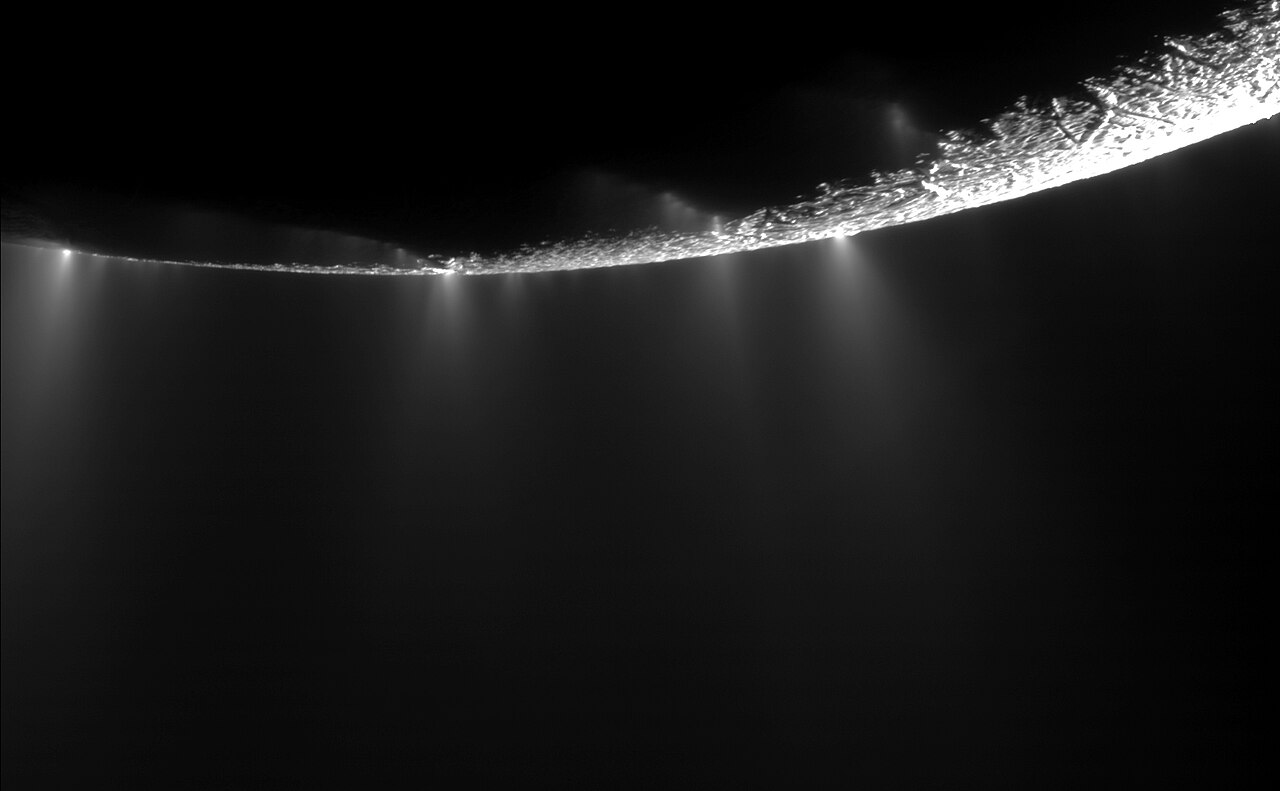
Cassini's most startling discovery was the presence of water-rich plumes erupting from Enceladus's south polar region. More than a hundred individual geysers have been catalogued, and together they launch roughly 200 kilograms of material into space every second. The jets carry water vapour, molecular hydrogen, sodium chloride crystals, ice particles, and a variety of other volatiles. NASA scientists noted that the overall composition closely resembles that of comets. A portion of the ejected water falls back onto the surface as fresh snow, accumulating to hundreds of metres in thickness and giving Enceladus one of the highest reflectivities of any body in the Solar System. The remainder escapes the moon's weak gravity and feeds Saturn's E ring—the widest and outermost of its major rings—making Enceladus the principal supplier of that ring's material. Because Enceladus orbits within the densest section of the E ring, it continuously replenishes the ring, sustaining a cycle that keeps this broad, tenuous structure alive.
Tidal Heating and the Hidden Ocean
Enceladus's geological vitality traces directly back to its orbital mechanics. Locked in a 2:1 mean-motion resonance with Dione—completing two full orbits around Saturn for every single orbit Dione completes—the moon maintains a forced eccentricity of 0.0047. This non-zero eccentricity produces continuous tidal deformation of Enceladus's body, and the internal friction generated by that deformation dissipates heat deep into the interior. That tidal heating is the primary engine behind the cryovolcanism, the escaping internal heat, and the near-total absence of impact craters across the south polar region. In 2014, NASA reported that Cassini data pointed to a substantial liquid-water ocean beneath the south pole, roughly ten kilometres in thickness. The ocean's existence has since been confirmed through mathematical modelling and successful replication. Enceladus also rotates synchronously, keeping one face permanently toward Saturn, and analyses of its shape suggest it once experienced a 1:4 secondary spin-orbit libration that may have supplied an additional heat source in its geological past.
Hydrothermal Chemistry and the Case for Habitability
Cassini's chemical analysis of the plume material yielded evidence of hydrothermal activity beneath the ice shell, potentially driving complex chemical reactions within the subsurface ocean. This finding has energised ongoing research into whether Enceladus's hydrothermal environment could be habitable to microorganisms analogous to those thriving around Earth's deep-sea hydrothermal vents. A particularly tantalising clue is the methane detected in the plumes: researchers suggest it could be a metabolic byproduct of such organisms rather than a product of purely abiotic chemistry. The combination of liquid water, molecular hydrogen, sodium compounds, and hydrothermal thermal gradients mirrors the conditions that sustain microbial ecosystems around terrestrial ocean vents. While no direct biosignature has yet been confirmed, the convergence of these chemical and geological factors positions Enceladus as one of the most compelling candidates for extraterrestrial habitability in our Solar System.
Gallery
Frequently Asked Questions
What is Enceladus Life Signatures and Habitability?
ELSAH is an astrobiology concept mission put forward in 2017 under NASA's New Frontiers program. Led by Christopher P. McKay at Goddard Space Flight Center, it would have sent a spacecraft to Enceladus to hunt for biosignatures and evaluate whether the moon's environment could sustain life.
Who is behind Enceladus Life Signatures and Habitability?
Christopher P. McKay served as the principal investigator, and the mission was managed out of NASA's Goddard Space Flight Center.
Did Enceladus Life Signatures and Habitability get selected for New Frontiers?
No. When the finalists were announced on 20 December 2017, Dragonfly to Titan and CAESAR were the missions that moved forward, leaving ELSAH unselected.
What are Enceladus Life Signatures and Habitability's mission goals?
The concept calls for a spacecraft to visit Enceladus, search for biosignatures, and assess the moon's habitability. However, NASA has not published detailed mission specifications beyond the high-level proposal.
Why is Enceladus Life Signatures and Habitability important to Saturn-moon fans?
It stands as one of the few formal proposals to directly probe Enceladus's hidden ocean for evidence of life, giving the community a concrete (if unrealized) vision of what a dedicated Enceladus flyby could achieve.
More in Moons of Saturn, Part 2 1-24
Spotted an error? Know more?
Reader corrections go straight into our review queue. Suggest an edit · How this site is sourced