Iapetus (moon)
Saturn's walnut-shaped moon with a dark and bright face.

NASA / JPL · Public domain
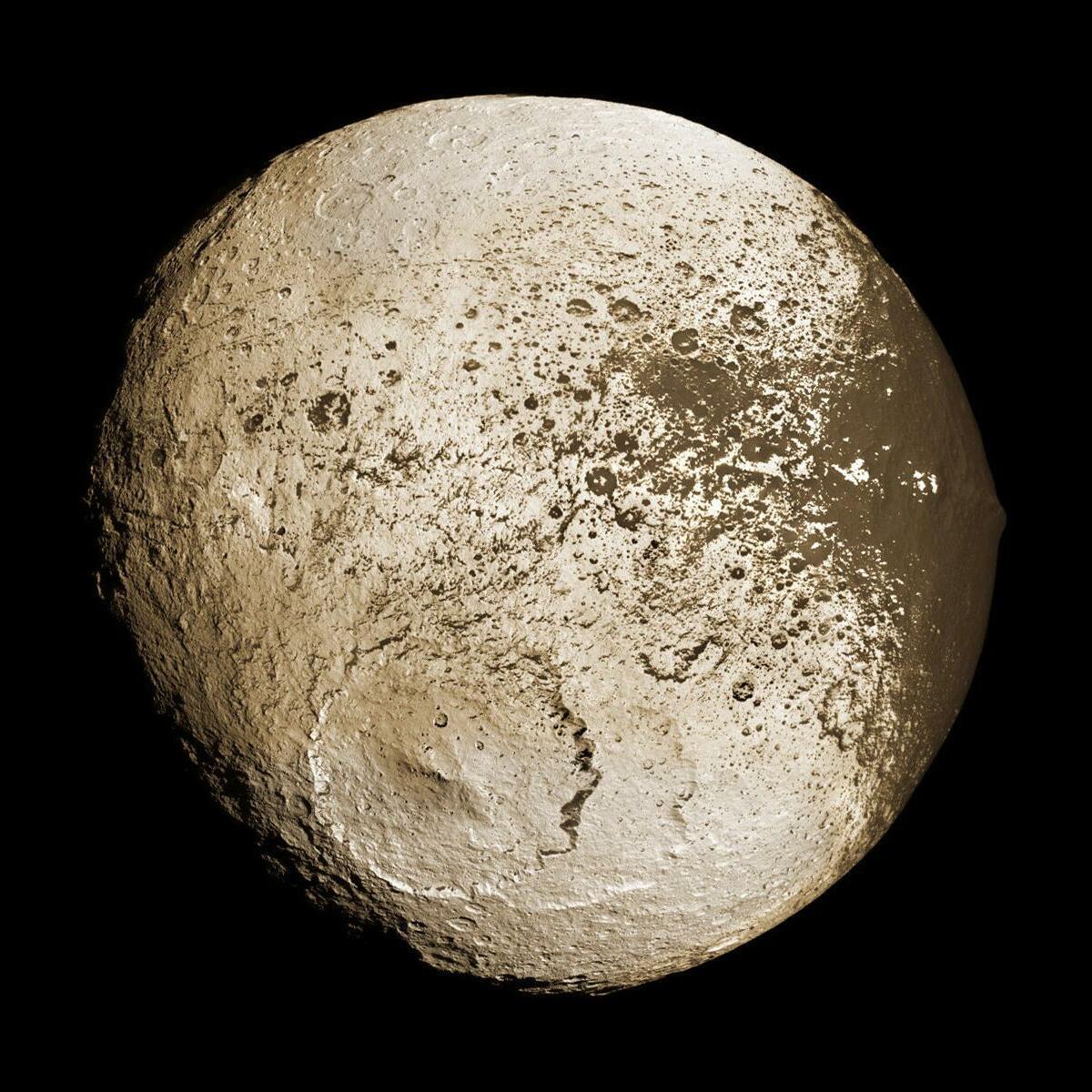
Iapetus is the outermost of Saturn's large moons and the third-largest moon of Saturn, with an estimated diameter of 1,469 km. It is notable for its striking two-tone coloration—a dark leading hemisphere and a bright trailing hemisphere—and a massive equatorial ridge that runs three-quarters of the way around the moon. Discovered in 1671 by Giovanni Domenico Cassini, it is named after the Titan Iapetus from Greek mythology.
Quick Facts
- Mpc Name
- Saturn VIII
- Pronounced
- aɪ · ˈ · æ · p · ə · t · ə · s
- Adjectives
- Iapetian aɪ · ə · ˈ · p · iː · ʃ · ə · n248
- Named After
- Ἰαπετός Īapetus
- Discoverer
- G. D. Cassini
- Discovered
- October 25, 1671
- Periapsis
- 3 · 461 · 972.4 km
- Apoapsis
- 3 · 661 · 427.6 km
- Eccentricity
- 0.028
- Avg Speed
- 3.35 km/s
- Inclination
- 7.6° (to Laplace plane) / 17.28° (to the ecliptic) / 15.47° (to Saturn's equator)
- Satellite Of
- Saturn
Facts from the source article.
Lore & Background
Iapetus was discovered by Giovanni Domenico Cassini in October 1671, making it the first moon he discovered and the second moon of Saturn found after Titan. Cassini noticed that Iapetus was visible only on the western side of Saturn and not on the eastern side until 1705, when an improved telescope revealed it was two magnitudes dimmer on the eastern side. He correctly deduced that the moon is tidally locked, with one bright hemisphere and one dark hemisphere. The name Iapetus was suggested by John Herschel in 1847, following the tradition of naming Saturn's moons after Titans. The moon's orbit is unusual: it is the most distant tidally locked moon in the Solar System, has the most inclined orbital plane of the regular satellites, and its orbital precession is about the slowest possible for a Saturnian moon. Its formation is uncertain; it may be a primordial satellite or formed from debris of giant impacts, but recent studies suggest all moons inward of Titan are no more than 100 million years old. Iapetus is heavily cratered, with large impact basins including Turgis, which has a diameter of 580 km. The dark material on its leading hemisphere is believed to come from outside Iapetus and contains organic compounds similar to those in primitive meteorites.
Reader's Guide
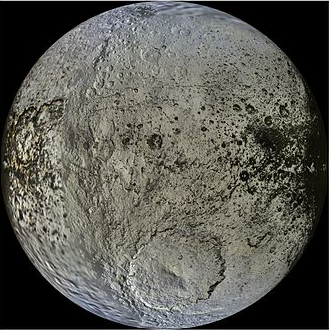
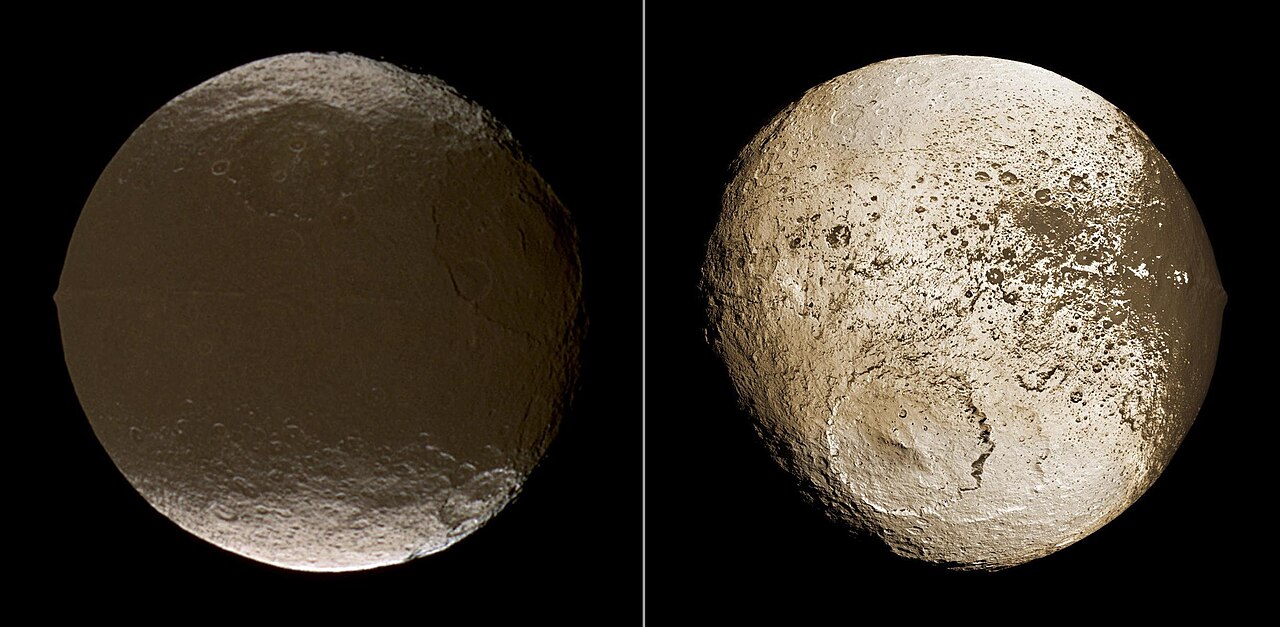
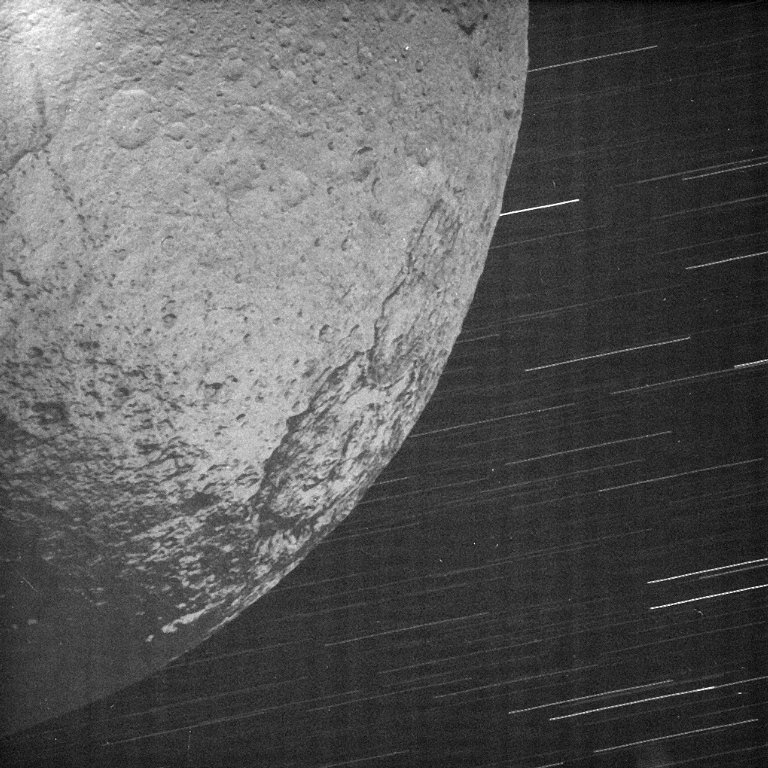
Iapetus holds a unique place among Saturn's moons due to its extreme two-tone coloration and equatorial ridge. The dark hemisphere, Cassini Regio, has an albedo of 0.03–0.05, while the bright trailing hemisphere reaches 0.5–0.6, nearly as bright as Europa. This dichotomy, first observed by Cassini, arises from a thin layer of dark material that fills low-lying regions and is likely lag from sublimation of ice, further darkened by sunlight. The equatorial ridge, so high it distorts the moon's shape, gives Iapetus a walnut-like appearance. Its distant, inclined orbit makes it the only large moon from which Saturn's rings would be clearly visible. The moon's orbital inclination varies between 5 and 21° over a 3,400-year precession period, and it is in a secular resonance involving Jupiter and Saturn. Iapetus also supports long-runout landslides, possibly aided by ice sliding. The moon's Roman numeral designation is Saturn VIII, and geological features on Iapetus are named after characters and places from the French epic poem The Song of Roland.
Did You Know?
- Iapetus was the first moon discovered by Giovanni Domenico Cassini, in 1671.
- Its equatorial ridge runs three-quarters of the way around the moon and visibly distorts its shape.
- The dark hemisphere, Cassini Regio, has an albedo as low as 0.03, while the bright hemisphere reaches 0.6.
Discovery & the Two-Faced Mystery
Iapetus entered human knowledge in October 1671, when the Italian-born French astronomer Giovanni Domenico Cassini first spotted it on the western side of Saturn. It was Cassini's first lunar discovery, the second moon of Saturn ever identified (after Huygens found Titan in 1655), and the sixth extraterrestrial moon known to science. Yet almost immediately, a puzzle emerged: months later, when Iapetus swung to Saturn's eastern side, Cassini could not find it. The same failure repeated the following year. It took until 1705, with a sharper telescope, that Cassini finally caught it on the eastern side and noted it appeared two magnitudes fainter. From this, he correctly deduced that the moon possessed one bright hemisphere and one dark hemisphere, and that it was tidally locked to Saturn. The bright face presented itself to Earth when the moon sat west of the planet; the dark face, when it sat east. A simple observational gap had revealed one of the Solar System's most striking color asymmetries.
An Orbit Set Apart
Iapetus occupies a genuinely peculiar orbital niche among Saturn's satellites. Though it ranks as the third-largest moon of the planet, it circles at a distance far beyond Titan and roughly 2.4 times farther than Hyperion. Remarkably, it remains tidally locked—always showing the same face to Saturn—making it the most distant tidally locked moon in the entire Solar System. Its orbital plane is also the most tilted of all regular Saturnian satellites; only the outer irregular moons like Phoebe exceed it. This high inclination grants Iapetus a unique vantage: it is the only large moon from which Saturn's rings would appear as a broad, clearly visible disc rather than a thin edge-on line. The origin of this tilt remains unexplained, though capture is considered unlikely; one hypothesis points to a gravitational encounter between Saturn and another planet in the deep past. The inclination oscillates between 5 and 21 degrees over a nodal precession cycle of roughly 3,400 years. Iapetus also sits just beyond the Laplace radius, placing it in a gray zone between regular and irregular satellite dynamics, and participates in a secular resonance with both Jupiter and Saturn that may persist for tens of millions of years.
Naming & Identity
The name Iapetus traces back to the Titan of Greek mythology, a suggestion made by John Herschel in his 1847 publication from the Cape of Good Hope. Herschel argued that Saturn's moons should be named after the Titans—siblings of Cronus, the Roman equivalent of Saturn—and the Giants who had fought alongside them against Zeus and the Olympians. Before this, Cassini had labeled Iapetus among the Sidera Lodoicea, a group of four moons (including Tethys, Dione, and Rhea) named in honor of King Louis XIV. In practice, astronomers defaulted to Roman numerals: Iapetus was Saturn V at its discovery, became Saturn VII after Mimas and Enceladus were found in 1789, and settled at Saturn VIII once Hyperion was identified in 1848—a designation it still carries. An obsolete spelling, Japetus, persists in some older literature, a relic of the era when Latin did not distinguish between the letters i and j. Geological features on the moon are named after characters and places from the French epic The Song of Roland. A proposed symbol combining a Greek iota with the crook of Saturn's mark was suggested by software engineer Denis Moskowitz, though it has never gained wide adoption.
Origins & Composition
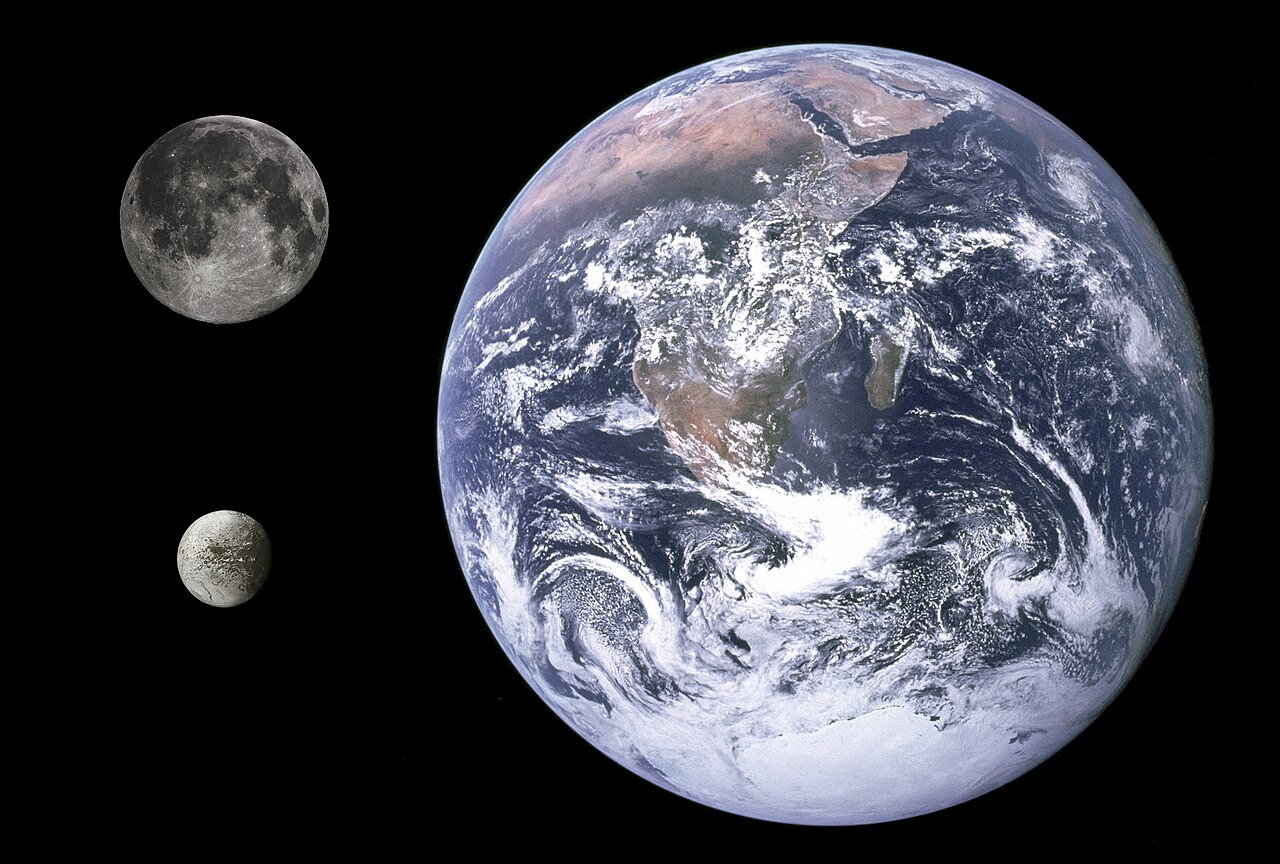
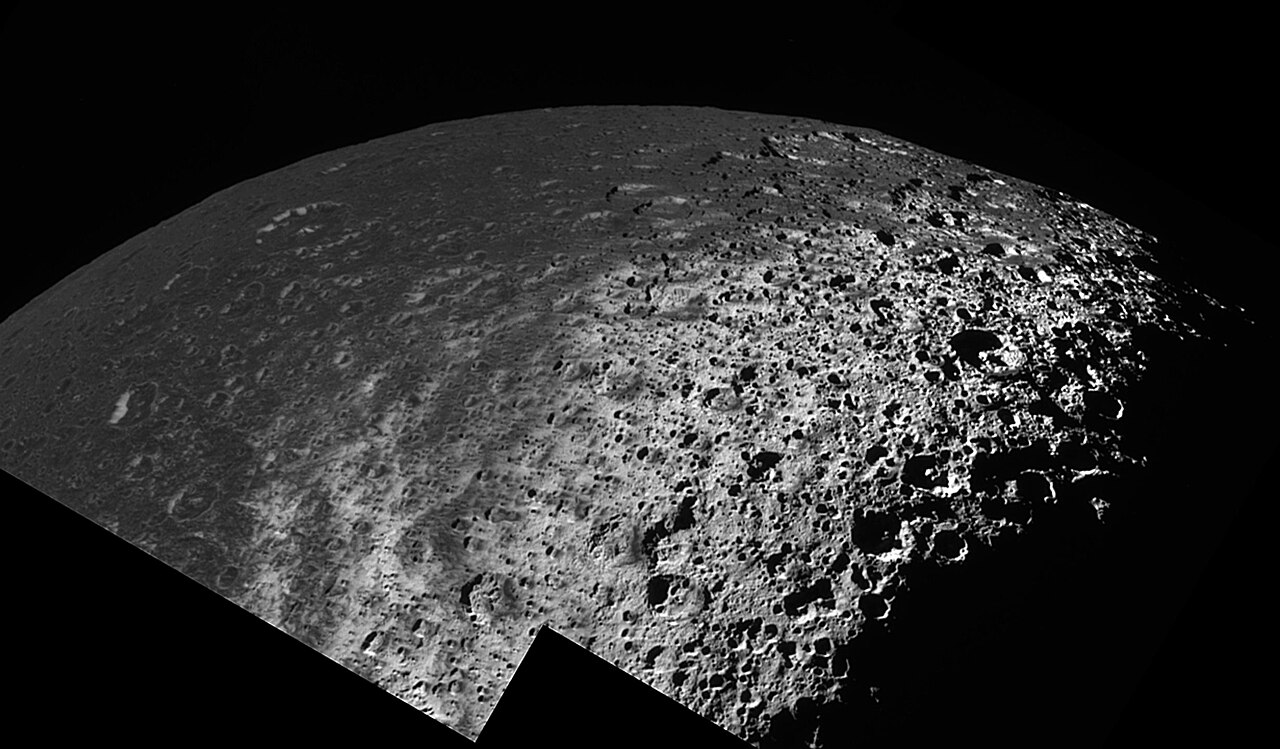
Iapetus is a relatively low-density body, indicating that ice makes up the bulk of its interior. Its estimated diameter of 1,469 kilometers places it as the third-largest moon orbiting Saturn and the eleventh-largest in the entire Solar System. The moon's surface bears several distinctive features, most notably the dramatic color contrast between its dark leading hemisphere and bright trailing hemisphere, and a massive equatorial ridge that stretches three-quarters of the way around the body. As for how Iapetus came to be, the standard model for Saturn's moons involves co-accretion from a circumplanetary disc, much like the formation of the planets themselves. However, a competing hypothesis for Titan's origin invokes a series of giant impacts between pre-existing moons, with Iapetus and Rhea potentially forming from the resulting debris. More recent research complicates this picture: studies suggest that all of Saturn's moons inward of Titan are no older than 100 million years, which would make it unlikely that Iapetus formed in the same collisional cascade as Rhea. Instead, Iapetus—along with Titan—may be a primordial satellite, a survivor from the earliest epoch of Saturn's formation.
Gallery
Frequently Asked Questions
What is Iapetus?
Iapetus is Saturn's third-largest moon and the outermost of its major satellites, measuring about 1,469 kilometers across. It also ranks as the eleventh-largest moon in the entire solar system.
Why does Iapetus look like a walnut?
The moon's nickname comes from its dramatic two-tone surface, where the leading hemisphere is coated in dark material while the trailing hemisphere stays bright. This stark split gives it a two-faced, almost split-personality appearance that no other Saturnian moon shares.
What is the equatorial ridge on Iapetus?
A towering mountain range stretches along Iapetus's equator for roughly three-quarters of the way around the moon. It is one of the longest and most prominent ridges found on any satellite in the solar system.
Who discovered Iapetus and when?
Italian astronomer Giovanni Domenico Cassini identified Iapetus in 1671 while studying Saturn's system. The moon was subsequently named after the Titan Iapetus from Greek mythology.
What is Iapetus made of?
The moon is composed primarily of water ice, with roughly twenty percent of its mass consisting of rocky materials. This ice-and-rock mixture is typical of Saturn's larger moons.
More in Moons of Saturn, Part 2 1-24
Spotted an error? Know more?
Reader corrections go straight into our review queue. Suggest an edit · How this site is sourced