Enceladus Explorer
Proposed orbiter and lander with ice-melting probe for Enceladus life detection.

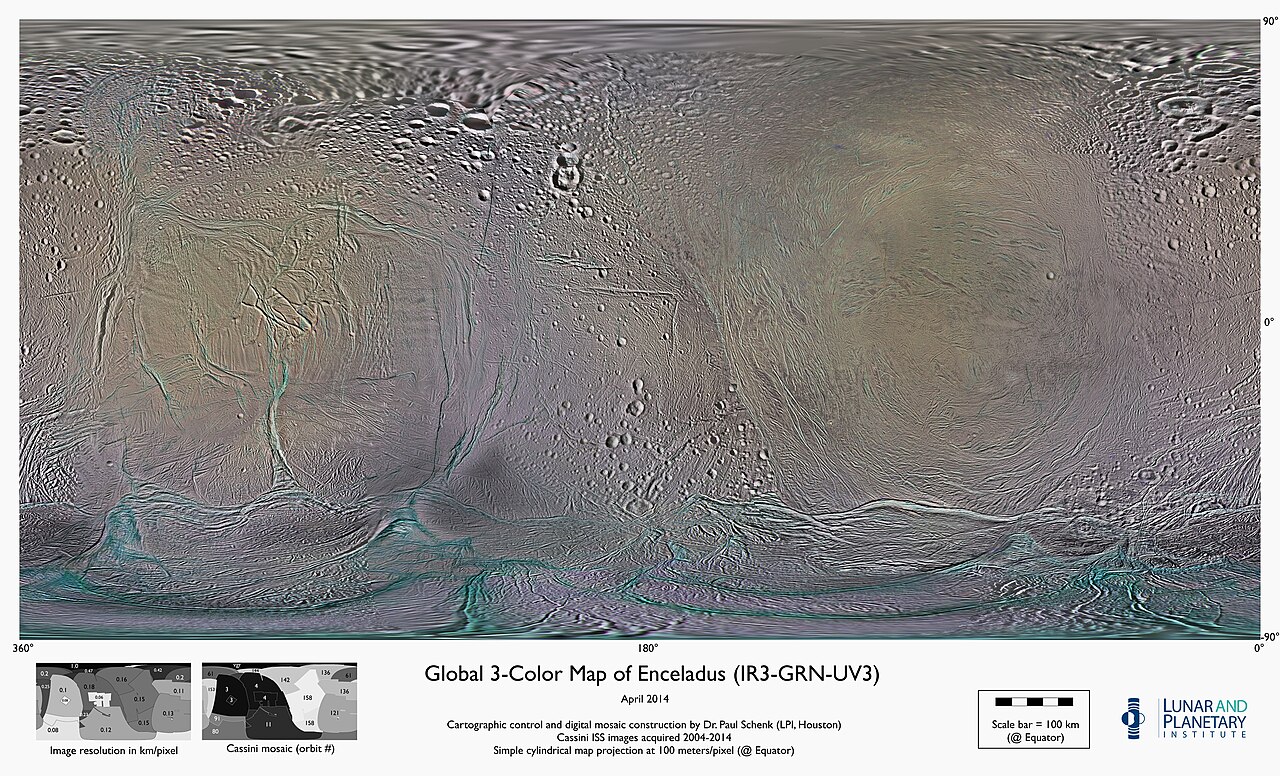
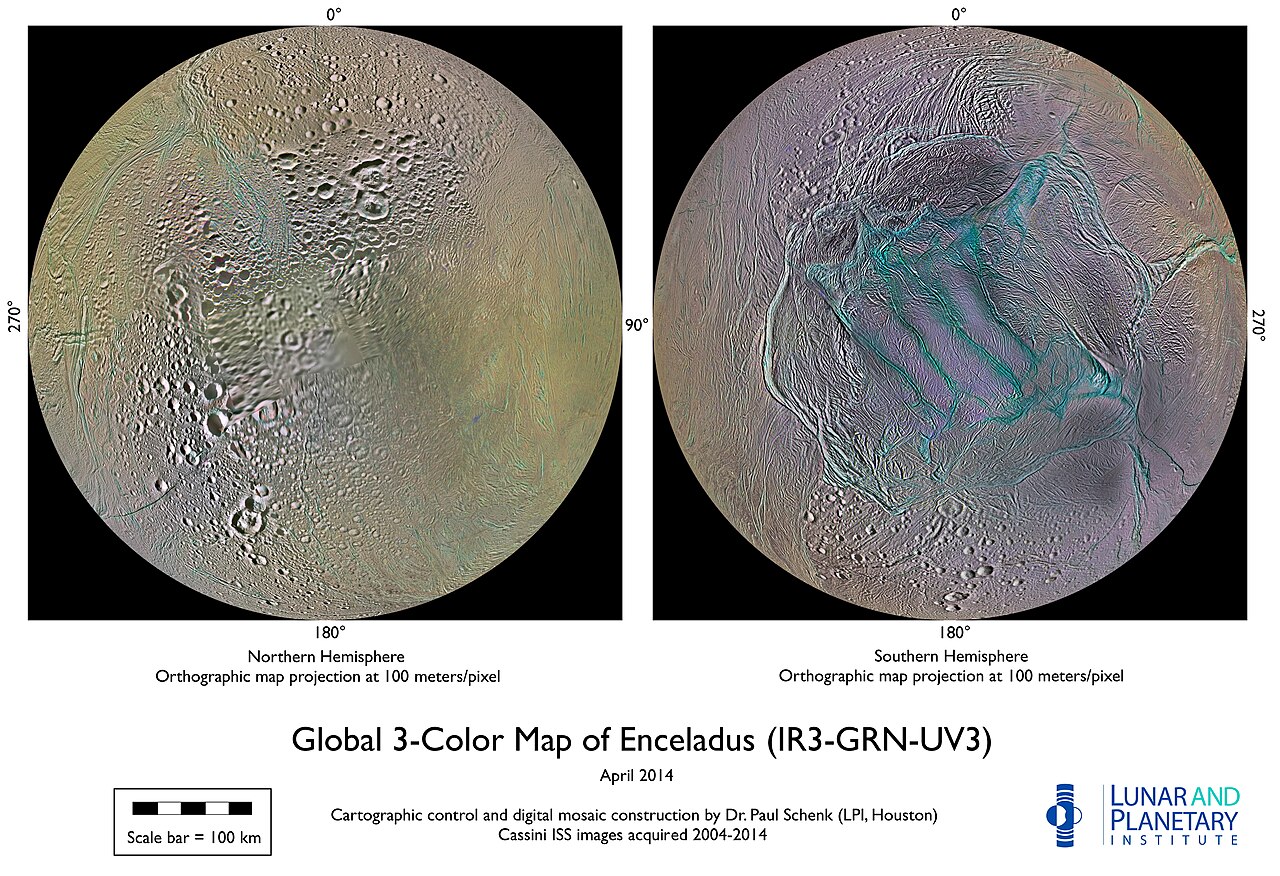
NASA / JPL-Caltech / Space Science Institute / Lunar and Planetary Institute · Public domain
Enceladus Explorer (EnEx) is a proposed mission to Saturn's moon Enceladus, combining an orbiter and a lander. The lander carries a maneuverable ice-melting probe designed to search for signs of life beneath the surface. The project is led by the German Aerospace Center (DLR) and involves a consortium of seven German universities.
Enceladus is a small, icy moon with a chemical makeup similar to comets. It has water jets erupting from its surface, possibly linked to hydrothermal vents on the ocean floor where the moon's internal ocean meets rock—a potential habitat for life. These geysers offer a way to sample the subsurface ocean; if microbial life exists, ice particles from the sea could carry evidence. Water from the ocean is thought to rise through cracks in the ice and escape into space via plumes, remaining liquid at shallow depths of tens of meters.
The EnEx mission includes a lander with the IceMole probe and an orbiter that relays communications between the lander and Earth. After launch, both craft travel together to Saturn using nuclear electric propulsion to power ion thrusters. The lander touches down at a safe distance from an active plume. The IceMole then melts its way through the ice, navigating autonomously around obstacles, toward a subglacial fracture about 200 meters deep. There it examines the environment for microorganisms before potential biosignatures degrade from exposure to space. The IceMole's high energy needs are met by a cable from the lander's small nuclear reactor, which supplies 5 kilowatts of electrical power.
The IceMole is an autonomous, maneuverable melting probe designed for clean analysis and sampling of glacial ice and subglacial materials, including liquid from a water reservoir beneath the icy crust. It combines melting with mechanical propulsion, and has demonstrated downward, horizontal, and upward melting, as well as curve driving and dirt layer penetration. It also includes systems for obstacle avoidance, target detection, and acoustic navigation in ice.
- Funding agency
- German Aerospace Center (DLR)
- Project start date
- 22 February 2012
- Participating institutions
- seven German universities
- Lander probe name
- IceMole
- Target depth
- about 200 m (660 ft)
- Lander power source
- small nuclear reactor providing 5 kW of electrical power
- Propulsion type
- nuclear electric propulsion (NEP) powering electric ion thrusters
Lore & Background
Enceladus is a small icy moon, seemingly similar in chemical makeup to comets, with jets or geysers of water erupting from its surface that might be connected to active hydrothermal vents at its subsurface water ocean floor, where the moon's ocean meets the underlying rock, a prime habitat for life. The geysers could provide easy access for sampling the moon's subsurface ocean, and if there is microbial life in it, ice particles from the sea could contain the evidence astrobiologists need to identify them. Water from the ocean is assumed to upwell through cracks in the ice and then eject into outer space through the plumes, remaining liquid up to shallow depths in the order of even tens of meters.
The EnEx mission consists of a lander carrying the IceMole, and an orbiter with the main function to act as a communications relay between the lander and Earth. After launch, the lander and orbiter would perform the interplanetary transfer to Saturn together, using on-board nuclear electric propulsion (NEP) to power electric ion thrusters. The lander would land at a safe distance away from an active vapor plume. The IceMole would then be deployed to melt its way through, while navigating autonomously around hazards, and towards a target subglacial aquiferous fracture at a depth of about 200 m for an in situ examination for the presence of microorganisms before potential biosignatures and biomolecules are degraded by exposure to outer space. The IceMole has a high energy demand that would be met by a cable run from the lander's small nuclear reactor providing 5 kW of electrical power.
The IceMole is an autonomous and maneuverable melting ice probe for clean in situ analysis and sampling of glacial ice and subglacial materials, including a liquid sample from a water reservoir below the icy crust. Its design is based on combining melting and mechanical propulsion. The team demonstrated downward, horizontal and upward melting, as well as curve driving and dirt layer penetration. It offers systems for obstacle avoidance, target detection, and acoustic navigation in ice.
Reader's Guide
The Enceladus Explorer concept is significant as a proposed mission specifically designed to assess the existence of life on Enceladus by directly accessing subsurface liquid water through its geyser plumes. The article notes that the geysers could provide easy access for sampling the moon's subsurface ocean, and if microbial life exists, ice particles from the sea could contain evidence astrobiologists need. The mission's legacy, as described, lies in its innovative approach: using a maneuverable ice-melting probe called IceMole that can navigate autonomously around hazards to reach a target depth of about 200 meters, where it would examine for microorganisms before biosignatures degrade from space exposure. The project was funded by the German Aerospace Center and involved a consortium of seven German universities, starting in February 2012. The concept's technical novelty includes combining melting and mechanical propulsion for directional ice travel, demonstrated in downward, horizontal, and upward modes, along with obstacle avoidance and acoustic navigation. The mission architecture pairs a lander with an orbiter for communications relay, using nuclear electric propulsion for the interplanetary journey. This approach addresses the challenge of sampling Enceladus's ocean without contamination, aiming to detect life in its most pristine state.
Did You Know?
- The EnEx mission would use nuclear electric propulsion (NEP) to power electric ion thrusters for the interplanetary transfer to Saturn.
- The IceMole probe is designed to melt through ice and navigate autonomously around hazards to a depth of about 200 meters.
- The lander would carry a small nuclear reactor providing 5 kW of electrical power to meet the IceMole's high energy demand.
Discovery, Naming & Early Observation
Enceladus was first spotted on August 28, 1789, by William Herschel using his newly built 1.2-metre telescope at Observatory House in Slough, England. Although it was then the largest instrument in the world, the moon's faint apparent magnitude of +11.7 and its tight proximity to the brilliant disc of Saturn and its rings made it a difficult target for smaller telescopes. Like several other Saturnian satellites identified before the Space Age, it was first detected during a Saturnian equinox, when Earth lies within the ring plane and the glare from the rings is reduced. For well over a century after that initial sighting, Enceladus remained essentially a point of light, with only its orbital parameters, estimated mass, density, and reflectivity known. The name was proposed in 1847 by John Herschel, William's son, in his publication on Cape of Good Hope observations. Drawing on Greek mythology, in which Saturn corresponds to Cronus, the Titan king, John assigned the name of the giant Enceladus to this moon. The International Astronomical Union later formalised the naming of surface features after characters and locations from Burton's 1885 translation of One Thousand and One Nights, with 85 features officially designated to date.
Spacecraft Revelations & the E Ring Connection
For nearly two centuries after Herschel's sighting, Enceladus offered astronomers nothing more than a faint dot and a set of orbital numbers. That changed when Voyager 1 and Voyager 2 swept past Saturn in 1980 and 1981, providing the first close-up imagery of the moon's surface. The real revolution arrived in 2005 with NASA's Cassini spacecraft, which performed a series of close flybys that transformed Enceladus from a quiet, snow-covered world into one of the most dynamically interesting bodies in the outer Solar System. Cassini revealed water-rich plumes erupting from the south polar region, with cryovolcanoes launching geyser-like jets of water vapour, molecular hydrogen, sodium chloride crystals, and ice particles into space at a combined rate of roughly 200 kilograms per second. More than one hundred individual geysers have since been catalogued. The composition of these plumes closely mirrors that of comets, and a significant fraction of the ejected material never falls back to the surface but instead feeds the vast E ring, making Enceladus the principal supplier of that ring's material.
Tidal Heating & Ongoing Geological Activity
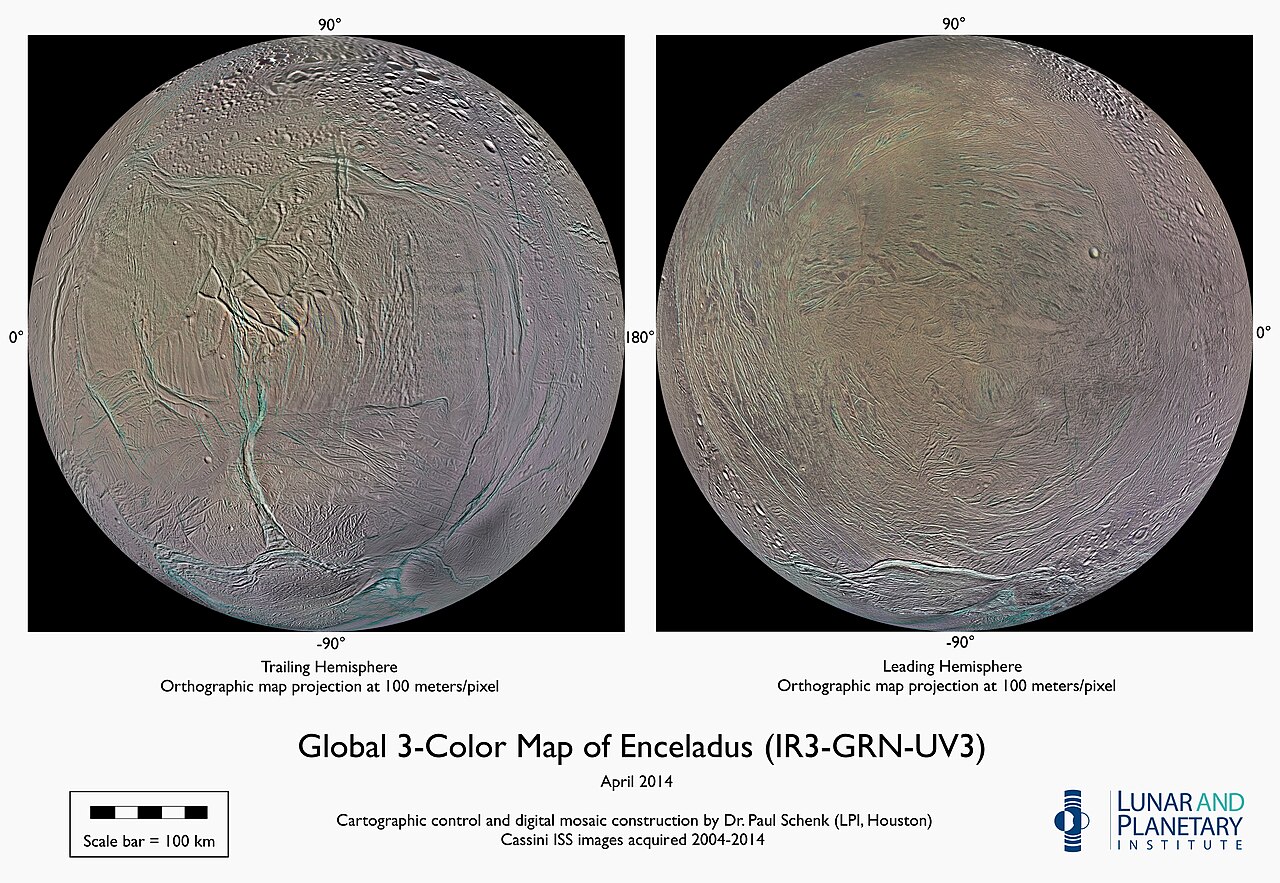
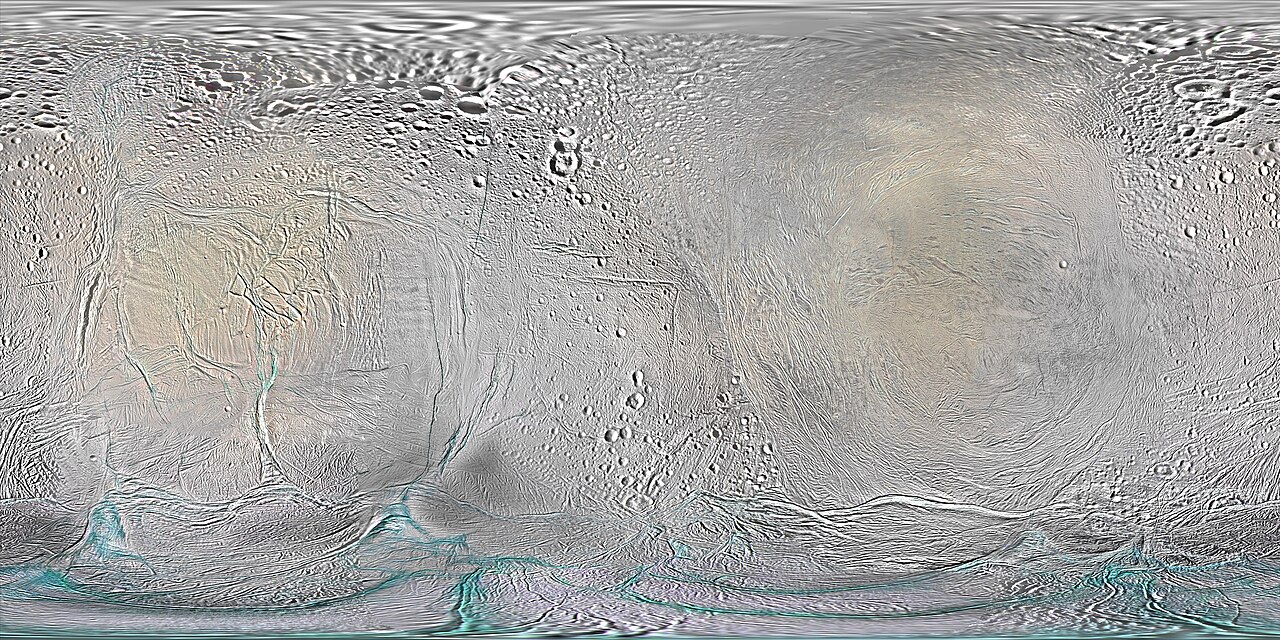
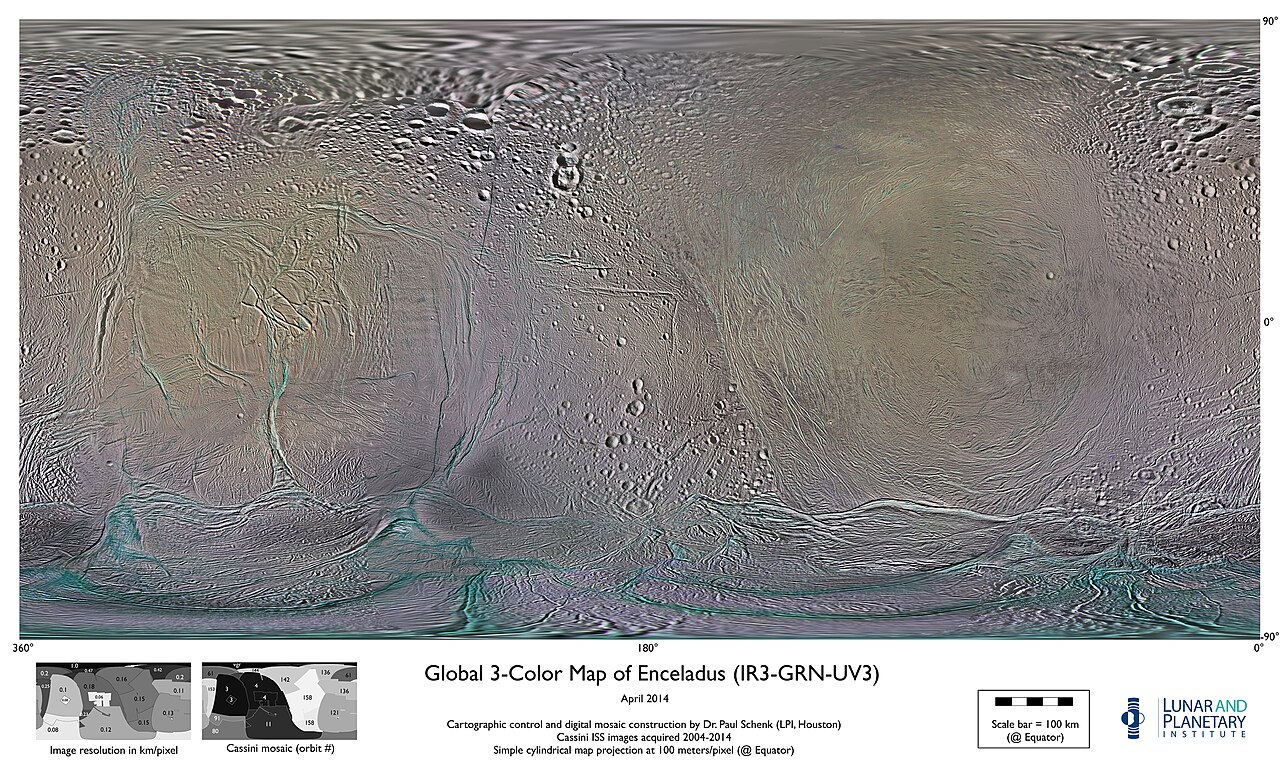
Despite its modest diameter of roughly 500 kilometres—only about a tenth of Titan's—Enceladus displays a remarkable diversity of terrain, spanning ancient, heavily cratered highlands to young, tectonically sculpted regions near the south pole. The engine behind this activity is gravitational: Enceladus is locked in a 2:1 mean-motion resonance with Dione, completing two orbits for every one Dione completes. This resonance forces a small but persistent orbital eccentricity of 0.0047, and the resulting tidal flexing generates internal heat that drives the moon's geologic processes. In 2014, NASA reported that Cassini data provided evidence for a substantial subsurface ocean of liquid water beneath the south polar ice, estimated at around ten kilometres in thickness. This ocean has since been mathematically modelled and replicated. The near-total absence of impact craters in the south polar region, combined with active cryoeruptions and measurable escaping heat, confirms that Enceladus is geologically alive today. The snow that blankets the surface, hundreds of metres thick and freshly deposited, gives the moon one of the highest albedos in the Solar System and keeps its noon temperature near minus 198 degrees Celsius.
Hydrothermal Chemistry & the Prospect of Habitability
Perhaps the most tantalizing discovery from the Cassini era is the suggestion that Enceladus's interior may support conditions favourable to life. Chemical analysis of the plume material detected signatures consistent with hydrothermal activity at the seafloor, implying that liquid water interacts with rocky material in a way that drives complex chemical reactions. This is significant because on Earth, hydrothermal vent ecosystems host diverse microbial communities that thrive without sunlight. Ongoing research indicates that Enceladus's hydrothermal environment could be habitable to some of the same microorganisms found around terrestrial vents. Even more intriguingly, methane detected in the plumes could potentially be a biological byproduct rather than purely abiotic in origin. The plumes also contain molecular hydrogen, a key energy source for chemosynthetic organisms. Taken together, these findings position Enceladus as one of the most promising targets in the search for extraterrestrial life, offering a subsurface ocean world where the essential ingredients for biology—liquid water, chemical energy, and key elements—appear to converge.
Gallery
Frequently Asked Questions
What is Enceladus Explorer?
Enceladus Explorer (EnEx) is a proposed space mission concept aimed at Saturn's moon Enceladus, pairing an orbital spacecraft with a surface lander that carries a maneuverable ice-melting probe to hunt for biosignatures beneath the ice.
Who leads the Enceladus Explorer project and when did it begin?
The German Aerospace Center (DLR) heads the effort, working alongside a consortium of seven German universities. The project was formally kicked off on 22 February 2012.
What is IceMole and how deep does it go?
IceMole is the lander's autonomous, ice-melting probe designed to burrow roughly 200 meters (about 660 feet) into Enceladus's frozen crust to reach the liquid ocean below and sample it for potential life.
How does the Enceladus Explorer lander stay powered?
A compact nuclear reactor mounted on the lander generates approximately 5 kilowatts of electrical power, enough to drive the ice-melting mechanism and keep the onboard instruments running in Enceladus's frigid environment.
Why do scientists think Enceladus could harbor life?
The moon's active water geysers are thought to be fed by hydrothermal vents where its internal ocean meets rocky terrain, creating a chemically rich interface that could sustain microbial ecosystems. Its overall composition also closely resembles that of comets, making it a prime target for astrobiology.
More in Moons of Saturn, Part 2 1-24
Spotted an error? Know more?
Reader corrections go straight into our review queue. Suggest an edit · How this site is sourced