
Cordova Mons
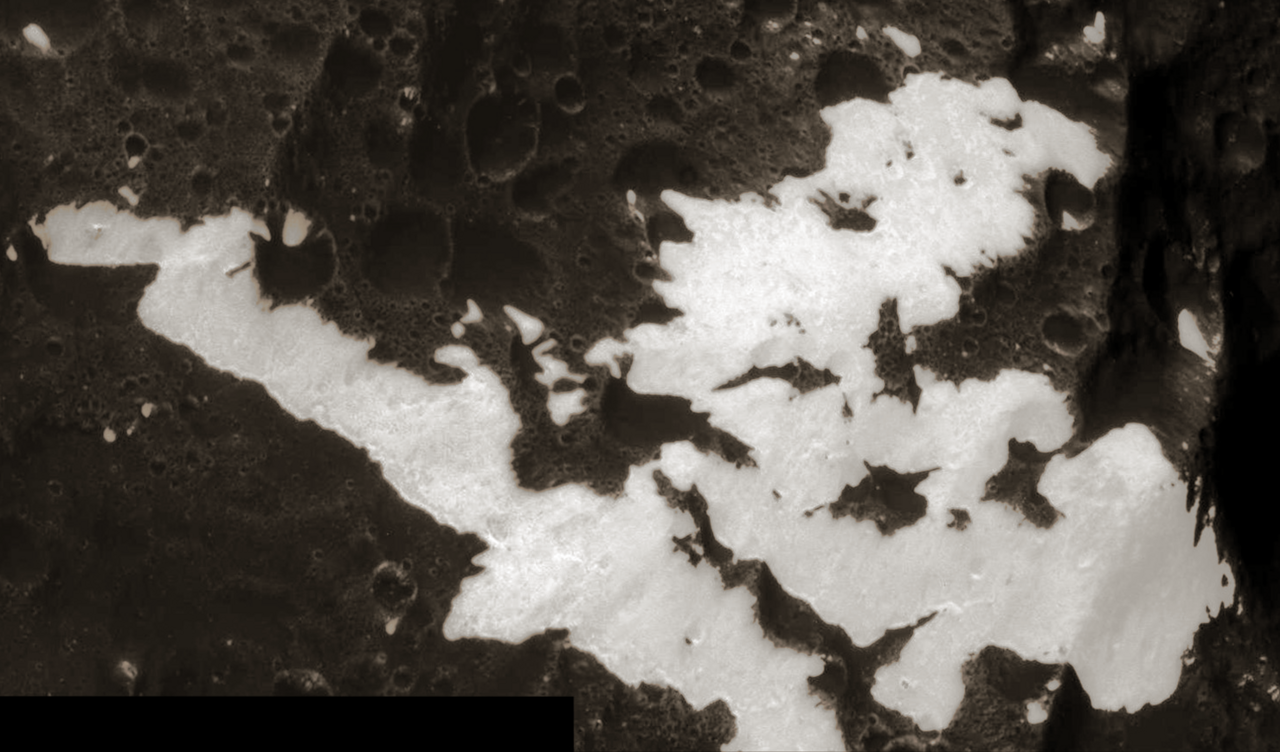
A bright equatorial peak on Saturn's moon Iapetus.

NASA / JPL · Public domain
Cordova Mons is a peak within the equatorial ridge of Iapetus, Saturn’s third-largest moon. It sits precisely on the moon’s equator and belongs to the Carcassone Montes range, which contains six or seven mountains. Its summit, coated in bright ice, gleams as a luminous patch against the dark landscape when observed from space.
The mountain’s name comes from the city of Córdoba in Spain, featured in the medieval epic *The Song of Roland*. In the poem, Charlemagne captures Córdoba from its Muslim rulers, though historically this never happened—Charlemagne lived centuries before Christian forces took the city during the Reconquista. The International Astronomical Union officially approved the name in August 2008.
Cordova Mons was first detected in Voyager 2 images from August 1981, during the spacecraft’s distant pass over Iapetus’s north pole. Bright dots appeared along the equator near the moon’s limb, rising above the dark terrain. These peaks were so tall they visibly distorted Iapetus’s spherical shape. Later, the Cassini probe’s close flybys—especially one in September 2007—confirmed that one of those dots was Cordova Mons’s white peak.
Geologically, Cordova Mons is the fifth member of the Carcassone Montes range when counted from west to east. It lies at the boundary between Iapetus’s bright and dark hemispheres. To its west are the crater Eudropin and the bright side; to the east are craters Basile, Torleu, Priamon, and Matthay, along with the dark region Cassini Regio. South of the mountain is the crater Timozel. Cordova Mons and its parent range were once informally called the Voyager Mountains, but both now have formal names.
The origin of Cordova Mons and the equatorial ridge remains unknown. Heavy cratering suggests they are extremely ancient. Hypotheses include remnants of an earlier oblate shape from faster rotation, debris from a collapsed ring system, or upwelled icy material from the moon’s interior, but none fully explain all features.
The clearest images of Cordova Mons came from Cassini’s September 2007 flyby, when the probe passed 1,227 kilometers from Iapetus, resolving details as small as 55 meters. As of 2026, no future missions to Iapetus have been approved.
Quick Facts
- Diameter
- 85 km
- Location
- Iapetus
- Eponym
- Córdoba, Spain
Facts from the source article.
Lore & Background
Cordova Mons was first seen in images taken by Voyager 2 during its brief flyby of Saturn in August 1981. As Voyager 2 passed over Iapetus's north pole at a great distance of 909,000 km (565,000 mi), bright strings of dots appeared along the moon's equator, near its limb from the spacecraft's perspective. These bright dots seem to protrude above the surrounding dark terrain on Iapetus. Cordova Mons and its sibling mountain peaks are so high that they clearly distort the spherical shape of Iapetus. When the Cassini space probe arrived at Saturn in July 2004, it was able to perform close flybys of Iapetus. These flybys, particularly the one in September 2007, confirmed that some of the bright dots in the older Voyager images were actually the white peak of Cordova Mons rising above the surrounding dark terrain.
Cordova Mons is a middle member of the Carcassone mountain range. From west to east, it is the fifth component of Carcassone Montes. Like its parent mountain range, Cordova Mons lies exactly on Iapetus' equator and at the transition zone between the bright and dark sides of Iapetus. To the west of Cordova Mons lies the crater Eudropin and the bright hemisphere of Iapetus, while to its east lie the craters Basile, Torleu, Priamon, and Matthay along with the rest of Iapetus's dark side, known as Cassini Regio. To the south lies the crater Timozel. In the past, Cordova Mons, together with its parent mountain range, Carcassone Montes, was once considered part of the Voyager Mountains, the informal name for Iapetus's equatorial ridge. Today, both features have been given their own formal names.
With the exception of Cassini Regio, all geological features and craters on Iapetus are formally named after characters and places from the Frankish medieval epic poem the Song of Roland. Mountains and mountain ranges on Iapetus, in particular, are named after places where the events of the poem took place. Cordova Mons is named after the city of Córdoba in Spain. Córdoba was conquered by Muslim Arabs from the Christian Visigoths in the 8th century CE, and it became a center of the Muslim world in the medieval Western hemisphere for centuries until it was taken by the Christian Spanish forces in the 13th century CE during the Reconquista. The Song of Roland claims that Córdoba was captured by Charlemagne from its Muslim rulers during his lifetime, but this is anachronistic and historically impossible, as Charlemagne lived in the 8th–9th centuries CE—four centuries before the city was actually conquered by Christian forces.
Reader's Guide
Cordova Mons is significant as a prominent member of Iapetus's equatorial ridge, a feature whose origin remains unknown. The mountain's white ice-covered peak, contrasting sharply with the dark surrounding terrain, made it visible as a bright dot in Voyager 2 images from 1981, and later confirmed by Cassini's close flyby in September 2007. That flyby, at a minimum distance of 1,227 km, resolved details as small as 55 meters per pixel on Cordova Mons, providing the clearest images of any part of Iapetus to date. The mountain's location exactly on the equator and at the transition between Iapetus's bright and dark hemispheres adds to its scientific interest. Its naming after Córdoba, Spain, follows the convention of using places from the Song of Roland for Iapetus's mountains, though the poem's claim of Charlemagne capturing the city is historically inaccurate. The heavy cratering observed across the ridge indicates that Cordova Mons and surrounding structures are extremely ancient. Several hypotheses for its formation exist—remnants of an earlier oblate shape, collapse of a former ring system, or upwelling of icy material—but none fully account for all characteristics. As of 2026, there are no approved future missions to Iapetus, making the Cassini data the best available.
Did You Know?
- Cordova Mons is the fifth component of the Carcassone Montes mountain range from west to east.
- The mountain was first seen as a bright dot in Voyager 2 images taken from 909,000 km away in August 1981.
- Cordova Mons is named after the city of Córdoba, Spain, from the Song of Roland, though the poem's claim of Charlemagne capturing it is anachronistic.
- During Cassini's September 2007 flyby, details as small as 55 meters per pixel were resolved on Cordova Mons.
First Glimpses and Close Encounters
Cordova Mons first entered humanity's awareness during Voyager 2's brief August 1981 flyby of Saturn. From a staggering distance of 909,000 kilometers as the spacecraft passed over Iapetus's north pole, the mountain appeared merely as part of a bright string of dots tracing the moon's equator near its limb. What struck observers was that these dots seemed to rise above the surrounding dark terrain, and the peaks were tall enough to visibly distort Iapetus's otherwise spherical silhouette. For over two decades, these dots remained a mystery. That changed when the Cassini probe reached Saturn in July 2004 and began performing close flybys of Iapetus. The September 2007 encounter, conducted at a minimum range of just 1,227 kilometers, resolved surface details down to 55 meters per pixel and confirmed beyond doubt that one of those enigmatic bright dots was the white-capped summit of Cordova Mons. Those Cassini images remain the sharpest views ever obtained of any region on Iapetus. As of 2026, no future mission to the moon has been approved.
Position and Surrounding Terrain
Cordova Mons sits precisely on Iapetus's equator, a fact that places it at the heart of the moon's most dramatic topographic feature. It is the fifth peak in the Carcassone Montes range when counted from west to east, making it a middle member of this six-to-seven-mountain chain. Its position is especially striking because it occupies the transition zone between Iapetus's bright hemisphere and its dark side, Cassini Regio. The white ice that blankets its summit causes the mountain to glow as a brilliant spot against the surrounding dark terrain when sunlight strikes it from space. To the west, the landscape opens into the bright hemisphere and the crater Eudropin. To the east, a string of craters—Basile, Torleu, Priamon, and Matthay—marks the boundary of the dark Cassini Regio. The crater Timozel lies to the south. Historically, Cordova Mons and its parent range were grouped under the informal label "Voyager Mountains," a catch-all term for the entire equatorial ridge. Both features have since received their own formal designations, distinguishing them from the broader ridge structure.
A Name from the Song of Roland
The naming of Iapetus's surface features follows a distinctive cultural tradition: with the sole exception of Cassini Regio, every geological feature and crater on the moon draws its name from the Frankish medieval epic the Song of Roland. Mountains and ranges specifically take their names from locations where the poem's events unfold. Cordova Mons is named for the city of Córdoba in Spain, a place of enormous historical significance. In the eighth century CE, Muslim Arab forces conquered the city from the Christian Visigoths, and for several centuries it served as a major intellectual and cultural center of the Muslim world in the western hemisphere. Christian Spanish forces eventually recaptured Córdoba in the thirteenth century during the Reconquista. The Song of Roland, however, claims that Charlemagne himself seized the city from its Muslim rulers—a narrative that is anachronistic, since Charlemagne lived in the eighth and ninth centuries, roughly four centuries before the actual Christian conquest. The International Astronomical Union formally approved the name Cordova Mons in August 2008.
An Unresolved Origin Story
The origin of Cordova Mons, like the rest of Iapetus's vast equatorial ridge, remains one of the moon's great unsolved geological puzzles. The most telling clue to its age is the heavy cratering observed across the ridge, which strongly suggests that Cordova Mons and its neighboring peaks are extraordinarily ancient. Despite decades of study, no single hypothesis fully explains every characteristic of the feature. One line of thinking proposes that the ridge and its mountains are remnants of Iapetus's earlier, more oblate shape, a form the moon would have had while rotating more rapidly in its youth. Another hypothesis suggests the mountains formed from the collapse of a former ring system that once encircled the moon. A third possibility points to upwelling of icy material from Iapetus's deep interior, pushing crustal material upward to build the ridge. Each theory captures certain aspects of the ridge's appearance and structure, yet none accounts for the full picture, leaving Cordova Mons's true formation story an open question in planetary science.
Gallery
Frequently Asked Questions
What is Cordova Mons?
Cordova Mons is a bright, ice-capped peak that forms part of Iapetus's equatorial ridge. It is the fifth mountain from the west within the Carcassone Montes chain and stands out as a luminous spot against the moon's otherwise dark terrain.
Where exactly is Cordova Mons located?
It sits directly on Iapetus's equator, making it one of the few features in the Carcassone Montes range positioned precisely at zero latitude. Iapetus is Saturn's third-largest moon.
How was Cordova Mons first spotted?
The peak was first identified in imagery returned by Voyager 2 during its August 1981 flyby of Saturn's system. The name 'Cordova Mons' was later officially approved by the IAU in August 2008.
What is the origin of the name Cordova Mons?
It takes its name from the Spanish city of Córdoba, which appears in the medieval French epic The Song of Roland as the site of Charlemagne's legendary (but historically inaccurate) conquest. The IAU draws on place names from various literary traditions when naming features on Saturn's moons.
What is the closest spacecraft observation of Cordova Mons?
Cassini flew within 1,227 kilometers (762 miles) of Iapetus in September 2007, providing the most detailed views of the peak to date. That flyby revealed the bright ice coating on its summit in far greater resolution than the original Voyager 2 images.
More in Moons of Saturn, Part 2 1-24
Spotted an error? Know more?
Reader corrections go straight into our review queue. Suggest an edit · How this site is sourced