L4 (spacecraft)
Proposed ESA mission to study Enceladus's plumes and land on its south pole.

NASA · Public domain
L4 is a European Space Agency (ESA) proposal to explore Saturn’s moon Enceladus. If given the go-ahead, the mission would launch in the early 2040s and include both an orbiter and a lander. Enceladus became ESA’s top exploration priority in 2024 because of strong evidence that it could support life.
Enceladus is an icy moon of Saturn with a liquid water ocean beneath its surface. It is one of the few geologically active worlds in the Solar System: its underground ocean shoots water geysers into space. Planetary scientists believe this water touches the moon’s rocky interior, which could supply the chemical building blocks for life. Unlike other ocean worlds, where the ocean lies under thick, solid ice, Enceladus’s ocean can be studied more directly by analyzing the water from its plumes. The Cassini probe detected molecules in those plumes that life needs, such as phosphates and salts, boosting the case for habitability.
The L4 probe would launch on two new-generation Ariane 6 rockets, arriving at Saturn about a decade later. The spacecraft has two parts that would need to be assembled in space. The mission aims to reach Saturn during its southern summer, when sunlight illuminates the moon’s south pole, where the geysers are located. After arrival, the probe would perform multiple flybys of Enceladus and other icy moons—Titan, Rhea, Dione, Tethys, and Mimas. After sampling the geysers from orbit, the spacecraft would land on Enceladus’s south pole, near the active geysers, with a planned landing in 2052. The lander might use rollable solar arrays.
Between 2018 and 2021, ESA scientists set priorities for Voyage 2050, the next phase of the agency’s Science Programme. They chose three themes for large missions: icy moons (with Enceladus as a prime astrobiology target), exoplanets, and the early Universe. The 2023-2032 Planetary Science Decadal Survey, published by US scientists in 2022, ranked a mission to Enceladus as its second priority. In 2024, ESA made Enceladus the top candidate for its next L-class mission under Voyage 2050, following JUICE (L1), LISA (L2), and Athena (L3). At the 2025 ministerial council, where ESA member states approved their largest budget yet, Director General Josef Aschbacher mentioned L4 to Enceladus as a key future project.
Quick Facts
- Mission Type
- Enceladus orbiter and lander
- Operator
- ESA
- Launch Date
- 2042 (Planned)
- Launch Rocket
- Ariane 6
- Programme
- Voyage 2050 (Science Programme)
- Previous Mission
- Plasma Observatory
Facts from the source article.
Lore & Background
L4 is a proposed mission to Enceladus by the European Space Agency (ESA). If approved, it is expected to be launched in the early 2040s. The mission will consist of an orbiter and a lander. Since 2024, Enceladus has been identified as the European Space Agency's top priority for space exploration due to strong signs of potential habitability.
The L4 probe is proposed to be launched in the early 2040s aboard two new generation Ariane 6 rockets, arriving at Saturn around a decade later. The ESA chart shows that the spacecraft will be composed of two parts which will need to be assembled while in outer space. Ideally, L4 should arrive at Saturn around the time when the planet and its moons' southern poles are illuminated by the Sun—around Saturn's southern summertime—to allow the space probe to study Enceladus's geysers which are located on the moon's south pole.
After arriving at the Saturn system, the probe will then perform multiple flybys of Enceladus and Saturn's other icy moons, including Titan, Rhea, Dione, Tethys, and Mimas. After performing multiple sampling of the moon's geysers while in orbit, the L4 spacecraft will then land on Enceladus' south pole where the active geysers are located. The landing is envisioned to take place in 2052. The lander may use rollable solar arrays.
Reader's Guide
L4 is notable as ESA's top-priority large-class mission for the Voyage 2050 programme, following JUICE (L1), LISA (L2), and Athena (L3). Its significance stems from Enceladus's status as an icy ocean-bearing moon with strong signs of potential habitability. The Cassini space probe detected molecules from the moon's watery plumes that life needs to survive, such as phosphates and salts. Unlike other ocean worlds, Enceladus's internal ocean can be observed more directly by analysing water erupting from its geysers. The mission's profile includes multiple flybys of Saturn's icy moons and a landing on Enceladus's south pole in 2052. The project history shows that between 2018 and 2021, ESA scientists identified icy moons as a priority theme, and the 2023-2032 Planetary Science Decadal Survey listed a mission to Enceladus as its second priority. In 2024, ESA identified Enceladus as the most promising target for its next L-class mission. During the 2025 ministerial council, Director General Josef Aschbacher mentioned L4 as one of the agency's top potential future projects. In 2026, the mission team had to rework the proposal after the originally planned Ariane 64 Block 3 was cancelled, refocusing on Ariane 64 Block 2 or an alternative launch vehicle.
Did You Know?
- The spacecraft will consist of an orbiter and a lander, assembled while in outer space.
- The landing on Enceladus's south pole is envisioned to take place in 2052.
- Enceladus was identified as ESA's top priority for space exploration in 2024 due to strong signs of potential habitability.
The Giants and Their Wonders
Saturn commands the largest confirmed moon family in our Solar System, with 293 satellites whose orbits have been verified as of mid-2026. Among this vast retinue, three stand out for their extraordinary surface and atmospheric characteristics. Titan, the second-largest moon anywhere in the system and bigger than the planet Mercury, wraps itself in a thick nitrogen-dominated atmosphere. Beneath that shroud lie flowing river networks and standing bodies of liquid hydrocarbon—lakes that have no parallel on any other world. Enceladus, by contrast, is a frozen sphere blanketed in a deep layer of snow, yet it belches plumes of ice particles from vents near its south pole, a sign of internal activity that keeps scientists intrigued. Iapetus presents perhaps the most visually striking puzzle: its two hemispheres differ dramatically in color, one dark and one bright, while a formidable chain of equatorial mountains—some of the tallest peaks known in the Solar System—circles its midline. Together these three bodies illustrate just how wildly diverse a single planet's satellite family can be.
Two Worlds of Orbits
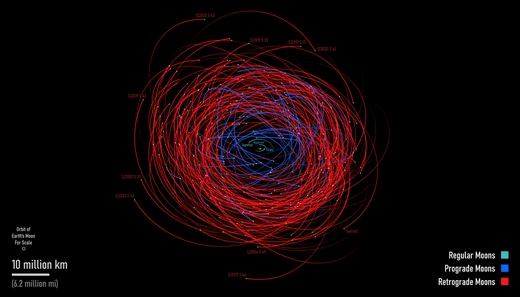
The 293 confirmed moons split into two fundamentally different populations. The 25 regular satellites trace flat, prograde paths close to Saturn's equatorial plane, with Iapetus as the exception—its orbit is prograde but significantly tilted. This group includes the seven rounded bodies, four small trojan companions, and several circling inside the G Ring or between Mimas and Enceladus. Janus and Epimetheus form the only known mutually co-orbital pair in the Solar System, while Hyperion is locked in a resonance with Titan. Some regular satellites serve as shepherds of the dense A Ring and the narrow F Ring. Their names draw from the mythological Titans and Titanesses, though two—S/2009 S 1 and S/2009 S 2—remain unnamed. The other 268 moons are irregular satellites, ranging from 2 to 213 kilometers, with highly inclined and eccentric orbits in both prograde and retrograde directions. They are likely captured minor planets or collision debris, sorted into the prograde Inuit and Gallic groups and the large retrograde Norse group. Phoebe, the biggest irregular, breaks the naming pattern with a Greek Titaness name despite belonging to the Norse set. As of April 2026, 228 of these irregulars still lack names.
From Eyepiece to Spacecraft
For over two centuries, Saturn's moons were found one by one through ground-based telescopes. Christiaan Huygens spotted Titan in 1655 using a refracting telescope he built himself, equipped with a 57-millimeter objective. Giovanni Domenico Cassini followed between 1671 and 1684, identifying Tethys, Dione, Rhea, and Iapetus—a quartet he called the Sidera Lodoicea. William Herschel added Mimas and Enceladus in 1789, and Hyperion was located in 1848 by W. C. Bond, G. P. Bond, and William Lassell. The shift to long-exposure photographic plates opened a new era: W. H. Pickering found Phoebe in 1899, the first moon discovered this way. In 1966 Audouin Dollfus identified Janus during a ring edge-on viewing near equinox, and a few years later it became clear that a second body, Epimetheus, shared its orbit. Ground-based work in 1980 yielded three trojan moons of Dione and Tethys. Then uncrewed probes transformed the field. Voyager's 1980–1981 flyby revealed Atlas, Prometheus, and Pandora, while Pan was pulled from archival Voyager imagery in 1990. Cassini, arriving in July 2004, added Methone, Pallene, Polydeuces, Daphnis, Anthe, Aegaeon, and the B Ring moonlets S/2009 S 1 and S/2009 S 2, the latter not reported until June 2026.
Where Moons End and Rings Begin
Saturn's magnificent ring system is composed of countless objects spanning from dust grains to moonlets several hundred meters wide, each tracing its own orbit around the planet. The 293 confirmed moons do not include these embedded moonlets, nor the hundreds of possible kilometer-scale distant bodies that have been glimpsed only once. Because no agreed-upon size or dynamical threshold separates a moon from a ring particle, an absolute count of Saturnian satellites remains impossible. More than 150 moonlets hiding within the rings have been identified by the gravitational disturbances they stir in surrounding ring material, yet researchers believe this represents only a tiny fraction of the true population. In April 2014, observations even hinted at the possible birth of a new moonlet inside the A Ring. The situation underscores a deeper truth: Saturn's satellite family is not a fixed roster but a living, evolving system in which small bodies are continually being created, shepherded, and perhaps destroyed, blurring the line between the planet's rings and its moons.
Gallery
Frequently Asked Questions
What is L4 (spacecraft)?
L4 is a proposed European Space Agency mission built around an orbiter and a lander, both aimed at Saturn's icy moon Enceladus. ESA elevated it to its top exploration priority in 2024 after mounting evidence suggested the moon could host conditions suitable for life.
When and how will L4 (spacecraft) launch?
The mission is slated for the early 2040s, riding on two new-generation Ariane 6 rockets. The original configuration called for Ariane 64 Block 3 vehicles, but the plan was later refocused toward Block 2 or an alternative variant.
Where will L4 (spacecraft) land, and when?
The lander is designed to touch down on Enceladus's south pole, the region where the moon's water geysers erupt from its subsurface ocean. The target landing date is 2052, ideally timed to coincide with Saturn's southern summer for better surface lighting.
What will L4 (spacecraft) actually do there?
The orbiter will monitor Enceladus's plumes and overall geology from orbit, while the lander will probe the liquid water ocean and how it interacts with the rocky material beneath the ice shell. Together the two elements are meant to assess whether the moon's environment could sustain microbial life.
Why is L4 (spacecraft) a big deal for Saturn-system fans?
Enceladus is one of the very few geologically active worlds in the Solar System, with an underground ocean that repeatedly shoots water into space. A successful L4 mission would represent the first direct, on-the-ground exploration of a potentially habitable body beyond Earth, making it a landmark step in the search for life.
More in Moons of Saturn, Part 2 1-24
Spotted an error? Know more?
Reader corrections go straight into our review queue. Suggest an edit · How this site is sourced