Enceladus Life Finder
Proposed NASA mission to assess Enceladus's ocean habitability.

NASA/JPL/USGS · Public domain
Enceladus Life Finder (ELF) is a proposed NASA mission concept designed to study whether the subsurface ocean of Saturn's moon Enceladus could support life. The spacecraft would orbit Saturn and make multiple passes through the moon's icy plumes, using solar panels for power.
First proposed in 2015 for a Discovery Mission opportunity, and again in 2017 for NASA's New Frontiers program, ELF was not selected either time. If chosen in the future, it would search for biosignatures and biomolecules in the geysers that shoot water, salts, and organic material from a subsurface ocean through cracks in the south polar region. The water is thought to be heated by hydrothermal vents similar to those on Earth's ocean floor. ELF's instruments would look for amino acids, analyze fatty acids, and determine whether methane in the plumes could come from living organisms.
In 2008, Cassini flew through a plume and detected simple organics like methane, carbon monoxide, carbon dioxide, nitrogen, and complex organic compounds, along with sodium and potassium indicating a salty ocean. However, Cassini lacked the sensitivity for direct life detection. In December 2023, astronomers reported the first discovery of hydrogen cyanide in the plumes—a possible building block for life—along with other organic molecules, some still unidentified. Researchers noted these compounds could support microbial life or drive complex organic synthesis.
The ELF mission would build on Cassini's 2005 discovery of active jets and an internal ocean. It would fly through the plumes eight to ten times over three years, sampling ice particles that could contain evidence of microbial life from the subsurface sea. The principal investigator is Jonathan Lunine of Cornell University.
The mission's goals come from the most recent decadal survey: determine the primordial sources of organics and sites of organic synthesis today, and find out whether Enceladus currently has habitats where life could exist—and whether life exists there now. Three objectives support these goals: measure neutral species to see if organics have been thermally altered; characterize the ocean's pH, oxidation state, chemical energy, and temperature to assess its life-carrying capacity; and look for signs of biological processes using three independent chemical tests.
ELF's payload would include two mass spectrometers.
- Proposed to
- NASA's New Frontiers program Mission 4 (May 2017) and Discovery Mission 13 (2015)
- Principal investigator
- Jonathan Lunine of Cornell University, Ithaca, New York
- Number of plume flythroughs
- 8 to 10
- Mission duration
- 3 years
- Payload instruments
- Mass Spectrometer for Planetary Exploration (MASPEX) and Enceladus Icy Jet Analyzer (ENIJA)
Lore & Background
The Enceladus Life Finder mission was first proposed in 2015 for Discovery Mission 13 funding, and then proposed in May 2017 to NASA's New Frontiers program Mission 4, but it was not selected. If selected at another future opportunity, the ELF mission would search for biosignatures and biomolecules in the geysers of Enceladus. The south polar jets loft water, salts and organic molecules dozens of miles over the moon's surface from an underground regional ocean, with the hypothesis that the water is warmed by thermal vents similar to features found deep in Earth's oceans.
In 2008, the Cassini orbiter flew through a plume and detected simple organics including methane, carbon monoxide, carbon dioxide, nitrogen, and complex organic compounds, as well as sodium and potassium implying a salty liquid ocean. However, Cassini did not have the sensitivity required for direct analyses. On 14 December 2023, astronomers reported the first discovery in the plumes of hydrogen cyanide, a possible chemical essential for life, as well as other organic molecules.
The ELF mission concept would have the orbiter fly 8 to 10 times through plumes over 3 years. The geysers could provide easy access for sampling the moon's subsurface ocean, and if microbial life exists, ice particles from the sea could contain evidence. The mission's three objectives include measuring neutral species to ascertain thermal alteration, determining the interior marine environment's pH, oxidation state, available chemical energy, and temperature, and looking for indications of biological processes through three independent chemical measurements.
Reader's Guide
The Enceladus Life Finder represents a direct follow-up to the Cassini orbiter's discoveries, which revealed active jetting and an internal ocean on Enceladus. The mission's significance lies in its targeted search for biosignatures using two advanced mass spectrometers—MASPEX for gas and ENIJA for solid particles—designed to overcome Cassini's sensitivity limitations. ELF's three independent life-detection tests (amino acid distribution, fatty acid carbon number bias, and isotopic ratios with methane abundance) aim to minimize ambiguity in identifying biological processes. The discovery of hydrogen cyanide in the plumes in 2023 further underscores the moon's potential to support life. Although not selected for Discovery or New Frontiers funding, the mission concept remains a benchmark for future astrobiology exploration of Enceladus, leveraging the plume access to the subsurface ocean without requiring landing. Its legacy includes defining the scientific payload and objectives that could be adopted by subsequent proposals, such as the Enceladus Orbilander or other missions.
Did You Know?
- The ELF mission would fly through Enceladus's plumes 8 to 10 times over 3 years.
- Cassini detected sodium and potassium in the plumes, implying a salty liquid ocean.
- Hydrogen cyanide, a possible chemical essential for life, was discovered in the plumes on 14 December 2023.
- The mission's payload includes two mass spectrometers: MASPEX for gas and ENIJA for solid particles.
Discovery and the Long Wait for Answers
Enceladus first entered human knowledge on the night of August 28, 1789, when William Herschel pointed his newly completed 1.2-metre telescope—then the largest instrument on Earth—toward Saturn from Observatory House in Slough, England. The moon's faint brightness, with an apparent magnitude of only +11.7, and its close proximity to the brilliant planet and its dazzling rings made it an extremely challenging target for smaller ground-based telescopes. Herschel happened to make his observation during a Saturnian equinox, a window when Earth sits within the ring plane and the glare from the rings diminishes, rendering the smaller satellites slightly easier to spot. For nearly two centuries after that initial sighting, Enceladus remained little more than a smudge of light; astronomers could estimate its mass, density, and reflectivity from orbital data, but its surface was an unknown. The Voyager 1 and Voyager 2 flybys of 1980 and 1981 began to change that picture, and Cassini's repeated close approaches starting in 2005 transformed Enceladus from a distant dot into a world of startling complexity.
The Geyser World
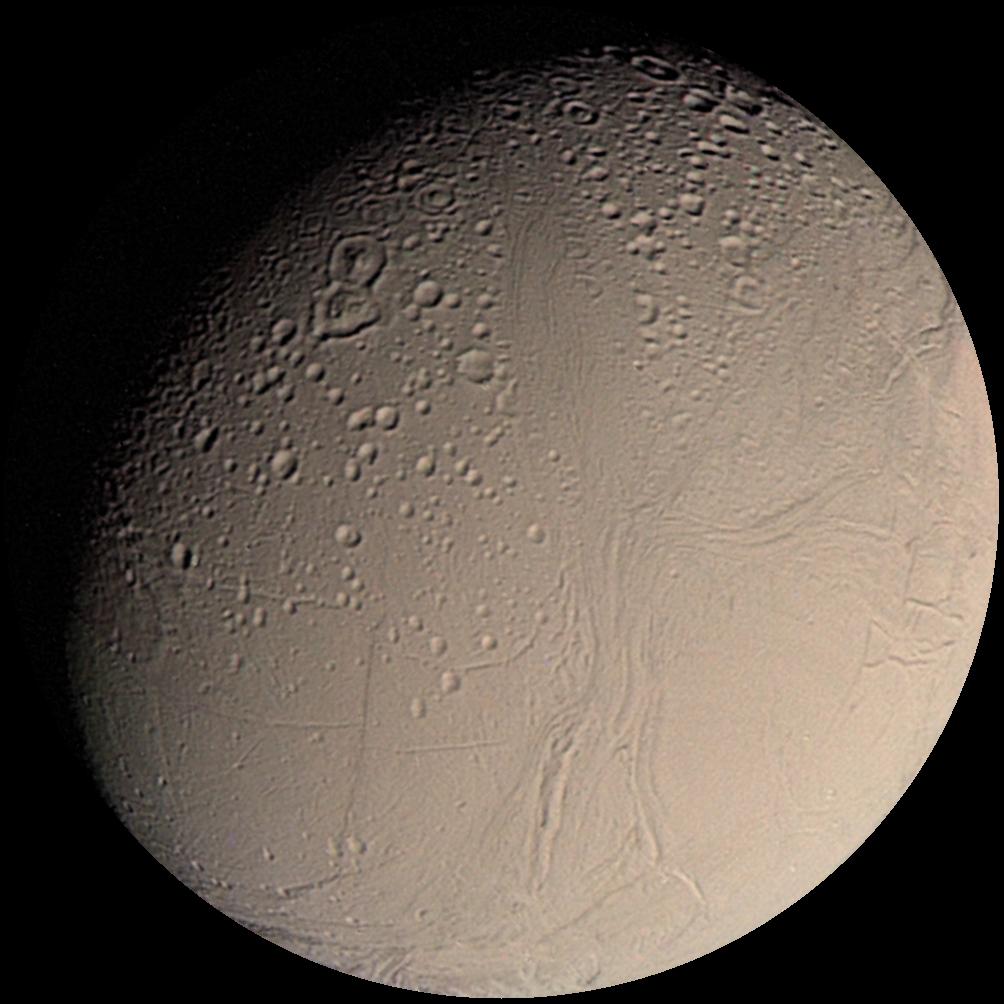
Beneath the pristine white snow that blankets Enceladus's surface—snow so fresh and thick it can reach several hundred metres in depth—lies one of the most active geological landscapes in the Solar System. Cassini's flybys revealed that the south polar region is punctuated by more than a hundred cryovolcanic vents, each launching geyser-like columns of water vapour, molecular hydrogen, assorted volatile compounds, and solid debris such as sodium chloride crystals and ice grains into space. The combined output of these plumes amounts to roughly 200 kilograms of material every second. NASA scientists have noted that the chemical makeup of the jets closely resembles that of cometary material. A fraction of the ejected water condenses and drifts back down as the ever-renewing snow cover, while the remainder escapes the moon's weak gravity and becomes the dominant source of particles feeding Saturn's vast E ring. Cassini also conducted direct chemical sampling of the plume material, detecting signatures that point to hydrothermal processes occurring deep below the icy crust.
A Hidden Ocean and the Question of Life
In 2014, NASA announced that Cassini data provided compelling evidence for a vast subsurface ocean of liquid water beneath Enceladus's south polar ice shell, estimated to be roughly ten kilometres thick. Subsequent mathematical modelling has successfully reproduced the conditions needed for such an ocean to persist. The same chemical analyses that detected hydrothermal signatures in the plumes suggest that water-rock interactions are occurring at depth, potentially driving complex chemical reactions. Ongoing research has explored whether this hydrothermal environment could sustain life analogous to the microbial communities thriving around Earth's deep-sea hydrothermal vents. One particularly tantalising finding is the detection of methane in the plumes; some scientists propose that this methane could be a biological by-product rather than purely abiotic in origin. Together with the moon's measurable internal heat loss and the striking scarcity of impact craters across the south polar terrain, these clues paint a picture of a small icy world that is not only alive geologically but may also harbour conditions compatible with microbial life.
Tidal Forces and Orbital Resonance
Enceladus circles Saturn as the second-largest moon in the system, completing one orbit every 32.9 hours at a distance of roughly 238,000 kilometres from the planet's centre. It threads its way between the orbits of Mimas and Tethys and travels through the densest portion of Saturn's E ring, the outermost of the planet's major ring structures. The moon's geological engine is powered by a gravitational interplay with its larger neighbour Dione: the two bodies share a 2:1 mean-motion resonance, meaning Enceladus laps Dione every two of its own orbits. This resonance sustains a small but persistent orbital eccentricity of 0.0047, which in turn forces Enceladus to stretch and compress slightly with each revolution. The friction generated by that tidal flexing is the principal heat source driving the cryovolcanism and tectonic activity observed today. Enceladus is also tidally locked, always presenting the same face toward Saturn, and analyses of its shape hint that it may once have experienced a 1:4 spin-orbit libration that could have supplied an additional, now-vanished, source of internal warmth.
Gallery
Frequently Asked Questions
What is Enceladus Life Finder?
Enceladus Life Finder is a conceptual NASA spacecraft designed to investigate whether the hidden ocean beneath Enceladus's icy shell could harbor living organisms. Rather than landing on the moon, the craft would orbit Saturn and fly repeatedly through the water-ice jets erupting from the moon's southern polar region.
Who is behind Enceladus Life Finder?
Jonathan Lunine, a planetary scientist at Cornell University in Ithaca, New York, serves as the principal investigator for the mission concept. He first pitched the idea to NASA in 2015 as a Discovery Mission candidate and resubmitted it in 2017 under the New Frontiers program.
How would Enceladus Life Finder sample Enceladus's plumes?
The spacecraft would use solar panels for power while orbiting Saturn, then execute between eight and ten close flythroughs of the moon's geyser streams over a roughly three-year mission. During each pass, its instruments would analyze the water vapor, dissolved salts, and organic compounds being ejected from the subsurface ocean.
What instruments does Enceladus Life Finder carry?
The proposed payload includes two key instruments: the Mass Spectrometer for Planetary Exploration (MASPEX) and the Enceladus Icy Jet Analyzer (ENIJA). Together they are designed to detect and characterize biosignature molecules and other organic compounds within the plume material.
Why hasn't Enceladus Life Finder launched yet?
NASA passed on the concept both when it was submitted for the Discovery Mission 13 slot in 2015 and for the New Frontiers Mission 4 slot in May 2017. As of now it remains a study rather than an approved flight, though it could still be proposed for a future selection round.
More in Moons of Saturn, Part 2 1-24
Spotted an error? Know more?
Reader corrections go straight into our review queue. Suggest an edit · How this site is sourced