
Carcassone Montes
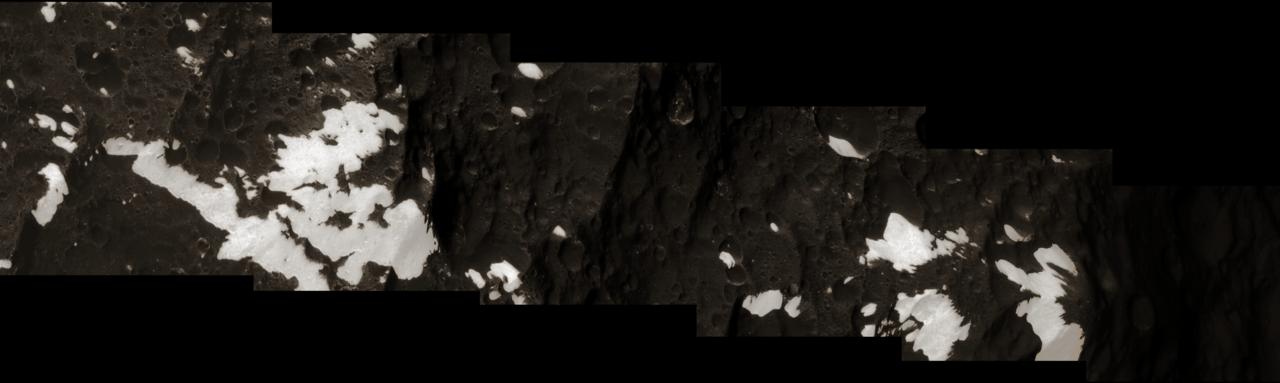
A bright, isolated segment of Iapetus's equatorial ridge.

NASA/JPL · Public domain
Carcassone Montes is a segment of the equatorial ridge on Iapetus, Saturn’s third-largest moon. It stretches roughly 740 kilometers along the moon’s equator and is one of three such mountain range sections.
The range is named after the walled city of Carcassonne in southern France, which, in the medieval epic *The Song of Roland*, was sacked by the hero Roland. The International Astronomical Union approved the name in August 2008, though the spelling differs slightly from the city’s.
First spotted in Voyager 2 images from August 1981, the range appeared as bright dots near Iapetus’s equator, protruding above dark material. Their nature was debated until the Cassini probe confirmed in 2004 that these were the white peaks of Carcassone Montes.
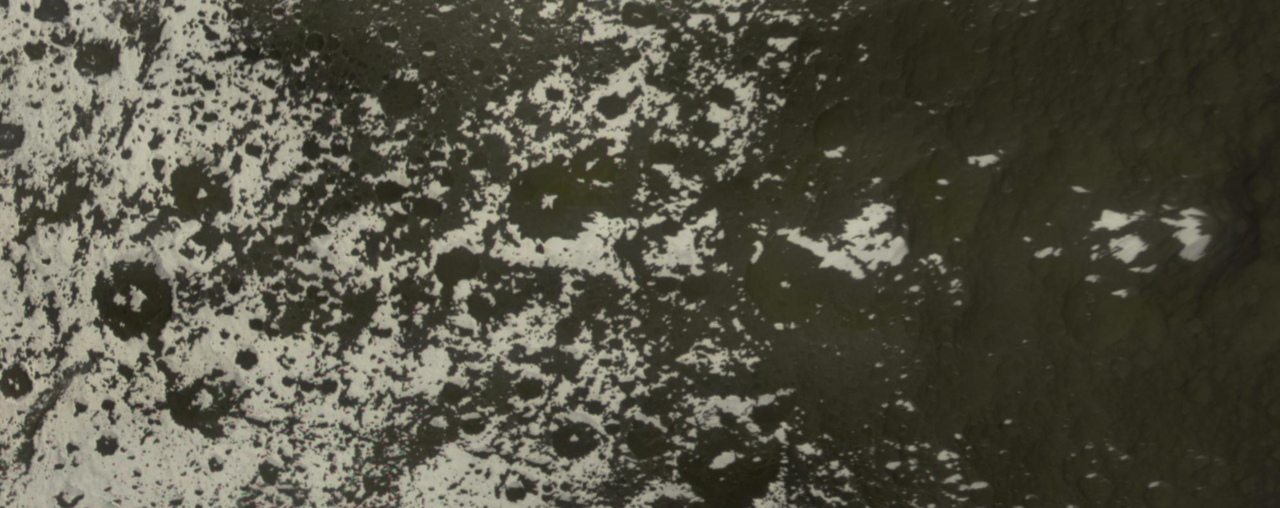
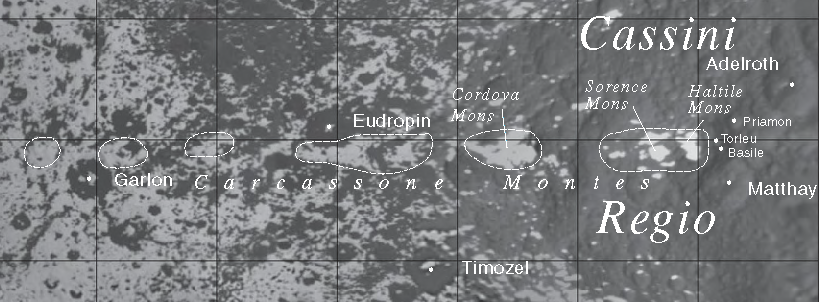
Carcassone Montes forms the westernmost part of Iapetus’s equatorial ridge, lying at the boundary between the moon’s bright and dark sides. Its peaks are covered in bright, icy material that glistens against darker surroundings. The range runs from 188°W to 246°W (or 172°E to 114°E) and consists of at least six mountain sets, partly separated. Only the three easternmost—Cordova Mons, Sorence Mons, and Haltile Mons—have official names. To the north lies the crater Eudropin; to the east are Basile, Torleu, Priamon, and Matthay; to the south is Timozel. The range is isolated from the rest of the equatorial ridge, unlike the continuous Toledo Montes. It was once grouped informally with Toledo and Tortelosa Montes as part of the “Voyager Mountains.”
The origin of Carcassone Montes, like the entire equatorial ridge, remains unknown. It is heavily cratered, suggesting great age. Why it follows the equator so precisely is also unexplained. Proposed theories include remnants of an early, faster-spinning Iapetus, collapse of a former ring system, or upwelling of icy material from the interior, but none have gained wide acceptance as of 2026.
Voyager 2 discovered the range in 1981, but Cassini provided the first detailed views. Cassini’s closest flyby of Iapetus occurred on 10 September 2007, resolving features as small as 55 meters per pixel from a distance of 1,227 kilometers. No subsequent flybys were made, and no future missions to Iapetus have been approved as of 2026.
Quick Facts
- Length
- 740 km
- Location
- Iapetus
- Eponym
- Carcassonne, France
Facts from the source article.
Lore & Background
Carcassone Montes was first seen in images taken by Voyager 2 in August 1981, during the probe's brief flyby of Saturn and its system of moons. As Voyager 2 passed over Iapetus's north pole, bright strings of dots appeared along the moon’s equator, near the edge of the moon from the spacecraft’s perspective. These bright dots were seen protruded above the surrounding dark material on Iapetus. The nature of these bright spots remained debated for decades until the Cassini space probe arrived in the Saturnian system in July 2004. Its close flybys of Iapetus confirmed that the bright dots were actually the white peaks of Carcassone Montes, rising above the dark terrain surrounding them.
Carcassone Montes forms the westernmost section of the equatorial ridge on Iapetus. It lies exactly at the transition zone between the bright and dark sides of Iapetus. Because of its location, the mountain range is dotted with several overlapping bright and dark patches. Many of the highest peaks of Carcassone Montes are covered with bright, icy material that glistens in sunlight strongly in contrast to their darker surroundings. Officially, Carcassone Montes runs from 188°W to 246°W (172°E to 114°E) on Iapetus' surface. It is composed of at least six sets of mountains that are partly broken from each other. Only the three easternmost mountains have names: Cordova Mons, Sorence Mons and Haltile Mons. To the north of Carcassone Montes lies the crater Eudropin, while to its east lie the craters Basile, Torleu, Priamon, and Matthay. To the south lies the crater Timozel. Carcassone Montes is an isolated section of Iapetus's equatorial ridge, not connected to the rest of the unbroken equatorial ridge chain located on the dark side of Iapetus, unlike the continuous Toledo Montes.
Reader's Guide
Carcassone Montes holds significance as one of the three named segments of Iapetus's equatorial ridge, a feature whose origin remains a mystery. Its discovery by Voyager 2 in 1981 and later detailed imaging by Cassini in 2007 provided key insights into the ridge's structure. The mountain range's location at the transition between Iapetus's bright and dark hemispheres makes it a unique geological boundary. Its heavily cratered surface indicates great antiquity, and its near-perfect alignment with the equator poses unresolved questions about its formation. The naming follows the convention for Iapetus features, drawing from the Song of Roland, with Carcassone Montes named after the city of Carcassonne. As of 2026, no approved future missions to Iapetus exist, leaving Carcassone Montes and the equatorial ridge as enduring subjects for study. The legacy of Carcassone Montes lies in its role as a key piece of evidence in debates about Iapetus's history, including hypotheses about a former ring system, rapid early rotation, or internal upwelling, none of which have been widely accepted.
Did You Know?
- Carcassone Montes was first seen as bright dots in Voyager 2 images from August 1981.
- Cassini made its closest approach to Carcassone Montes on 10 September 2007, resolving details as small as 55 metres per pixel.
- Carcassone Montes is heavily cratered, indicating it is extremely ancient.
From Distant Dots to Resolved Peaks
Carcassone Montes first entered human awareness during Voyager 2's brief August 1981 flyby of the Saturnian system. As the spacecraft swept over Iapetus's north pole, its cameras captured what appeared as bright strings of dots tracing the moon's equator near the limb. These luminous specks seemed to rise above the surrounding dark terrain, yet their true nature remained a subject of debate for more than two decades. The mystery was finally resolved when the Cassini probe entered the Saturn system in July 2004. Through a series of close flybys, Cassini confirmed that those enigmatic bright dots were in fact the white, ice-capped summits of a mountain range. The most dramatic encounter came on 10 September 2007, when Cassini passed within 1,227 kilometres of Iapetus, resolving surface details down to 55 metres per pixel. That flyby remains the closest any spacecraft has come to Carcassone Montes. As of 2026, no future mission to Iapetus has been approved, leaving that 2007 pass as our most detailed view of the range.
A Range at the Boundary of Light and Shadow
Carcassone Montes occupies a unique position as the westernmost segment of Iapetus's equatorial ridge, sitting precisely at the transition between the moon's bright and dark hemispheres. This boundary location gives the range a distinctive appearance: its surface is mottled with overlapping patches of bright and dark material, and its highest summits are draped in bright, icy material that catches and reflects sunlight with striking contrast against the darker terrain below. The range stretches roughly 740 kilometres, running almost perfectly along the equator from 188°W to 246°W. Geologically, it comprises at least six partially disconnected mountain groups, though only the three easternmost peaks carry formal names: Cordova Mons, Sorence Mons, and Haltile Mons. The surrounding landscape is marked by several named craters—Eudropin to the north, Timozel to the south, and a cluster of Basile, Torleu, Priamon, and Matthay to the east. Beyond those craters, the vast dark expanse of Cassini Regio dominates the eastern horizon. Unlike the continuous Toledo Montes, Carcassone Montes stands as an isolated fragment, unconnected to the longer ridge chain on the dark side.
A Name Drawn from a Medieval Epic
The naming of Carcassone Montes follows a distinctive tradition unique to Iapetus. With the single exception of Cassini Regio, every formally recognized geological feature and crater on the moon draws its name from the Song of Roland, a Frankish medieval epic poem. Within this framework, mountains and mountain ranges are assigned names of places where the poem's events unfold. Carcassone Montes takes its name from the fortified city of Carcassonne in southern France, which, according to the narrative, was sacked by Roland, the epic's central hero. The International Astronomical Union, the body that governs the formal naming of celestial features, approved the designation in August 2008. Notably, the official astronomical spelling drops one of the two n's found in the French city's name, rendering it Carcassone rather than Carcassonne. This small orthographic difference is a reminder that the name, while rooted in a real medieval stronghold, exists in a slightly altered form on the maps of a distant moon orbiting Saturn.
An Ancient Enigma at the Equator
The origin of Carcassone Montes remains one of the unsolved puzzles in planetary science. The range is heavily cratered, a signature that points to an extremely ancient age, yet the very fact that it traces Iapetus's equator so precisely defies easy explanation. Several competing hypotheses have been advanced over the years. One family of theories proposes that the ridge, including Carcassone Montes, represents a frozen remnant of Iapetus's earlier oblate shape, a bulge left behind when the moon spun considerably faster than it does today. Another line of thinking suggests the mountains formed from the gravitational collapse of a former ring system around Iapetus. A third hypothesis invokes upwelling of icy material from the moon's deep interior. As of 2026, none of these explanations has achieved broad acceptance among planetary scientists. The range's isolation from the rest of the equatorial ridge—unlike the continuous Toledo Montes—adds another layer of complexity to the problem. Carcassone Montes endures as a testament to how much of Iapetus's history remains hidden beneath its ancient, cratered surface.
Gallery
Frequently Asked Questions
What is Carcassone Montes?
Carcassone Montes is a bright, isolated stretch of peaks that forms one of three named segments of the equatorial ridge on Iapetus, Saturn's third-largest moon. It runs as a distinct mountain range along the moon's equator.
Where is Carcassone Montes located on Iapetus?
The range spans roughly from 188°W to 246°W longitude along Iapetus's equator. It sits as a clearly defined bright segment within the broader equatorial ridge system.
How was Carcassone Montes first spotted?
Voyager 2 captured the first images of the feature in August 1981, when it showed up as a cluster of bright dots near Iapetus's equator. The IAU formally approved the name in August 2008.
Why is it called Carcassone Montes?
The name draws on the medieval walled city of Carcassonne in southern France, which plays a role in the epic poem The Song of Roland. The IAU sanctioned the slightly altered spelling when it approved the designation in 2008.
How long is Carcassone Montes?
The segment stretches approximately 740 kilometers (around 460 miles) along Iapetus's equator. It is one of three such named ridge sections that make up the moon's equatorial mountain system.
More in Moons of Saturn, Part 2 1-24
Spotted an error? Know more?
Reader corrections go straight into our review queue. Suggest an edit · How this site is sourced