Enceladus Orbilander
Proposed NASA Flagship mission to orbit and land on Enceladus.

NASA, APL · Public domain
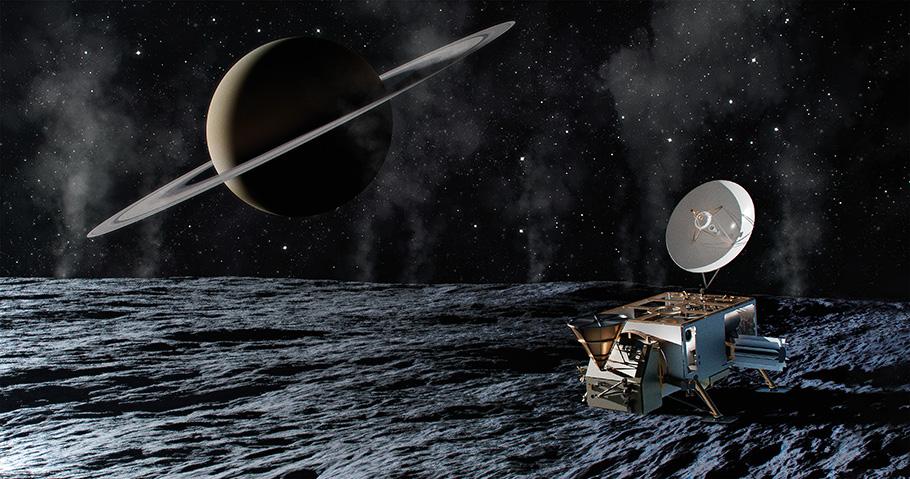
The Enceladus Orbilander is a proposed NASA Flagship mission targeting Saturn’s moon Enceladus. The spacecraft would first orbit the moon for 1.5 years, sampling the water plumes that extend into space, then land on the surface for a two-year investigation of materials for signs of life. Estimated to cost $4.9 billion, it could launch in the late 2030s aboard a Space Launch System or Falcon Heavy, with a landing in the early 2050s. The 2023–2032 Planetary Science Decadal Survey ranked it as the second highest priority Flagship mission, behind the Uranus Orbiter and Probe.
Enceladus, 500 kilometers (310 miles) in diameter, is Saturn’s sixth largest moon and the 19th largest in the Solar System. It has been visited by three probes: the twin Voyager spacecraft and the Cassini orbiter. Cassini, with 23 targeted close flybys, revealed Enceladus as geologically active, with young terrain, active warm-water plumes, and evidence of a subsurface ocean. It also found signs of hydrothermal processes driving the geysers and geology, making the moon a prime candidate for finding life. After Cassini, several proposals followed. Journey to Enceladus and Titan competed for the 13th Discovery mission but was not selected. In 2017, Enceladus Life Signatures and Habitability and Enceladus Life Finder competed for the 4th New Frontiers mission but were also not selected.
The Orbilander proposal, led by Shannon MacKenzie, was created for the Planetary Science Decadal Survey. Earlier studies had considered multiple flybys, but MacKenzie’s team, working under a larger budget cap for a Flagship mission, examined an orbiter, lander, or combination. They chose to combine both functions into one spacecraft because Enceladus’s small size and weak gravity make landing require negligible delta-v compared to entering orbit. The Decadal Survey recommended it as the second highest priority new Flagship mission, citing its focus on exobiology and planetary habitability.
Because landing on Enceladus requires little extra energy beyond entering orbit, the Orbilander uniquely merges orbiter and lander roles in a single spacecraft. It will carry three instrument suites and a sampling system, each tailored to different phases of science operations.
Quick Facts
- Mission Type
- Enceladus Orbiter and Lander
- Operator
- NASA
- Manufacturer
- APL (proposed)
- Dry Mass
- 2690 kg
- Power
- 741 W (at launch) 589 W (landing)
- Launch Rocket
- Space Launch System Block 2 (proposed)
- Launch Site
- Kennedy Space Center, Pad 39B
- Programme
- Large Strategic Science Missions · Planetary Science Division
- Previous Mission
- Uranus Orbiter and Probe
Facts from the source article.
Lore & Background
The Enceladus Orbilander proposal was created by a team led by Shannon MacKenzie to support the Planetary Science Decadal Survey. While previous mission studies had investigated multiple flybys to study Enceladus, MacKenzie's team, studying a Flagship mission architecture with a greater budget cap, decided to study an orbiter, lander, or a combination thereof. Ultimately, the decision to combine the orbiter and lander into one spacecraft was informed by Enceladus's small size and negligible gravity, which results in trivial delta-v to land.
Enceladus has been visited and imaged in detail by three other probes: the twin Voyager spacecraft, and the Saturn orbiting Cassini spacecraft. Cassini's 23 targeted close flybys helped discover that Enceladus is a geologically active world, with young terrain, active warm water plumes, and evidence hinting at a subsurface ocean. Cassini also provided evidence of hydrothermal processes driving both the geysers and Enceladus's active geology, making the moon one of the most attractive places to find life within the solar system.
After Cassini's mission, a variety of proposals to follow-up on Cassini's findings at Enceladus were made. Journey to Enceladus and Titan competed for the 13th Discovery Program mission but was not selected. In 2017, two Enceladus focused astrobiology missions, Enceladus Life Signatures and Habitability and Enceladus Life Finder, competed for the 4th New Frontiers mission but were ultimately not selected.
Reader's Guide
The Enceladus Orbilander is notable as the second highest priority Flagship mission recommended in the 2023–2032 Planetary Science Decadal Survey, after the Uranus Orbiter and Probe. Its selection was motivated by the proposal's exobiology and planetary habitability focus. The mission would uniquely combine both the functions of an orbiter and a lander into a single spacecraft due to Enceladus's small size and negligible gravity, which makes landing energetically trivial compared to orbital capture. The spacecraft would carry three separate instrument suites and a sampling system tailored to different regimes of science operations. The mission profile includes a complex 4.5-year tour of Saturn's moons using gravity assists from Titan, Rhea, Dione, and Tethys before entering Enceladus orbit. While orbiting, it would spend 1.5 years in a 12-hour elliptical orbit passing over the south polar tiger stripes to collect plume particles. After determining a safe landing ellipse, the spacecraft would use terrain-relative navigation similar to OSIRIS-REx to avoid hazards during descent, shutting off its main engine at 10 meters above the surface to avoid contamination before soft landing.
Did You Know?
- The Enceladus Orbilander would spend 1.5 years orbiting Enceladus and 2 years on the surface.
- The mission could launch in the late 2030s on a Space Launch System or Falcon Heavy.
- The main engine shuts off at 10 meters above the surface to avoid contaminating the area.
Discovery and Two Centuries of Mystery
Enceladus first entered human knowledge on August 28, 1789, when William Herschel spotted the faint dot through his newly completed 1.2-metre telescope at Slough, England. The observation was made during a Saturnian equinox, a window when Earth sits within the ring plane and the glare from Saturn's rings diminishes, making the small satellites easier to detect. Despite this early sighting, the moon's apparent magnitude of just +11.7 and its close proximity to the brilliant planet and its rings kept it largely invisible to smaller ground-based instruments for nearly two centuries. For most of that time, astronomers could only estimate its mass, density, and reflectivity from orbital data. The situation changed dramatically in 1980 and 1981, when Voyager 1 and Voyager 2 swept past Saturn and returned the first resolved images of Enceladus's surface. The name itself, drawn from the Titan giant of Greek myth, was proposed by John Herschel in 1847, linking the moon to the mythological family that ruled under Cronus, the Greek counterpart of Saturn.
A Pristine, Frozen Landscape
At roughly 500 kilometres across, Enceladus is the sixth-largest satellite of Saturn and the eighteenth-largest body in the entire Solar System, yet it is only about one-tenth the diameter of Titan, Saturn's giant moon. What makes this small world remarkable is its extraordinary albedo: the surface is blanketed in freshly deposited snow hundreds of metres deep, giving Enceladus one of the highest reflectivities of any known body in the Solar System. This extreme brightness means that even at local noon the surface temperature plunges to a mere −198 °C, far below what a darker, light-absorbing surface would reach. Despite its modest size, the moon displays a striking range of terrain, from ancient, heavily cratered highlands to young, tectonically warped regions. The International Astronomical Union has officially named 85 of these features, drawing their names from characters and locations in Richard Francis Burton's 1885 translation of One Thousand and One Nights, with craters taking character names and other landforms such as fossae, dorsa, and rupes taking place names.
Geysers, Snowfall, and Saturn's E Ring
Beginning in 2005, the Cassini spacecraft conducted a series of close flybys that transformed Enceladus from a quiet, bright dot into one of the most dynamic small worlds known. The most spectacular discovery was a cluster of cryovolcanic vents near the south pole, where more than one hundred geyser-like jets erupt water vapour, molecular hydrogen, sodium chloride crystals, and ice particles into space at a combined rate of roughly 200 kilograms per second. NASA scientists noted that the plume composition closely resembles that of comets. A portion of the ejected water condenses and falls back onto the surface as fresh snow, gradually building the hundreds-of-metres-thick blanket that gives the moon its brilliant white appearance. The remainder escapes into orbit and becomes the dominant source of material feeding Saturn's E ring, the widest and outermost of the planet's major rings. Enceladus actually orbits within the densest portion of this ring, continuously replenishing it. The sheer volume of material being expelled, combined with the near absence of impact craters in the south polar region, confirms that the moon is actively reshaping itself in the present day.
A Subsurface Ocean and the Search for Life
In 2014, NASA announced that Cassini data provided evidence for a vast liquid-water ocean beneath Enceladus's icy southern shell, estimated to be around ten kilometres thick. This finding has since been corroborated by mathematical models that successfully replicate the moon's observed behaviour. The engine driving this internal warmth is tidal heating: Enceladus is locked in a 2:1 mean-motion orbital resonance with Dione, meaning it completes two orbits for every one Dione completes. This resonance maintains a small but persistent orbital eccentricity, and the resulting tidal flexing dissipates heat deep within the moon. Cassini's chemical analyses of the plume material revealed signatures consistent with hydrothermal activity, suggesting that seawater may interact with hot rock in a manner analogous to Earth's ocean-floor vent systems. Ongoing research indicates that such a hydrothermal environment could potentially support microorganisms similar to those thriving around terrestrial hydrothermal vents, and that the methane detected in the plumes might be a biological by-product rather than purely geological in origin.
Gallery
Frequently Asked Questions
What is the Enceladus Orbilander?
It is a proposed NASA Flagship spacecraft built to study Saturn's moon Enceladus by first spending eighteen months in orbit collecting samples from its water plumes, then touching down on the surface for a two-year search for biosignatures.
What would the Enceladus Orbilander actually do during its mission?
The craft would circle Enceladus for a year and a half, scooping up material from the plumes that shoot out into space, and then settle onto the icy surface to spend two years analyzing the terrain for any chemical traces of life.
How much does the Enceladus Orbilander cost and when could it fly?
NASA estimates the total price tag at roughly $4.9 billion, with a target launch window around October 2038 on either an SLS or Falcon Heavy rocket. If the timeline holds, the lander would make contact with Enceladus's surface in the early 2050s.
What is Enceladus and why do scientists want to land there?
Enceladus is a small icy moon about 500 kilometers across that fires geysers of water vapor and ice grains into orbit, hinting at a subsurface ocean. That combination of liquid water and active geology makes it one of the most promising places in the solar system to look for microbial life.
How does the Enceladus Orbilander rank in NASA's mission priorities?
The 2023–2032 Planetary Science Decadal Survey placed it as the second-highest-priority Flagship concept, just behind the Uranus Orbiter and Probe. It sits in the top tier of planned deep-space explorations for the coming decades.
More in Moons of Saturn, Part 2 1-24
Spotted an error? Know more?
Reader corrections go straight into our review queue. Suggest an edit · How this site is sourced