Microprocessor chronology
A timeline of microprocessor evolution from 4-bit to multi-core chips.

The chronology of microprocessors traces the evolution of central processing units on a single integrated circuit from the early 1970s onward. It is notable for documenting the rapid progression in word length, fabrication technology, and architectural philosophy that defined the computing industry.
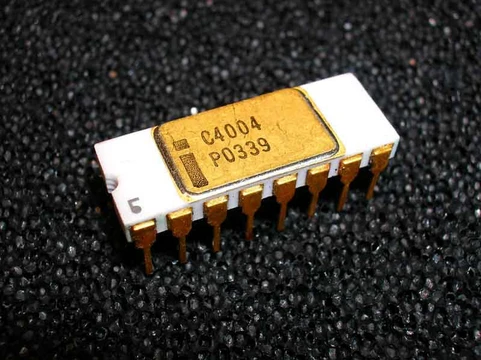
- First commercial microprocessor
- Intel 4004 (1971)
- Early logic type
- pMOS (early 1970s), then nMOS (after mid-1970s)
- Key yield improvement
- Micralign system reduced flawed chips from ~70% to 10%
- Cost example
- MOS 6502 cost $25 in single-unit quantities
- Dominant 1980s technology
- CMOS gates
- First 32-bit designs
- Motorola 68000, National Semiconductor NS32000
- First integrated fpu
- Intel 486 (1989)
Lore & Background
The first chips considered microprocessors appeared in the late 1960s and early 1970s, including the MP944 used in the Grumman F-14 CADC. Intel's 4004 of 1971 is widely regarded as the first commercial microprocessor. Early designs used pMOS logic, switching to nMOS after the mid-1970s. Depletion-mode nMOS allowed single-voltage +5V operation, simplifying power supply and TTL interfacing, but was susceptible to sodium impurities until around 1975. The introduction of the Perkin-Elmer Micralign projection system reduced defective chips from about 70% to 10%, dramatically lowering costs; the MOS 6502, designed to exploit these improvements, cost only $25. Word lengths varied: 4-bit processors like the 4004 were common early on, followed by 8-bit designs (Intel 8080, 6502), and later 16-bit designs like the Zilog Z8000. Unusual word lengths (12-bit, 20-bit) largely disappeared by the decade's end.
In the 1980s, the expected widespread move to 16-bit designs almost did not occur; instead, 32-bit designs like the Motorola 68000 and National Semiconductor NS32000 emerged. The IBM PC used the 16-bit Intel 8088. CMOS gates became the primary method, offering lower power dissipation, aided by Japanese firms adopting CMOS while US firms remained on nMOS. The Micralign was replaced by steppers, enabling sub-1-micron feature sizes. Key home computers used 1970s processors: the 6502 powered the Commodore 64, Apple II, BBC Micro, and Atari 8-bit computers; the Z80 powered the ZX Spectrum and MSX systems. The IBM PC (1981) started the move to 16-bit, soon passed by 68000-based systems. IBM PC compatibles moved to 32-bit with the Intel 80386 in late 1985. Memory management units became common mid-decade, and floating point units appeared on the Intel 486 in 1989. RISC architecture emerged, driven by MIPS Technologies, SPARC, and ARM, with every major vendor introducing a RISC design by the decade's end.
The 1990s saw 32-bit microprocessors dominate the consumer market, with clock speeds increasing more than tenfold. 64-bit processors began to emerge later in the decade. Processors adopted a front-side bus (FSB) clock speed separate from the internal clock; the Pentium III had an internal speed of 450–600 MHz and FSB of 100–133 MHz. In the 2000s, 64-bit processors became mainstream. Clock speeds reached a ceiling due to heat dissipation, leading to multi-core processors. Overclocking became common, with off-the-shelf cooling systems and the advent of gaming PCs. Transistor counts increased by about an order of magnitude, and process sizes decreased from 180 nm to 45 nm. In the 2010s, multi-chip modules made of several chiplets appeared, allowing higher integration with smaller, easier-to-manufacture chips.
Reader's Guide
The microprocessor chronology illustrates a relentless drive toward greater complexity and performance, driven by improvements in fabrication and design philosophy. The shift from pMOS to nMOS and then to CMOS was critical: nMOS enabled single-voltage operation and lower costs, while CMOS solved power dissipation problems that threatened further scaling. The Micralign projection system and later steppers were pivotal in reducing defect rates and enabling smaller feature sizes, directly lowering the cost of microprocessors and making them accessible for home computers. The transition from 4-bit to 8-bit, then to 32-bit (bypassing widespread 16-bit adoption except in the IBM PC), reflects how market forces and architectural innovation outpaced simple word-length progression. The emergence of RISC demonstrated that smaller, simpler designs could compete with complex instruction set computers, reshaping the industry. The integration of memory management and floating-point units into the processor die reduced system cost and complexity. The later move to multi-core processors and multi-chip modules addressed the heat dissipation barrier and continued the trend of increasing transistor counts, ensuring that microprocessors remained the central component of computing devices from mainframes to smartphones.
Did You Know?
- The MOS 6502, designed to take advantage of improved yields from the Micralign system, cost only $25 in single-unit quantities.
- The IBM PC used the 16-bit Intel 8088, selected in 1979 before 32-bit designs had matured.
- The first integrated floating-point unit appeared on the Intel 486 in 1989.
The 1970s: Manufacturing Breakthroughs and the Logic Transition
The early microprocessor era was defined less by raw computational ambition than by the struggle to make silicon fabrication economically viable. In the early 1970s, designers relied on pMOS logic, but the industry's pivot to nMOS around 1975 transformed what was possible. Depletion-mode nMOS offered a practical advantage: it operated on a single +5V supply, making it straightforward to interface with the ubiquitous TTL devices. The catch was that nMOS was vulnerable to electronic noise from silicon impurities, particularly sodium, and it was only when those contaminants were successfully eliminated that nMOS could claim the market. Equally transformative was the arrival of the Micralign photomasking system from Perkin-Elmer. By projecting a mask image onto the wafer without physical contact, it eliminated the photoresist damage that plagued older contact aligners. Defect rates plummeted from roughly 70% to 10%, slashing the cost of complex chips. A contact aligner system might cost around $300 in single-unit quantities, while the MOS 6502, designed to exploit these new fabrication capabilities, retailed at just $25. This cost collapse is what made the microprocessor a genuinely commercial product rather than a laboratory curiosity.
The 1980s: CMOS Adoption and the Japanese Competitive Edge
One of the most consequential technological shifts of the 1980s was the industry's migration from nMOS to CMOS gate architecture. CMOS had existed since the early 1970s—RCA's 1975 COSMAC processor is a notable early example—but it did not become the dominant approach until the 1980s. The reason was practical: as processor designs grew in complexity, power dissipation and overheating became critical problems. CMOS's two-transistor gate design, while roughly twice as expensive to fabricate as a single-transistor nMOS gate, determined logic by the voltage difference between its two sides rather than by a single transistor's voltage relative to the substrate. This made it detectable at far lower power levels, dramatically reducing heat. The competitive implications were significant. Japanese semiconductor firms adopted CMOS aggressively during the decade while many American companies clung to nMOS, giving the Japanese industry a substantial performance and efficiency edge. Meanwhile, fabrication technology itself advanced beyond the Micralign, which had been obsolete by the early 1980s. New stepper systems, employing high magnification and extremely powerful light sources, enabled mask patterns to be copied onto wafers at sizes below the previous one-micron barrier, opening the door to far denser and more capable chip designs.
The 1980s: RISC Emergence and the Integration of Functional Units
The 1980s also witnessed a fundamental rethinking of how a processor's instruction set should be structured. The reduced instruction set computer, or RISC, concept had been developed at IBM in the 1970s, but the company never brought a powerful RISC system to market, largely out of concern that it would cannibalize sales of their larger mainframe products. The commercial breakthrough came instead from smaller firms—MIPS Technologies, SPARC, and ARM—which lacked access to the high-end fabrication facilities available to Intel or Motorola. Their strategy was to design chips of far lower complexity that nonetheless delivered highly competitive performance. By the end of the decade, every major vendor had introduced its own RISC design, including IBM's POWER, Intel's i860, and Motorola's 88000. In parallel, microprocessors began absorbing functional units that had previously existed as separate external components. Memory management units became standard by the mid-1980s, appearing on designs such as the Intel 80286 and Motorola 68030. Floating-point units followed at the decade's close, first integrated into the Intel 486 in 1989 and then the Motorola 68040 the following year. This trend toward integration meant that a single chip could now deliver capabilities that once required an entire board of discrete components.
The 1990s: Tenfold Speed Gains and the 64-Bit Horizon
The 1990s were characterized by an acceleration in processor performance that was almost unprecedented in the industry's history. The 32-bit microprocessor firmly dominated the consumer market throughout the decade, and clock speeds climbed by more than a factor of ten between 1990 and 1999. This dramatic increase in operating frequency was made possible by the continued maturation of CMOS fabrication and the stepper-based photolithography techniques that had broken the one-micron barrier in the 1980s. The RISC architectures that had emerged as a counterpoint to complex instruction set designs in the previous decade continued to evolve, while the broader ecosystem of integrated functional units—memory management, floating-point arithmetic—became standard expectations rather than premium add-ons. Toward the latter part of the decade, 64-bit processors began to appear, signaling the next major expansion in data-path width. This followed a pattern established in the 1970s, when improvements in yield, wafer size, and feature reduction had enabled the transition from 4-bit to 8-bit and then to 16-bit designs. The 1990s thus represented both the culmination of the 32-bit era and the opening chapter of the 64-bit future, with the industry once again poised for a fundamental shift in architectural scale.
Frequently Asked Questions
What does the microprocessor chronology cover?
It traces the step-by-step evolution of single-chip central processing units from the early 1970s through to modern multi-core designs. The timeline highlights how word length, fabrication methods, and architectural thinking shifted across decades.
What was the first commercial microprocessor in the chronology?
The Intel 4004, released in 1971, holds that distinction as the earliest commercially available microprocessor. It kicked off the entire progression documented in the timeline.
How did logic fabrication technology progress through the chronology?
Early designs in the 1970s relied on pMOS transistors, which gave way to nMOS after the mid-1970s. By the 1980s, CMOS gates had become the dominant fabrication approach.
Which designs are recognized as the first 32-bit microprocessors in the chronology?
The Motorola 68000 and the National Semiconductor NS32000 are typically cited as the pioneering 32-bit entries. They marked a major leap beyond the 8- and 16-bit architectures that preceded them.
Why do enthusiasts consider the microprocessor chronology significant?
It captures how a single integrated circuit went from a 4-bit novelty to complex multi-core processors within a few decades. Milestones like the Micralign yield-improvement system (cutting defective chips from roughly 70% to 10%) and the MOS 6502's $25 single-unit price point show just how rapidly the industry matured.
More in Microprocessors 1-24
Spotted an error? Know more?
Reader corrections go straight into our review queue. Suggest an edit · How this site is sourced