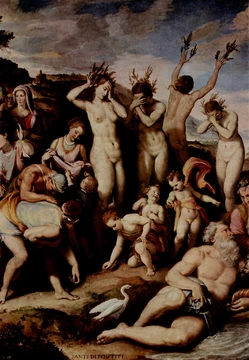
Harmonia
Goddess of harmony, wife of Cadmus, grandmother of Dionysus.
Harmonia, the Greek goddess of harmony and concord, is usually the daughter of Aphrodite and Ares. She is famous for marrying Cadmus and for the disasters that struck her family, especially through the Necklace of Harmonia. Her daughter Semele made her the grandmother of Dionysus.
Quick Facts
- God of
- Goddess of harmony and concord
- Abode
- Thebes, Illyria
- Spouse
- Cadmus
- Children
- Autonoë
- Agave
- Illyrius
- Ino
- Semele
- and Polydorus
- Parents
- Ares and Aphrodite or; Zeus and Electra
Facts from the source article.
Did You Know?
- The theonym Harmonia derives from the Greek noun harmoníā, meaning 'means of joining, frame, covenant, agreement'.
- The word harmoníā comes from an adjective preserved only as a personal name, Harmōn.
- Harmōn is derived from the prefix ar- (from PIE h₂er- 'to fit') combined with the suffix -men-.
Family
Harmonia's parentage varies between accounts. She is most often named a daughter of Ares and Aphrodite, making her sister to Aeneas, Phobos, and Eros. In other accounts, she was born in Samothrace to Zeus and the Pleiad Electra, sister to Dardanus and Iasion. She married Cadmus, the legendary founder of Thebes, and bore him Ino, Polydorus, Autonoë, Agave, Semele, and in some accounts Illyrius.
Mythology
Harmonia's myths are closely tied to those of her husband Cadmus. She was acquired as his bride in two ways: in the Samothracian version, she was either given to Cadmus or carried off by him after his initiation into the island's mysteries; in the version where she is daughter of Aphrodite and Ares, Zeus gifted her to Cadmus after he completed eight years of servitude to Ares for slaying a dragon sacred to that god. Their wedding was attended by all the gods, and many gifts were given, notably a peplos and a necklace wrought by Hephaestus. Common versions say Hephaestus created the necklace out of anger at Aphrodite's affair with Ares, cursing any children of that union. Other traditions attribute the gifts to Athena, Aphrodite, or Cadmus's sister Europa, who had received them from Zeus. The necklace, called the Necklace of Harmonia or the Necklace of Eriphyle, brought misfortune upon all who wore it, especially Theban queens and princesses. It is usually described as gold inlaid with jewels, often emeralds. Hyginus instead claims the ill fate came from a peplos 'dipped in crime' given by Hephaestus and Hera. When Cadmus was expelled from Thebes, Harmonia accompanied him to Illyria, where they fought for the Enchelii and conquered the enemy, making Cadmus king. Soon after, Cadmus was turned into a serpent, possibly due to his killing of the sacred dragon; he had remarked that if the gods loved a serpent's life, he wished for it himself, and began to change. Harmonia, seeing this, stripped herself and begged to share his fate. As she embraced the serpent Cadmus in a pool of wine, the gods granted her request and transformed her. The couple was sent to Elysium.
More in Metamorphoses Into Animals in Greek Mythology
Spotted an error? Know more?
Reader corrections go straight into our review queue. Suggest an edit · How this site is sourced