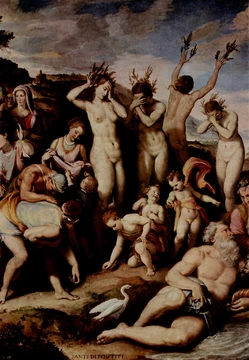
Korybantes
Armed dancers who served the goddess Cybele.
The Korybantes were armed, crested dancers who worshipped the Phrygian goddess Cybele through drumming and ecstatic dance. They are also known as the Kurbantes in Phrygia. Their rites were noted for their orgiastic nature.
Quick Facts
- Also called
- Corybantes
- Corybants
- Kurbantes
- Worshipped deity
- Cybele
- Region
- Phrygia
Facts from the source article.
Did You Know?
- The name Korybantes may derive from the Macedonian word korybé, meaning 'crown' or 'mountain peak'.
- The Korybantes were said to be offspring of Apollo by the Muse Thalia, the nymph Rhetia, or the nymph Danais.
- Other parentage accounts include Zeus and the Muse Calliope, Helios and Athena, or Cronus.
Kouretes
The Kouretes were nine dancers who venerated Rhea, the Cretan counterpart of Cybele. According to Oppian, the Curetes, who guarded the young Zeus, were turned into lions by Cronus. Zeus then made them kings of the animals, and Rhea yoked them to her chariot. The Kouretes are often confused with the Korybantes, but are distinguished by their Cretan origin and less orgiastic rites.
Initiatory dance
These armored male dancers kept time to a drum and rhythmic stamping. The dance in armor, called the Pyrrhic dance or pyrrhichios, was a male coming-of-age initiation ritual linked to warrior victory celebrations. The name has no connection with King Pyrrhus of Epirus. Both the Kouretes and Cretan Zeus were associated with the transition of boys into manhood in Cretan cities.
Ecstatics
The Phrygian Korybantes were often confused with other ecstatic male groups such as the Idaean Dactyls and the Cretan Kouretes. In Hesiod's account, the Kouretes' ritual clashing of spears and shields drowned out the cries of the infant Zeus, hiding him from his father Cronus. The myth is a Greek interpretation of Minoan ritual. Offerings from the cave include decorated bronze shields and a bronze gong with Near Eastern style. Korybantes also presided over the infancy of Dionysus and Zagreus. Their ecstatic cult is comparable to that of the Maenads. Ovid says the Kouretes were born from rainwater, suggesting a connection with the Hyades.
Other functions
Jane Ellen Harrison described the Kouretes as primitive magicians, seers, and metalworkers, with metallurgy seen as nearly magical. Several groups of Korybantes existed, such as the Cabeiri and those from Euboea and Samothrace. Hoplodamos and his Gigantes were included among them, and the Titan Anytos was classed as a Kourete. In Homer, Agamemnon tells Odysseus to choose kouretes, the bravest Achaeans, to bring gifts to Achilles.
More in Metamorphoses Into Animals in Greek Mythology
Spotted an error? Know more?
Reader corrections go straight into our review queue. Suggest an edit · How this site is sourced