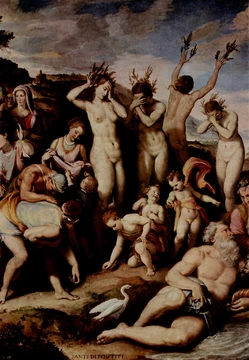
Lycian peasants
Leto turned inhospitable Lycian peasants into frogs.
The Lycian peasants are figures in a Greek myth in which the goddess Leto, carrying her infant twins Artemis and Apollo, was denied water from a pond in Lycia by the local people. In punishment, she transformed them into frogs. The story illustrates the ancient Greek concept of xenia, or sacred hospitality, and is best known from Ovid's Metamorphoses.
Quick Facts
- Region
- Lycia (southwestern Asia Minor)
- Deity involved
- Leto (Latona to the Romans)
- Offspring present
- Artemis and Apollo
- Punishment
- Transformation into frogs
Facts from the source article.
Mythology
After giving birth on Delos, Leto traveled with the newborns Artemis and Apollo to Lycia, where she tried to drink from and bathe them in a spring. The local people stirred up mud from the bottom to prevent her. Enraged by their lack of hospitality, Leto turned them all into frogs, condemned to swim and hop in the murky water. The grammarian Servius implied the twins were born between two visits to Lycia: the first when she was rejected, the second when she returned to punish. Antoninus Liberalis named the spring Melite and added that cattle herders drove her away, after which wolves led her to the river Xanthos, where she bathed her children before returning to transform the Lycians.
Symbolism
Leto was especially worshipped in Lycia and regarded as its national deity; the region was also an important cult center for Artemis and Apollo. Her sanctuary, the Letoon, stood west of Xanthos along the Xanthos river. The name Leto was traditionally derived from the Lycian word lada, meaning 'wife', though scholars Paul Kretschmer and Robert S. P. Beekes proposed a pre-Greek origin. The site of the confrontation was apparently understood in antiquity to be where the Letoon was later built. The name Lycia was erroneously linked by ancient Greeks to lykos, their word for wolf, because friendly wolves had shown hospitality to Leto when humans did not. Apollo bore the epithet Lyceus, usually indicating youth and light, but sometimes interpreted as connecting him to wolves and Lycia. Stephanos of Byzantium told of an elderly Lycian woman, Syessa, who hosted Leto, contrasting with the inhospitable peasants. Polycharmos claimed Apollo and Leto were both born in Araxa in the Xanthos valley. Antoninus Liberalis, citing Menecrates of Ephesus and Nicander, dated Leto's arrival in Lycia to around the early fourth century BC, when Xanthos was a mixed Greek and Lycian settlement.
Art
The myth became a popular subject in post-antiquity art, especially in Northern Mannerist painting, where it combined mythology with landscape and peasant scenes. Leto is typically shown with her two children by a lake, with the peasants nearby beginning their transformation into frogs. The Latona Fountain in the Gardens of Versailles, built in 1670, depicts Leto with Artemis and Apollo on the top tier, surrounded by six lead half-human, half-frog sculptures around the basin; the four tiers use 230 pieces of marble from Carrara, Campan, and Languedoc. A copy of this fountain was built in the gardens of Herrenchiemsee in Bavaria. The tale also inspired music, such as Carl Ditters von Dittersdorf's symphony Verwandlung der lycischen Bauern in Frösche, one of several based on Ovid's Metamorphoses.
More in Metamorphoses Into Animals in Greek Mythology
Spotted an error? Know more?
Reader corrections go straight into our review queue. Suggest an edit · How this site is sourced