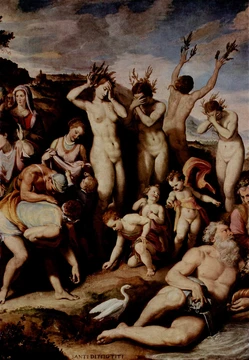
Mestra
Daughter of Erysichthon who escaped slavery through shape-shifting.
She is also called Hypermestra by Antoninus Liberalis, who names her father Aethon.[1][2] Her ability to change into any animal allowed her to escape repeated sales by her father.[3][4] Mestra, also called Hypermestra by Antoninus Liberalis, was the child of Erysichthon (also known as Aethon) from Thessaly.[1][2]
Quick Facts
- Father
- Erysichthon (also called Aethon)
- Alternate name
- Hypermestra
- Spouse
- Autolycus
- Divine patron
- Poseidon
- Island associated
- Cos
Facts from the source article.
Biology and range
Erysichthon used her ability to sell her repeatedly for money to buy food.[3] In Hesiod's version, Erysichthon sold Mestra to suitors for bride prices instead of into slavery.[5] Poseidon carried Mestra to the island of Cos, where she bore him a son named Eurypylus.[5] Antoninus Liberalis states that Hypermestra sold her body as a woman and became a man to feed her father.[2]
After her escape, Mestra went back to her father, who quickly learned about her shape-changing ability.[3] Driven by an unending hunger, Erysichthon ultimately consumed his own body and died.[3]
What the specialist sources record
Tzetzes on Lycophron describes Mestra as a sorceress who could change into any animal.[4] The same source gives an allegory: Mestra's father, having consumed everything and sold his fields, was starving.[4] Tzetzes also notes that "Of the all-changing" refers to Mestra, who could change into any form.[4]
References
- Wikipedia, "Mestra" (CC BY-SA 4.0), which cites: She is also occasionally referred to as Mnestra in modern sources, though the form is not anciently attested; cf. Clytemnestra, whose name does appear with and ; Ovid, Metamorphoses 8.739; cf. Hesiod, Ehoiai fr. 43a; Ovid, Metamorphoses 8.741–842; cf. Callimachus, Hymn to Demeter 24–69; Antoninus Liberalis, 17; Ovid, Metamorphoses 8.739 (we also read that source) en.wikipedia.org
- Antoninus Liberalis, 17. facts only, no text reused. topostext.org
- Wikipedia, "Mestra" (CC BY-SA 4.0), which cites: Ovid, Metamorphoses 8.850–54 (original not read by us) en.wikipedia.org
- Hesiod, Ehoiai fr. 43a (Berlin papyrus 7497); Ovid, Metamorphoses 8.871–74; Tzetzes on Lycophron, 1393. facts only, no text reused. topostext.org
- Wikipedia, "Mestra" (CC BY-SA 4.0), which cites: Hesiod, Ehoiai fr. 43a (Berlin papyrus 7497); Ovid, Metamorphoses 8.871–74; Tzetzes on Lycophron, 1393; Hesiod, Ehoiai fr. 43a.2–83; cf. West (1985a, p. 64); Hard, "The Routledge Handbook of Greek Mythology", Taylor & Francis Group, 2004, p. 433, 663; Hesiod, Ehoiai 43a.79(55)–82(58) (we also read that source) en.wikipedia.org
Each numbered sentence above was checked against the source it cites before publication. Sentences citing Wikipedia adapt text from the English Wikipedia article Mestra (contributors), used under CC BY-SA 4.0; this entry is available under the same licence. Other sources were used for facts only; no text or images are copied from them.
More in Metamorphoses Into Animals in Greek Mythology
Spotted an error? Know more?
Reader corrections go straight into our review queue. Suggest an edit · How this site is sourced