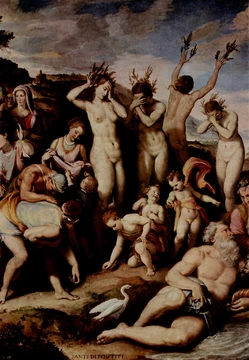
Hecuba
Queen of Troy who became a dog after the city's fall.
Hecuba was the wife of King Priam and queen of Troy during the Trojan War. She was the mother of Hector, Paris, Cassandra, and many other Trojan royals. Her story is marked by profound grief and a metamorphosis into a dog.
Quick Facts
- Siblings
- (2) Theano
- Consort
- (i) Apollo (ii) Priam
- Abode
- Phrygia or Thrace, later Troy
- Deity of
- Queen of Troy
- Member of
- the Trojan Royal Family
- Other names
- Hecabe, Dymantis
Facts from the source article.
Did You Know?
- The Byzantine chronicler Malalas described Hecuba as dark, good eyes, full grown, long nose, beautiful, generous, talkative, calm.
- Dares the Phrygian described her as beautiful, large figure, dark complexion, thinking like a man, pious and just.
Family
Ancient sources disagree on Hecuba's parentage. Homer says she was the daughter of King Dymas of Phrygia, while Euripides and Virgil claim she was the daughter of the Thracian king Cisseus. The mythographers Pseudo-Apollodorus and Hyginus leave the question open, with Pseudo-Apollodorus adding a third possibility: the river god Sangarius and the nymph Metope. A scholiast on Euripides summarizes non-extant versions naming Dymas or Sangarius by the Naiad Euagora, or by Glaucippe, daughter of Xanthus. Another scholiast on Homer gives her parents as either Dymas and the nymph Eunoe, or Cisseus and Telecleia, the latter making her a full sister of Theano. The emperor Tiberius reportedly pestered scholars with the question of who Hecuba's mother was. Hecuba bore 19 children, including Hector, Paris, Cassandra, and others. Two sons, Hector and Troilus, are said to have been fathered by the god Apollo.
Myths
After Troy fell, Apollo, who had once been Hecuba’s lover, took her to Lycia for safety, according to Stesichorus. The Bibliotheca says Hecuba and Apollo had a son named Troilus, and an oracle predicted Troy would stand if he lived to twenty; Achilles killed him. In Euripides’ The Trojan Women, Hecuba is enslaved by Odysseus after the city’s destruction. In his play Hecuba, her youngest son Polydorus is sent to King Polymestor for protection, but after Troy falls, Polymestor murders him. Hecuba learns this and, through trickery, blinds Polymestor and kills his two sons. Another version claims that when given to Odysseus as a slave, she snarled and cursed him, so the gods turned her into a dog, letting her escape. She later became one of Hecate’s familiars. In a different tradition, she went mad at the sight of her dead children Polydorus and Polyxena; Dante describes her barking like a dog. Another legend says she threw herself into the sea and became a she-dog with fiery eyes, buried at Kynosema, or dog’s grave, a landmark for sailors. Lycophron adds that Hecate rescued her and made her a canine familiar. Photius writes that Helen and Paris had a daughter named Helen, and Hecuba killed the girl when Troy fell.
In popular culture
Hecuba appears in Euripides' plays Hecuba and The Trojan Women, and in Seneca's tragedy Troades. She features in Jean Giraudoux's play The Trojan War Will Not Take Place, Michael Tippett's opera King Priam, and Martha Graham's ballet Cortege of Eagles. She is portrayed by Frances O'Connor in the 2018 miniseries Troy: Fall of a City. In Shakespeare's Hamlet, the character Hamlet marvels at an actor's grief for Hecuba, asking 'What's Hecuba to him, or he to Hecuba, that he should weep for her?'
More in Metamorphoses Into Animals in Greek Mythology
Spotted an error? Know more?
Reader corrections go straight into our review queue. Suggest an edit · How this site is sourced