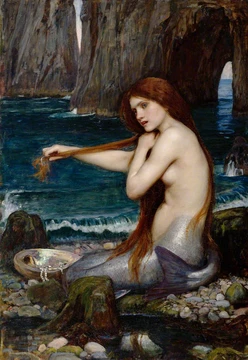
Suvannamaccha
Mermaid princess who hinders then aids Hanuman's bridge-building.

Suvannamaccha, whose name means "golden fish" in Thai, is a mermaid princess found in Thai and other Southeast Asian versions of the Ramayana. She is the daughter of the demon king Ravana (known as Thotsakan in Thailand). In the story, she attempts to sabotage Hanuman’s efforts to build a bridge to Lanka, but instead falls in love with him. In Thai folklore, her image is commonly seen on small cloth streamers or framed pictures, which are hung in shops and homes as lucky charms.
While Hanuman and his band of Vanaras are constructing a causeway to Lanka—needed so Rama’s army can rescue the kidnapped Sita—they notice that the boulders they throw into the sea each day vanish overnight. Hanuman investigates underwater and discovers a group of mermaids carrying the rocks away. Their leader is a beautiful mermaid who skillfully avoids his attacks. Hanuman falls in love with her and changes his approach, silently courting her until she responds.
She reveals herself as Suvannamaccha, daughter of Ravana, who ordered her to stop the causeway’s construction. Hanuman explains the reason for the bridge: Sita’s abduction and the coming battle between Rama and her father. Moved by love, Suvannamaccha agrees to stop interfering and even returns all the stolen rocks. The two part as lovers, but Hanuman leaves a seed with her, and she later gives birth to their son, Macchanu.
- name
- Suvannamaccha
- also_known_as
- Suphannamatcha, Suphan Matcha, Sovanna Maccha
- field
- Mythological figure
- nationality
- Southeast Asian (Thai, Khmer)
- known_for
- Daughter of Ravana, mermaid princess who falls in love with Hanuman
- offspring
- Macchanu (son with Hanuman)
Lore & Background
Suvannamaccha is a daughter of Ravana, the demon king who abducted Sita. In the story, Hanuman is building a causeway from India to Lanka so Rama's army can attack and rescue Sita. After several days, Hanuman's band of Vanaras notice that the rocks they throw into the sea each day disappear by the next day. Hanuman leads volunteers underwater and discovers mermaids carrying the rocks away. He spots a lovely mermaid supervising the others and swims toward her, but she evades him. Hanuman falls in love with her and changes his tactics to woo her silently; she responds, and they are soon together at the bottom of the sea.
Reader's Guide
Suvannamaccha holds significance as a figure who bridges the conflict between the demon king Ravana and the divine hero Hanuman. Her role in the Southeast Asian versions of the Ramayana introduces a romantic subplot that humanizes the epic's characters and adds a layer of moral complexity: she initially obeys her father but ultimately chooses love and aids Hanuman's mission. This narrative element underscores themes of loyalty, transformation, and the power of personal connection over familial duty. In Thai folklore, Suvannamaccha is widely recognized as a luck-bringing charm, with her image appearing on small cloth streamers or framed pictures hung in shops and houses throughout Thailand. Her popularity reflects the cultural adaptation of the Ramayana in Southeast Asia, where local traditions and beliefs have reshaped the epic. The story of Suvannamaccha also introduces Macchanu, her son with Hanuman, who becomes a character in later tales. Her legacy endures as a symbol of love overcoming obstacles and as a protective, auspicious figure in everyday Thai life.
Did You Know?
- Suvannamaccha's name literally means 'golden fish' in Pali.
- She is a daughter of Ravana (Thotsakan) in the Thailand and other Southeast Asian versions of the Ramayana.
- Her son with Hanuman is named Macchanu.
- Her image is used on small cloth streamers or framed pictures as luck-bringing charms in Thai shops and houses.
More in Mermaids 1-24
Spotted an error? Know more?
This is a living reference — every entry is fact-audited, and reader corrections feed straight into our audit queue. Suggest an edit · See this site's audit record