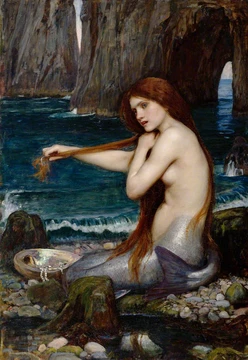
Mermaid of Zennor
Cornish folk tale of a mermaid who attended church.

The Mermaid of Zennor is a figure from Cornish folklore, originating in the village of Zennor. The legend tells of a mysterious woman who attended the parish church, later revealed to be a mermaid, and who enticed a young man to follow her, after which neither was seen again. The story is associated with a carved bench-end in St Senara's Church depicting a mermaid, and has been recorded and retold in various forms since the 19th century.
- field
- Cornish folklore
- nationality
- Cornish
- known_for
- Legend of a mermaid who attended church and enticed a young man away
- associated_location
- Zennor, Cornwall
Lore & Background
The legend was recorded by Cornish folklorist William Bottrell in 1873 when he visited Zennor. In his retelling, a beautiful and richly-dressed woman occasionally attended services at St Senara's Church in Zennor, and sometimes at Morvah. The parishioners were enchanted by her beauty and singing; she appeared infrequently for many years but never visibly aged, and no one knew where she was from. The woman became interested in a young man named Mathey Trewella, known as the best singer in the parish. One day, he followed her, and neither were ever seen again.
The villagers wondered what had become of the two, until one Sunday a ship cast anchor about a mile from Pendour Cove. Soon after, a mermaid appeared and asked that the anchor be raised, as one of its flukes was resting on her door, and she was unable to reach her children. The sailors obliged and quickly set sail, believing the mermaid to be an ill omen. When the villagers heard of this, they concluded that the mermaid was the same lady who had long visited their church, and that she had enticed Mathey Trewella to come and live with her. A shorter account related to Bottrell on a subsequent visit said the mermaid had come to church every Sunday to hear the choir, and her own voice was so sweet that she enticed Mathey Trewella, son of the churchwarden, to come away with her; neither was seen again on dry land. The famed 'mermaid chair' was the same bench on which the mermaid had sat and sung, opposite Trewella in the singing loft.
Reader's Guide
The Mermaid of Zennor is a notable example of Cornish folklore, distinguished by the mermaid's positive association with Christian worship, unlike many northern European legends where mermaids are repulsed by Christianity. The story is unusual in that the mermaid is the captor and the man the captive, reversing the gender roles common in tales like The Mermaid Wife. The legend is tied to a carved bench-end in St Senara's Church, which likely predates the tale but has reinforced its popularity. The story has been retold in later collections of Cornish folklore, generally following Bottrell's original accounts. It has inspired numerous adaptations, including poems by Vernon Watkins, Charles Causley, and John Heath-Stubbs; a novel by Craig Weatherhill; a children's book by Eileen Moloney; and references in Sue Monk Kidd's novel The Mermaid Chair. Musical adaptations include a song by Brenda Wootton, chamber operas by Leo Geyer and Paul Drayton, and a brass band work by Philip Harper. The legend's enduring appeal lies in its blend of mystery, local identity, and the supernatural.
Did You Know?
- The legend was first recorded by Cornish folklorist William Bottrell in 1873.
- The mermaid is associated with a carved bench-end in St Senara's Church in Zennor.
- The mermaid's name is never given in the original tellings; Craig Weatherhill later named her Azenor in his novel.
- The story is unusual because the mermaid seeks to attend church, rather than being repulsed by Christian practice.
Linguistic Heritage and Old Roots
The English word 'mermaid' finds its earliest known attestation in Middle English, appearing in Chaucer's Nun's Priest's Tale around 1390, where it is formed from 'mere' (sea) and 'maid' (young woman). Yet this compound is far from the oldest term for the creature. The now-obsolete word 'mermin,' listed as a headword in the OED, derives from Old English męremęnen, a pairing of 'sea' with 'female slave.' Its earliest surviving form, 'mereminne,' appears in a Corpus Glossary dating to approximately 725, used as a gloss for 'siren.' A Middle English bestiary from 1275 to 1300 employed 'mereman' to describe a being part maiden, part fish. The broader Germanic and Norse linguistic families offer rich parallels: Old High German merimenni surfaces in biblical glosses and the Physiologus, while Middle High German merminne appears in epics such as Rabenschlacht. Old Norse sjókona, meaning 'sea-woman,' and the masculine marmennill belong to the same cognate family. A separate Old English term, męrewif, referenced a sea hag and is attested in the Nibelungenlied, where its figures are rendered as 'sea-women' in Old Norse.
From Siren to Mermaid: A Medieval Transformation
In early Greek mythology, sirens were conceived as human-headed birds, though by the classical period artists occasionally depicted them with fish-like lower bodies. The decisive shift toward the fully fish-tailed image occurred during the medieval period. The earliest surviving text describing a siren with a scaly fish tail is the Liber Monstrorum de diversis generibus, written between the seventh and mid-eighth centuries, which called them 'sea girls' whose sweet song lured seafarers. An eleventh-century Old German Physiologus may have equated sirens directly with mermaids. By the mid-thirteenth century, a Middle English bestiary explicitly described the siren as having a maiden's body joined at the navel to a finned fish tail. Iconographic evidence confirms the visual shift: a ninth-century French Physiologus illustrated the siren as a woman-fish despite bird-like textual descriptions, and the Bodleian bestiary of 1220 to 1222 depicted fish-tailed figures even while its text compared them to winged fowl. Some scholars attributed this bird-to-fish transformation to Germanic mythological influence, though others noted parallels extended well beyond Teutonic culture.
Folklore Roles, Symbolism, and the Merfolk
Mermaids occupy a dual position in folklore traditions spanning Europe, Latin America, Asia, and Africa. In some narratives they are agents of danger, linked to storms, shipwrecks, and drownings. In others they appear as benevolent figures who bestow boons upon humans or fall in love with them. The male counterpart, the merman, is a recognized figure in folklore and heraldry, though traditions and reported sightings of mermen are less common than those of mermaids; both are collectively called merfolk or merpeople. In the Christian moralizing context found in medieval bestiaries, the mermaid's mirror and comb served as potent symbols of vanity, a persistent iconographic motif alongside the commonplace image of the siren holding a fish. The Western conception of mermaids as beautiful, seductive singers likely drew from the siren tradition, where Homer described their song as a lure for seafarers. This seductive quality, combined with their association with perilous maritime events, cemented their role as liminal figures straddling the boundary between human desire and oceanic danger.
Cultural Legacy and the Question of Real Sightings
Mermaids have maintained a powerful presence in Western art and literature from the medieval period through the modern era. Hans Christian Andersen's 1837 fairy tale 'The Little Mermaid' stands as one of the most celebrated literary treatments, and the figure has since been rendered in operas, paintings, books, comics, animation, and live-action films. The Western image of the mermaid as a beautiful, seductive singer may owe a significant debt to the Greek siren tradition, which evolved from bird-like creatures to fish-tailed ones during the Christian era. Historical accounts of actual mermaid sightings persist, such as those reported by Christopher Columbus during his Caribbean explorations, though these are generally attributed to sightings of manatees or similar aquatic mammals. Despite the absence of any evidence for mermaids existing outside folklore, reports of sightings continue to the present day, suggesting the creature endures as a powerful imaginative figure across cultures and centuries.
Frequently Asked Questions
Who is the Mermaid of Zennor?
She is a figure from Cornish folklore tied to the village of Zennor, best known for a tale in which a mysterious woman who regularly attended the local parish church was eventually revealed to be a mermaid.
What happens in the Mermaid of Zennor legend?
The story centers on a young man who is drawn away by the mermaid-woman, and after he follows her, both disappear and are never seen again.
Where is the Mermaid of Zennor story set?
The legend is rooted in Zennor, a village in Cornwall, and is specifically linked to the parish church there, St Senara's Church.
Is there a physical artifact connected to the Mermaid of Zennor?
Yes — a carved bench-end in St Senara's Church depicts a mermaid, serving as a tangible link to the local legend.
How old is the Mermaid of Zennor story?
While the tale likely circulated orally for generations, it was formally recorded and retold in written form beginning in the 19th century.
More in Mermaids 1-24
Spotted an error? Know more?
This is a living reference — every entry is fact-audited, and reader corrections feed straight into our audit queue. Suggest an edit · See this site's audit record