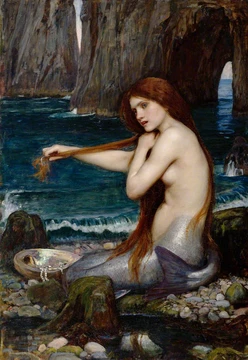
Chernava
Mermaid and river spirit from the Sadko epic.

Chernava (diminutive: Chernavushka; Russian: Чернава, Чернавушка) is a figure from Russian folklore, known as the Sea Tsar's daughter (or, according to some versions, a niece). She is a spirit and personification of the river of the same name, depicted as a mermaid with a human head and upper body and a fish's tail. Chernava is famed from her appearance in the epic of Sadko.
- field
- Russian folklore
- nationality
- Russian
- known_for
- Appearance in the Sadko bylina; personification of the river Chernava; mermaid; Sea Tsar's daughter
Lore & Background
In the Sadko bylina, Chernava appears as one of the Sea Tsar's daughters (or, in some versions, a niece) offered to Sadko as a bride. To consummate the marriage would mean Sadko could never return to the human world. Following the advice of St. Nicholas (or a similar figure), Sadko chooses Chernava as his bride but does not consummate the marriage; he lies down beside her without touching her, and upon waking finds himself on the shore of the Chernava River. She is not described as small, scrawny, or a servant, nor does she transform into the river.
Reader's Guide
Chernava's significance lies in her role within the Sadko bylina, where she acts as a helper figure who enables the hero's return to the human world. By transforming into a river while Sadko slept, she allows him to wake on the shore of the river Chernava and rejoin his first wife. Her story highlights themes of sacrifice and transformation in Russian folklore. The figure also has a lasting legacy in popular culture, as Chernava Colles, hills on planet Venus, are named after her. This naming reflects the broader tradition of using mythological figures to label features on other planets, connecting Earth's folklore to space exploration.
Did You Know?
- In the canonical Sadko bylina, Chernava is the Sea Tsar's daughter (or niece), not a servant, and has no physical description of being small or scrawny.
- On her wedding night with Sadko, he did not touch her, following the instructions of St. Nicholas.
- Chernava did not transform into a river; instead, Sadko woke up on the shore of the Chernava River after choosing her as his bride and not consummating the marriage.
- Chernava Colles, hills on planet Venus, are named after her.
Mythological Identity and Form
Chernava occupies a distinctive position in Russian mythological thought as both a divine offspring and a natural force given human shape. She is identified as the daughter of the Sea Tsar, though certain tellings recast her as his niece, placing her within the royal household of the underwater realm. Beyond her genealogical standing, she functions as the living spirit and personification of the river that bears her name, binding the world of water to a specific geographic feature. Her physical form follows the mermaid archetype familiar across Slavic storytelling: a human head and torso above the waist, transitioning below into a fish's tail. This hybrid anatomy marks her as a threshold figure, belonging simultaneously to the human and the aquatic. Her diminutive form, Chernavushka, suggests the affectionate, familiar tone in which she was spoken of in oral tradition, evoking a small girl of the river rather than a remote deity of the deep.
The Sadko Epic and the Wedding Night
The most celebrated appearance of Chernava comes in the Sadko bylina, one of the great Russian folk epics. In this narrative, the Sea Tsar presents the merchant Sadko with a choice among nine hundred mermaids as a prospective bride, with the stipulation that consummating the union would sever his ability to return to the human world. Chernava is singled out not as a radiant princess but as a slight, thin young girl who labors as a palace servant. Sadko selects her and lies beside her on their wedding night, yet he does not touch her. While he sleeps, Chernava undergoes a transformation, becoming the river itself and carrying him back to the human world. He awakens on the riverbank of the Chernava, reunited with his first wife. Her act of quiet self-sacrifice—relinquishing the marriage to restore Sadko's place among people—gives the character a moral weight that transcends her minor role in the epic.
Place in the Russian Epic Tradition
Chernava's story is preserved within the broader corpus of Russian byliny, the oral epic poems transmitted and collected since the nineteenth century. Alexander Fedorovich Hilferding's 1873 publication of the Onegsky byliny, based on field recordings he made in the summer of 1871 for the Imperial Academy of Sciences, represents one of the key scholarly efforts to fix these narratives in written form. The Sadko cycle, in which Chernava features, has also been rendered in prose versions and collected by figures such as Arthur Ransome in his Old Peter's Russian Tales, making the story accessible to English-speaking readers. The existence of multiple recorded variants, both verse and prose, testifies to the fluid, living quality of the tradition. Chernava's presence in these collections anchors her not merely as a literary curiosity but as a figure rooted in the performative culture of the Russian North, where the byliny were sung and retold across generations.
Legacy Beyond the Folklore
Though Chernava's primary home remains the oral and literary tradition of Russian epic poetry, her name has crossed into modern scientific and artistic nomenclature. The hills on the planet Venus designated as Chernava Colles bear her name, extending a figure from Slavic river mythology into the cartography of another world. In the performing arts, her story has been adapted into the opera Sadko by Rimsky-Korsakov, as referenced in musical encyclopedic sources, bringing the mermaid's quiet act of transformation to the concert stage. The character also appears in Mike Dixon-Kennedy's 1998 Encyclopedia of Russian and Slavic Myth and Legend and in James Bailey's 2015 anthology of Russian folk epics, ensuring that scholars and general readers alike can encounter her within the wider tapestry of Slavic myth. These varied contexts, from planetary geography to operatic performance to academic reference works, demonstrate how a minor character in a single epic can accumulate a long afterlife across disciplines.
Frequently Asked Questions
Who is Chernava?
Chernava is a mermaid figure from Russian folklore, most widely recognized for her role in the Sadko bylina (epic poem). She also serves as the spirit embodiment of the river that shares her name.
What does Chernava look like?
She is depicted with a human head and upper body, transitioning into a fish's tail at the waist. This is the classic mermaid form found in Russian folk tradition.
Where does Chernava appear in stories?
Her most well-known appearance is within the Sadko epic, one of the great Old Russian narrative poems. She functions as a character inside that larger heroic tale rather than headlining her own standalone legend.
Who is Chernava's parent?
In the majority of tellings she is the daughter of the Sea Tsar, though a handful of variant accounts describe her as his niece instead. Either way, her lineage ties her to the ruling sea court.
What river is Chernava connected to?
She is the personified spirit of the Chernava river, meaning the waterway and the character are treated as one and the same in the folklore. Her diminutive form, Chernavushka, is sometimes used in more affectionate or local retellings.
More in Mermaids 1-24
Spotted an error? Know more?
This is a living reference — every entry is fact-audited, and reader corrections feed straight into our audit queue. Suggest an edit · See this site's audit record